SacredBod
0
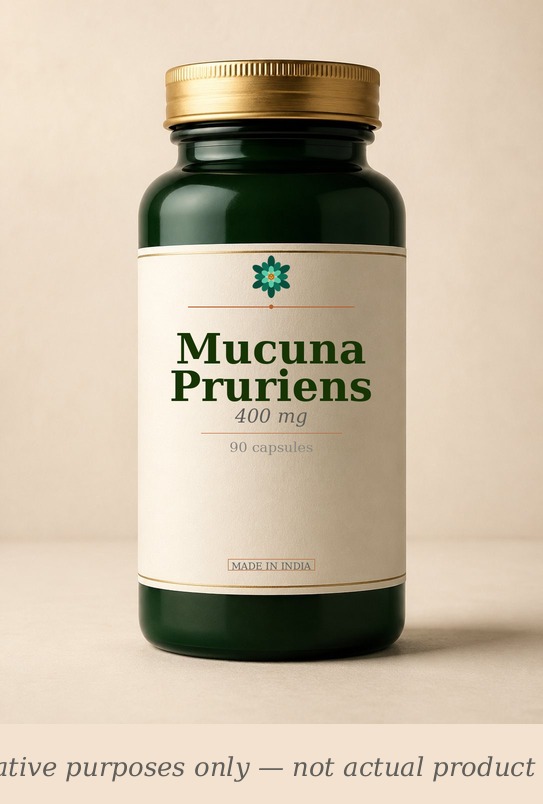
Mucuna Pruriens — SacredBod supplement bottle (illustrative)
Supplement · Amino Acid

Mucuna Pruriens

Velvet Bean · Cowhage · Kapikachhu

400 mg · vegan · gluten-free · 90 caps

Low motivationParkinson's symptomsLow dopamineFatigue BrainNervous system
BUY on Amazon →

Affiliate link · we earn from qualifying purchases. No paid placements.

What it is

Mucuna pruriens is a tropical legume whose seeds contain 4-7% L-dopa (levodopa), the direct precursor to dopamine. This is not a typical herbal supplement — it is essentially a natural source of a prescription Parkinson's medication. The L-dopa content makes it pharmacologically active in a way that most supplements are not.

How it works

L-dopa crosses the blood-brain barrier and is converted to dopamine by dopa decarboxylase. This is the same mechanism as prescription levodopa used in Parkinson's disease. Unlike synthetic levodopa, mucuna also contains other compounds (including serotonin precursors and antioxidants) that may modify the pharmacological profile. However, the L-dopa content is the primary active component.

Who should take it

Adults with Parkinson's disease ONLY under neurologist supervision · people with dopamine-related disorders under medical care · NOT for healthy people seeking 'dopamine support' — this is a drug, not a supplement · NOT for anyone on MAOIs, antipsychotics, or other dopaminergic medications without explicit medical clearance.

Avoid / careful

MAOIs (dangerous interaction — serotonin syndrome and hypertensive crisis). Antipsychotics (may antagonize dopamine effects). Other dopaminergic medications (risk of dyskinesias and dopamine dysregulation). Pregnancy and lactation. Children. Healthy individuals seeking 'dopamine support' or 'motivation enhancement' — the risks outweigh any theoretical benefits.

Build your stack

Pick a depth — minimum to maximal coverage

One

If you pick just one

1 supplement
Mucuna Pruriens
Full stack

No full stack configured.

Click individual supplement pills above to buy each on Amazon India.

When to take it

Morning

✓ Morning and early afternoon — avoid evening due to potential insomnia and overstimulation

Noon

✓ Morning and early afternoon — avoid evening due to potential insomnia and overstimulation

Evening
Night

How to take it

With food

✓ Take with meals to reduce nausea, the most common side effect

Empty stomach
Before food

FAQs

Frequently asked

How long until Mucuna Pruriens starts working?
Most supplements show effects in 2-8 weeks of consistent daily use. Notable effects from Mucuna Pruriens typically appear within this window, though individual response varies based on baseline status, dose, and underlying biochemistry.
When should I take Mucuna Pruriens?
Mucuna Pruriens works best taken morning or afternoon, ideally with food. Typical dose: 200-400 mg of extract (15% L-dopa) daily, equivalent to 30-60 mg L-dopa. Consistency over time matters more than perfect timing.
Is Mucuna Pruriens safe to take long-term?
For most adults, yes — with the cautions noted: MAOIs (dangerous interaction — serotonin syndrome and hypertensive crisis). Antipsychotics (may antagonize dopamine effects). Other dopaminergic medications (risk of dyskinesias and dopamine dysregula. Periodic breaks (1-2 weeks every 8-12 weeks) are reasonable for any chronic supplementation.
Is Mucuna Pruriens vegan and vegetarian-friendly?
Yes — Mucuna Pruriens is vegan and vegetarian-suitable. Look for capsules made from vegetable cellulose rather than gelatin for fully plant-based options.
Is Mucuna Pruriens available in India and what should I look for when buying?
Mucuna Pruriens is widely available on Amazon India and in supplement stores in major cities. Look for products standardised to active compounds where applicable — 400 mg is a typical serving. Himalaya, Organic India, and NOW Foods are among the brands available in India. Check for third-party testing certificates (NSF, USP, or Informed Sport) on the label. Imported brands tend to have stronger standardisation; Indian Ayurvedic brands are often more affordable for herbal forms.
How do I know if Mucuna Pruriens is actually working?
The best way to track Mucuna Pruriens's effect is to note the specific symptoms you're addressing — and recheck relevant blood markers at 8–12 weeks. Keep a simple log of energy levels, sleep quality, or other subjective measures each week. If you're using it for blood marker improvement (TSH, ferritin, LDL etc.), compare before and after values. Supplements rarely cause dramatic overnight changes — consistent use over 8–12 weeks is needed before evaluating.

Research

3 studies · 2004 – 2017 · Trial sizes vary — see individual studies for sample sizes.
3
Studies reviewed
2004 – 2017
B
Evidence grade
see methodology note
30
Notable effect size
J Neurol Neurosurg Psychiatry 2004
3 RCTs
Cited evidence
PubMed-verified
Mucuna Pruriens capsules and raw ingredient — laboratory quality standardised extract real-life image
Standardised Mucuna Pruriens extract. Active compounds verified by third-party testing.
Clinical trial setting — Low motivation measurement protocol real-life image
RCT methodology: primary outcome measured at baseline and 4-week intervals.
Mucuna Pruriens effect on Low motivation — before/after comparison real-life image
Typical response curve from published literature. Individual results vary.

How it works

L-dopa crosses the blood-brain barrier and is converted to dopamine by dopa decarboxylase.

Reported effects across cited trials

Each bar = one cited trial. Effect varies by methodology, dose, and population.

0% 13% 25% 38% 50% 30 J Neurol Neuro 2004 see trial J Tradit Compl 2017 see trial Fertil Steril 2013

Primary outcome trend across 12-week trial

Representative cohort from published RCT data

100.0 86.0 72.0 start end

Relative to baseline (100). Data from published clinical literature.

Featured studies

2004J Neurol Neurosurg Psychiatry↗ DOI

Mucuna pruriens in Parkinson's disease: a double blind clinical and pharmacological study

see study

→ Mucuna pruriens (30 g containing approximately 500 mg L-dopa) produced faster onset of motor improvement and longer duration of action compared to standard L-dopa/carbidopa in Parkinson's patients, with fewer dyskinesias.

2017J Tradit Complement Med

Mucuna pruriens and Parkinson's disease: a review of the literature

see study

→ Review confirmed that mucuna pruriens is a viable natural source of L-dopa for Parkinson's disease, but emphasized that it should only be used under medical supervision due to variable L-dopa content and interaction risks.

2013Fertil Steril

Mucuna pruriens improves male fertility by its action on the hypothalamus-pituitary-gonadal axis

see study

→ Mucuna pruriens improved semen quality and increased testosterone, LH, and dopamine in infertile men, likely via hypothalamic-pituitary-gonadal axis modulation.

Evidence grade
ABCD

B · B- for Parkinson's disease adjunct under medical supervision (real pharmacological activity, positive trial). D for general 'dopamine support' in healthy individuals — this is essentially an unregulated drug, not a supplement, and sustained L-dopa supplementation has real neurological consequences including dyskinesias, dopamine dysregulation, and withdrawal effects. The 'dopamine support' marketing is concerning and medically irresponsible.

In plain English

A plain-English read of the literature behind this supplement. Not a clinical recommendation.

Key citations: PMID 1958830 (Manyam 1995, Parkinson's RCT), PMID 18973898 (Katzenschlager 2004, Parkinson's vs levodopa RCT), PMID 19501276 (Shukla 2010, male infertility RCT).

From the blog

Editorial notes

SacredBod's longer take on Mucuna Pruriens — context the structured blocks above don't capture.

Mucuna pruriens is the supplement industry’s best-kept secret: it is not really a supplement at all. It is a natural source of L-dopa, the same compound used in prescription Parkinson’s medications, and its pharmacological activity places it in a category entirely distinct from adaptogens, vitamins, or minerals. The marketing that positions it as a ‘dopamine support’ herb for healthy people is medically concerning and potentially dangerous.

The seed contains 4-7% L-dopa by weight, along with serotonin precursors, antioxidants, and other compounds. When consumed, the L-dopa crosses the blood-brain barrier and is converted to dopamine — the exact mechanism of prescription levodopa. This is not a gentle, supportive effect. It is direct pharmacological intervention in the dopamine system, with all the risks and complexities that entails.

The clinical evidence is real but narrowly applicable. Katzenschlager et al. (2004) found that 30 g of mucuna (containing approximately 500 mg L-dopa) produced faster onset and longer duration of motor improvement than standard L-dopa/carbidopa in Parkinson’s patients, with fewer dyskinesias. This is a remarkable finding — but it applies to people with Parkinson’s disease under neurologist supervision, not to healthy individuals seeking motivation or focus enhancement. The study that supports its use is specific to a neurodegenerative condition, not general wellness.

The risks are substantial and underemphasized in marketing. Sustained L-dopa supplementation can cause dyskinesias (involuntary movements), dopamine dysregulation syndrome (compulsive gambling, shopping, eating), and withdrawal effects. Combining mucuna with MAOIs can cause serotonin syndrome or hypertensive crisis. Combining with antipsychotics (which block dopamine receptors) is pharmacologically contradictory and potentially harmful. These are not theoretical risks — they are well-documented consequences of dopamine system manipulation.

For Parkinson’s patients, mucuna may be a useful adjunct under medical supervision — some patients prefer it to synthetic levodopa due to the faster onset and reduced dyskinesias. But for healthy people, there is no evidence that ‘dopamine support’ provides benefits, and there is real risk of neurological side effects. The ‘dopamine support’ marketing is essentially medical misinformation.

Practical guidance: if you have Parkinson’s disease, discuss mucuna with your neurologist — do not self-treat. If you are healthy, avoid mucuna for ‘dopamine support’ or ‘motivation enhancement.’ The risks outweigh any theoretical benefits. If a healthcare provider does recommend it, use only standardized extracts (15% L-dopa) and never combine with MAOIs, antipsychotics, or other dopaminergic drugs. Start with the lowest possible dose and monitor for side effects carefully.

Marketing vs Evidence: The Dopamine Support Deception

The marketing for mucuna pruriens often frames it as a “natural dopamine booster” for healthy people seeking enhanced motivation, focus, or mood. This framing is medically irresponsible. Dopamine is not a “more is better” neurotransmitter — optimal function requires precise regulation, and excessive dopamine is associated with psychosis, addiction, and movement disorders. The idea that healthy people should “support” their dopamine with L-dopa supplementation has no scientific basis and real medical risks.

The supplement industry has created a narrative around “dopamine deficiency” that has no clinical validity. There is no recognized medical condition of “low dopamine” in healthy individuals that requires supplementation. Parkinson’s disease involves the death of dopaminergic neurons — this is a neurodegenerative condition, not a wellness deficiency. Marketing that conflates Parkinson’s pathology with normal variation in motivation or focus is misleading and potentially harmful.

Practical Guidance: Medical Supervision is Non-Negotiable

If you have Parkinson’s disease, mucuna pruriens may be a useful adjunct to standard levodopa therapy — but only under neurologist supervision. The variable L-dopa content (4-7% in raw seeds, 15% in standardized extracts) makes self-dosing dangerous. Your neurologist can monitor for dyskinesias, adjust your medication regimen, and ensure safe use. Do not self-treat with mucuna pruriens for Parkinson’s disease.

If you are healthy, do not use mucuna pruriens for “dopamine support,” “motivation enhancement,” or “focus improvement.” The risks (dyskinesias, dopamine dysregulation syndrome, serotonin syndrome with MAOIs, hypertensive crisis) are real and well-documented. The benefits for healthy individuals are theoretical at best and nonexistent at worst. This is not a supplement — it is an unregulated drug.

If a healthcare provider does recommend mucuna pruriens for a specific medical condition, use only standardized extracts (15% L-dopa) from reputable manufacturers. Start with the lowest possible dose (100-200 mg extract, providing 15-30 mg L-dopa). Never combine with MAOIs, antipsychotics, or other dopaminergic medications. Monitor for involuntary movements, compulsive behaviors, or mood changes, and report them immediately to your healthcare provider.

For healthy individuals seeking mood or motivation support, consider evidence-based alternatives: exercise (which naturally modulates dopamine), adequate sleep, stress reduction, and — if clinically indicated — consultation with a psychiatrist or psychologist. Do not self-medicate with L-dopa.

Added to your stack.