
What it is
A cruciferous root vegetable native to the high Andes of Peru, traditionally used as a food and tonic. Gelatinized maca — where starch is removed via heat — is the preferred supplemental form for clinical equivalence to trial doses.
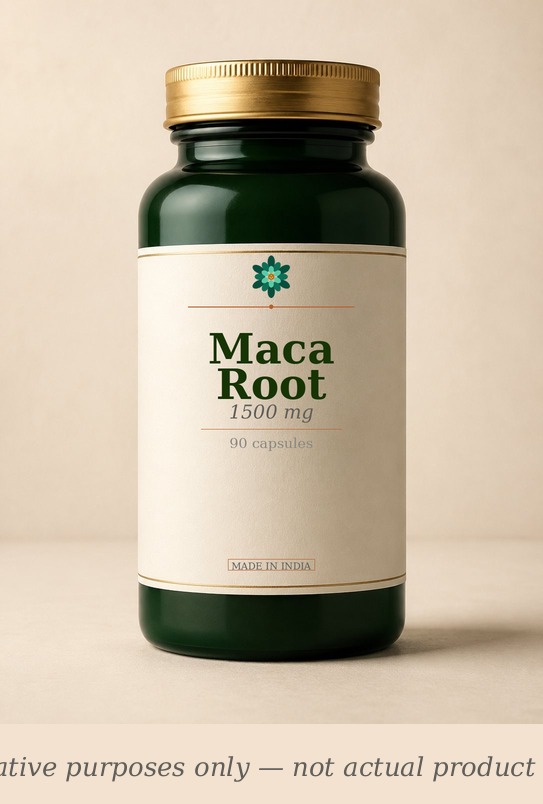
Lepidium meyenii · Peruvian Ginseng
1500 mg · vegan · gluten-free · 90 caps
Affiliate link · we earn from qualifying purchases. No paid placements.
A cruciferous root vegetable native to the high Andes of Peru, traditionally used as a food and tonic. Gelatinized maca — where starch is removed via heat — is the preferred supplemental form for clinical equivalence to trial doses.
Does not contain phytoestrogens or direct hormone activity. Appears to modulate hypothalamic-pituitary function and support endocrine balance indirectly. The mechanism is not fully characterized — which is why the 'testosterone booster' framing is speculative.
Menopausal women seeking symptom relief · people with mild libido or energy concerns · those wanting an adaptogenic alternative to ashwagandha.
Pregnancy/lactation (limited safety data), hormone-sensitive conditions (theoretical concern despite no proven estrogenic activity), thyroid disorders (cruciferous family — monitor if hypothyroid).
Pick a depth — minimum to maximal coverage
Click individual supplement pills above to buy each on Amazon India.
✓ AM or split dosing
✓ Powder mixes into smoothies; capsules bypass the taste
Maca does not contain phytoestrogens or androgens. It appears to act via hypothalamic-pituitary modulation — supporting endocrine balance without directly altering serum hormone levels. The exact molecular target remains unidentified.
From cited keystone trials. Effects are modest and gradual.
Modeled trajectory based on cited keystone trials
Greene Climacteric Scale composite. Most improvement by week 4–6; plateau by week 8.
n=9 · 4 months · 1500–3000 mg/day
→ Increased seminal volume, sperm count, and motility · serum hormones unchanged · mechanism not via LH/FSH/testosterone/estradiol
n=14 · crossover · 3.5 g/day · 6 weeks
→ Significant reduction in anxiety, depression, and sexual dysfunction scores on Greene Climacteric Scale · no estrogenic or androgenic activity detected
n=29 · crossover · 3.3 g/day · 6 weeks
→ Significant decreases in diastolic blood pressure and depression · no hormonal or immune biomarker changes
B · B for menopausal symptom relief (multiple RCTs, consistent effect, but small sample sizes). C+ for male fertility (promising sperm data from small trials, mechanism unclear). C for testosterone boosting in healthy men (no direct clinical evidence — marketing overstates the science). Safety profile is good in trials up to 4 months.
A plain-English read of the literature behind this supplement. Not a clinical recommendation.
Maca is one of the more honestly interesting botanicals in the supplement space — and one of the most dishonestly marketed. The clinical evidence for its primary use case, menopausal symptom relief, is real but modest. The Brooks 2008 crossover trial in 14 postmenopausal women showed significa...'t support the supplement industry's testosterone-booster narrative.
For men, the Gonzales 2001 trial is the key reference: 9 healthy men took 1500–3000 mg/day for 4 months. Seminal volume, sperm count, and motility all increased significantly. Serum testosterone, LH, FSH, prolactin, and estradiol were completely unchanged. Maca improved sperm production by mechanisms unrelated to the HPG axis — possibly via antioxidant or nutritional effects on the testes.
The testosterone-booster claim that dominates maca marketing is not supported by the clinical literature. If you want a supplement with actual testosterone trial data, look at tongkat ali or ashwagandha. Maca's value is elsewhere: gentle menopausal symptom relief, possible fertility support, and adaptogenic energy without hormonal disruption.
Keystone references: Gonzales et al. 2001 (Asian J Androl, PMID 11753476 — semen parameters in men); Brooks et al. 2008 (Menopause, PMID 18784609 — menopausal symptoms, no hormone activity); Stojanovska et al. 2015 (Climacteric, PMID 24931003 — blood pressure and depression in postmenopausal women).
How to use Maca Root specifically for Anxiety — the right dose, timing, blood markers to track, and how to know if it is working.
A clinical evidence review of Maca Root — RCT data, effect sizes, evidence grade, and what the numbers mean for your specific situation.
Everything you need to know about Maca Root — mechanism, dose, safety, buying guide for India, and what the research actually says.
The most-studied standardized ashwagandha extract — cortisol-lowering and strength data exist, but pregnancy is an absolute contraindication
BUY →The pre-bed combo lifters have used for thirty years to sleep deeper and wake stronger.
BUY →The single supplement with the strongest evidence base for a healthy human — if you actually take enough.
BUY →SacredBod's longer take on Maca Root — context the structured blocks above don't capture.
Maca is one of the more interesting botanicals in the supplement space — and one of the most dishonestly marketed. The clinical evidence for menopausal symptom relief is real but modest. The testosterone-booster claim that dominates its marketing is not supported by clinical data at all.
The Brooks 2008 crossover trial is the keystone reference: 14 postmenopausal women took 3.5 g/day of raw maca powder for 6 weeks. Anxiety, depression, and sexual dysfunction scores on the Greene Climacteric Scale all improved significantly. Critically, maca showed no estrogenic or androgenic activity in yeast reporter assays — it does not work like black cohosh or HRT. The Stojanovska 2015 trial replicated this pattern in 29 women with reduced blood pressure and depression, again with no hormonal changes.
For men, the Gonzales 2001 trial showed improved semen volume, sperm count, and motility over 4 months at 1500–3000 mg/day. Serum testosterone was completely unchanged. The mechanism appears to be antioxidant or nutritional support to the testes, not HPG-axis stimulation.
The “testosterone booster” framing you see on every maca product page is marketing fiction. If you want a botanical with actual testosterone trial data, use tongkat ali or ashwagandha. Maca’s value is in gentle menopausal symptom relief and possible fertility support — both without hormonal disruption. That’s a narrower but more honest value proposition.
Gelatinized maca is the preferred supplemental form. The gelatinization process removes starch, concentrating the active constituents and improving digestive tolerance. A 1500–3000 mg dose of gelatinized product approximates the 3.5 g raw powder used in trials.
Peptides are physician-only. Tell us a bit and we'll route you to the right specialist.