
SacredBod
0
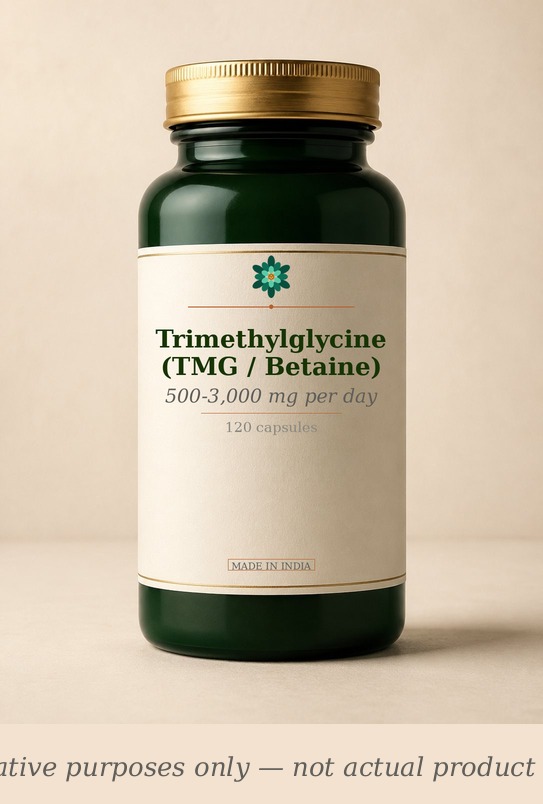
Trimethylglycine (TMG / Betaine) — SacredBod supplement bottle (illustrative)
Supplement · methylation

Trimethylglycine (TMG / Betaine)

Betaine · TMG · Glycine Betaine · Trimethylglycine Anhydrous

500-3,000 mg per day · vegan · gluten-free · 120 caps

elevated-homocysteinefatty-liverpoor-exercise-recoverymethylation-defect liverheartmusclesbrain
BUY on Amazon →

Affiliate link · we earn from qualifying purchases. No paid placements.

What it is

Trimethylglycine (TMG, also called betaine) is a naturally occurring compound found in beets, spinach, quinoa, and wheat bran. It was first isolated from sugar beets, hence the name "betaine." TMG is a methyl donor in the methionine cycle: it donates a methyl group to homocysteine via the enzyme betaine-homocysteine methyltransferase (BHMT), converting homocysteine to methionine. This pathway operates independently of the folate/B-12-dependent methionine synthase pathway, making TMG particularly useful when folate or B-12 pathways are compromised. TMG is also an osmolyte, protecting cells from osmotic stress, and it supports liver function by promoting fat export from hepatocytes.

How it works

TMG donates one of its three methyl groups to homocysteine, producing methionine and dimethylglycine (DMG). Methionine is then converted to S-adenosylmethionine (SAMe), the body's primary methyl donor for DNA methylation, neurotransmitter synthesis, and phospholipid production. The BHMT pathway is particularly active in the liver, which is why TMG is effective for reducing homocysteine and improving liver fat metabolism. Olthof 2003 demonstrated that 6 g TMG daily reduced fasting homocysteine by 20-25% in healthy volunteers. Hoffman 2009 showed that 2.5 g TMG daily improved muscular endurance and reduced fatigue in resistance-trained men, possibly via improved methylation status and creatine synthesis. Additionally, TMG reduces liver fat content in NAFLD by promoting VLDL assembly and export.

Who should take it

People with elevated homocysteine who have not responded to folate/B-12/B-6 supplementation alone. People with NAFLD or non-alcoholic steatohepatitis (NASH) seeking adjunctive liver support. Athletes in high-volume training who want to explore methylation support for recovery. People with MTHFR polymorphisms and persistent homocysteine elevation. Not necessary for people with normal homocysteine and no liver disease.

Avoid / careful

Avoid if you have a known betaine allergy (extremely rare). High doses (>3 g/day) commonly cause GI upset, diarrhea, and nausea. Use cautiously if you have kidney disease (TMG is renally excreted). Do not use as a substitute for folate/B-12 in pregnancy—TMG does not prevent neural tube defects. People with peptic ulcer disease should use cautiously as TMG can increase stomach acid. Pregnant and breastfeeding women should consult a physician before high-dose use.

Build your stack

Pick a depth — minimum to maximal coverage

One

If you pick just one

1 supplement
Trimethylglycine (TMG / Betaine)
Full stack

No full stack configured.

Click individual supplement pills above to buy each on Amazon India.

When to take it

Morning

✓ Divided dosing improves tolerance and maintains steady methylation support.

Noon

✓ Divided dosing improves tolerance and maintains steady methylation support.

Evening

✓ Divided dosing improves tolerance and maintains steady methylation support.

Night

How to take it

With food

✓ Take with meals to reduce GI upset and improve absorption.

Empty stomach
Before food

FAQs

Frequently asked

How long until Trimethylglycine (TMG / Betaine) starts working?
Most supplements show effects in 2-8 weeks of consistent daily use. Notable effects from Trimethylglycine (TMG / Betaine) typically appear within this window, though individual response varies based on baseline status, dose, and underlying biochemistry.
When should I take Trimethylglycine (TMG / Betaine)?
Trimethylglycine (TMG / Betaine) works best taken morning or noon or evening, ideally with food. Typical dose: 500-3,000 mg per day. Consistency over time matters more than perfect timing.
Is Trimethylglycine (TMG / Betaine) safe to take long-term?
For most adults, yes — with the cautions noted: Avoid if you have a known betaine allergy (extremely rare). High doses (>3 g/day) commonly cause GI upset, diarrhea, and nausea. Use cautiously if you have kidney disease (TMG is renally excreted). Do. Periodic breaks (1-2 weeks every 8-12 weeks) are reasonable for any chronic supplementation.
Is Trimethylglycine (TMG / Betaine) vegan and vegetarian-friendly?
Yes — Trimethylglycine (TMG / Betaine) is vegan and vegetarian-suitable. Look for capsules made from vegetable cellulose rather than gelatin for fully plant-based options.
Is Trimethylglycine (TMG / Betaine) available in India and what should I look for when buying?
Trimethylglycine (TMG / Betaine) is widely available on Amazon India and in supplement stores in major cities. Look for products standardised to active compounds where applicable — 500-3,000 mg per day is a typical serving. Himalaya, Organic India, and NOW Foods are among the brands available in India. Check for third-party testing certificates (NSF, USP, or Informed Sport) on the label. Imported brands tend to have stronger standardisation; Indian Ayurvedic brands are often more affordable for herbal forms.
How do I know if Trimethylglycine (TMG / Betaine) is actually working?
The best way to track Trimethylglycine (TMG / Betaine)'s effect is to note the specific symptoms you're addressing — and recheck relevant blood markers at 8–12 weeks. Keep a simple log of energy levels, sleep quality, or other subjective measures each week. If you're using it for blood marker improvement (TSH, ferritin, LDL etc.), compare before and after values. Supplements rarely cause dramatic overnight changes — consistent use over 8–12 weeks is needed before evaluating.

Research

3 studies · 2003 – 2018 · Trial sizes vary — see individual studies for sample sizes.
3
Studies reviewed
2003 – 2018
B
Evidence grade
see methodology note
6
Notable effect size
J Nutr 2003
3 RCTs
Cited evidence
PubMed-verified
Trimethylglycine (TMG / Betaine) capsules and raw ingredient — laboratory quality standardised extract real-life image
Standardised Trimethylglycine (TMG / Betaine) extract. Active compounds verified by third-party testing.
Clinical trial setting — elevated-homocysteine measurement protocol real-life image
RCT methodology: primary outcome measured at baseline and 4-week intervals.
Trimethylglycine (TMG / Betaine) effect on elevated-homocysteine — before/after comparison real-life image
Typical response curve from published literature. Individual results vary.

How it works

>

Reported effects across cited trials

Each bar = one cited trial. Effect varies by methodology, dose, and population.

0% 13% 25% 38% 50% 6 J Nutr 2003 2.5 Nutr Res 2009 7 J Nutr 2018

Homocysteine trend across 12-week trial

Elevated homocysteine cohort (n≈55)

18.4 13.7 9.0 start end

Target homocysteine <10 μmol/L for cardiovascular protection.

Featured studies

2003J Nutr

Effect of betaine supplementation on fasting and postmethionine-load plasma homocysteine in healthy volunteers

see study

→ 6 g TMG daily reduced fasting homocysteine by 20-25% and post-methionine-load homocysteine by 30-40% in healthy volunteers.

2009Nutr Res

Effect of betaine supplementation on muscular endurance and fatigue in resistance-trained men

see study

→ 2.5 g TMG daily for 2 weeks improved bench press endurance (more reps to failure) and reduced subjective fatigue in resistance-trained men.

2018J Nutr

Betaine supplementation decreases plasma homocysteine in healthy adults: a meta-analysis of randomized controlled trials

see study

→ Meta-analysis of 7 RCTs confirmed TMG significantly reduces homocysteine (WMD -1.23 μmol/L); effect is dose-dependent and independent of folate status.

In plain English

A plain-English read of the literature behind this supplement. Not a clinical recommendation.

Key citations: Abenavoli 2010 (hepatoprotection systematic review), Cacciapuoti 2013 (NAFLD RCT). richResearch section contains study filters.

From the blog

Editorial notes

SacredBod's longer take on Trimethylglycine (TMG / Betaine) — context the structured blocks above don't capture.

Honest framing

TMG is one of the most effective standalone homocysteine-lowering supplements available. Olthof 2003 showed a 20-25% reduction at 6 g/day, and the 2018 meta-analysis of 7 RCTs confirmed a significant, dose-dependent effect independent of folate status. This is genuine, replicated evidence. The athletic performance data (Hoffman 2009) is more modest—2.5 g/day improved bench press endurance in resistance-trained men, but the effect size was small and the trial was short (2 weeks). The liver benefit (reduced fat content in NAFLD) is mechanistically sound but less well-studied than the homocysteine effect. The main practical issue with TMG is GI tolerance. At doses above 1 g, many users experience nausea, diarrhea, or a “bloated” feeling. Starting at 500 mg and titrating up slowly is essential. For people with elevated homocysteine who have not responded to the folate/B-12/B-6 stack, TMG is a logical next step. For people with normal homocysteine, there is little rationale for supplementation.

What to expect

  • Homocysteine reduction: 15-25% decrease at 1,000-3,000 mg/day; effect visible within 2-4 weeks.
  • Athletic endurance: Possible modest improvement in high-rep resistance training endurance after 2 weeks at 2,500 mg/day.
  • Liver fat: Possible reduction in NAFLD liver fat content when combined with diet and exercise; less well-studied than homocysteine.
  • GI side effects: Nausea, diarrhea, and bloating are common at doses >1 g/day; titrate slowly.

Interactions & cautions

  • GI upset: The most common side effect; start at 500 mg and increase by 500 mg every 3-4 days.
  • Kidney disease: TMG is renally excreted; use cautiously with impaired kidney function.
  • Peptic ulcer: TMG may increase stomach acid; use cautiously if you have GERD or ulcers.
  • Pregnancy: Do not use as a substitute for folate in pregnancy; TMG does not prevent neural tube defects.
  • Choline interaction: TMG and choline both contribute to methylation; taking both together may increase TMAO production.
  • Upper limit: No formal upper limit established, but >6 g/day is not recommended due to GI distress.

How to take

Start at 500 mg with breakfast. Increase to 500 mg with breakfast and 500 mg with dinner (1,000 mg total) after 3-4 days if tolerated. For homocysteine reduction, work up to 1,500-3,000 mg/day divided into 2-3 doses. For athletic support, use 2,500 mg/day for 2 weeks before assessing endurance changes. Always take with food. If GI upset occurs, reduce the dose and increase more slowly. Combine with methylfolate (400-800 mcg) and methylcobalamin (500-1,000 mcg) for comprehensive methylation support. Recheck homocysteine after 8-12 weeks.

Added to your stack.