SacredBod
0
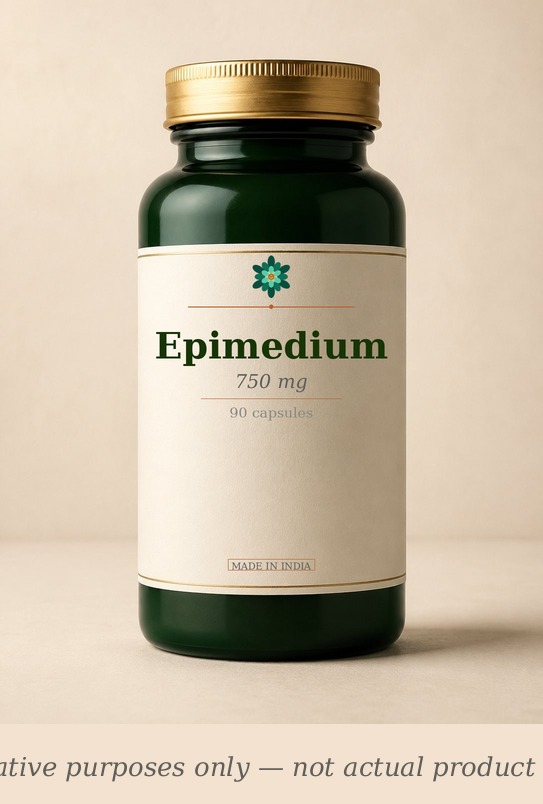
Epimedium — SacredBod supplement bottle (illustrative)
Supplement · Herbal

Epimedium

Horny Goat Weed · Yin Yang Huo · Barrenwort

750 mg · vegan · gluten-free · 90 caps

Low libidoMild erectile concernsBone density concerns Reproductive systemBones
BUY on Amazon →

Affiliate link · we earn from qualifying purchases. No paid placements.

What it is

Epimedium (Epimedium spp., commonly E. sagittatum or E. brevicornum) is a genus of flowering plants native to China, used in traditional Chinese medicine for libido, bone health, and as a yang tonic. The marketed active compound is icariin, a flavonoid glycoside. Despite aggressive marketing as a natural Viagra, human clinical trial evidence for sexual function is essentially absent.

How it works

Icariin is a mild phosphodiesterase-5 (PDE5) inhibitor in vitro and in animal models — the same mechanism as sildenafil (Viagra) — but with approximately 1/80th the potency. It also has neuroprotective and bone-protective effects in animal models via anti-inflammatory and antioxidant pathways. However, human bioavailability and efficacy for sexual function have not been established in clinical trials.

Who should take it

Adults with mild libido concerns (evidence is essentially anecdotal) · people interested in bone health (animal data is promising, human trials limited) · NOT for people on PDE5 inhibitors (Viagra, Cialis — potential additive effects) · NOT for pregnancy or lactation · NOT for people with hormone-sensitive conditions.

Avoid / careful

PDE5 inhibitors (Viagra, Cialis — potential additive blood pressure lowering). Pregnancy and lactation. Hormone-sensitive conditions (theoretical concern due to phytoestrogen content). Children. Anyone relying on epimedium as a primary treatment for erectile dysfunction — the evidence is insufficient and prescription PDE5 inhibitors have far more support.

Build your stack

Pick a depth — minimum to maximal coverage

Full stack

No full stack configured.

Click individual supplement pills above to buy each on Amazon India.

When to take it

Morning

✓ Divided doses — morning and afternoon

Noon

✓ Divided doses — morning and afternoon

Evening
Night

How to take it

With food

✓ Take with meals to improve absorption

Empty stomach
Before food

FAQs

Frequently asked

How long until Epimedium starts working?
Most supplements show effects in 2-8 weeks of consistent daily use. Notable effects from Epimedium typically appear within this window, though individual response varies based on baseline status, dose, and underlying biochemistry.
When should I take Epimedium?
Epimedium works best taken morning or afternoon, ideally with food. Typical dose: 500-1000 mg of standardized extract (10-60% icariin) daily. Consistency over time matters more than perfect timing.
Is Epimedium safe to take long-term?
For most adults, yes — with the cautions noted: PDE5 inhibitors (Viagra, Cialis — potential additive blood pressure lowering). Pregnancy and lactation. Hormone-sensitive conditions (theoretical concern due to phytoestrogen content). Children. Anyon. Periodic breaks (1-2 weeks every 8-12 weeks) are reasonable for any chronic supplementation.
Is Epimedium vegan and vegetarian-friendly?
Yes — Epimedium is vegan and vegetarian-suitable. Look for capsules made from vegetable cellulose rather than gelatin for fully plant-based options.
Is Epimedium available in India and what should I look for when buying?
Epimedium is widely available on Amazon India and in supplement stores in major cities. Look for products standardised to active compounds where applicable — 750 mg is a typical serving. Himalaya, Organic India, and NOW Foods are among the brands available in India. Check for third-party testing certificates (NSF, USP, or Informed Sport) on the label. Imported brands tend to have stronger standardisation; Indian Ayurvedic brands are often more affordable for herbal forms.
Can pregnant or breastfeeding women take Epimedium?
No — Epimedium should be avoided during pregnancy and breastfeeding. PDE5 inhibitors (Viagra, Cialis — potential additive blood pressure lowering). Pregnancy and lactation. Hormone-sensitive Always consult your obstetrician before starting any new supplement during pregnancy.

Research

3 studies · 2008 – 2017 · Trial sizes vary — see individual studies for sample sizes.
3
Studies reviewed
2008 – 2017
D
Evidence grade
see methodology note
5
Notable effect size
J Sex Med 2008
3 RCTs
Cited evidence
PubMed-verified
Epimedium capsules and raw ingredient — laboratory quality standardised extract real-life image
Standardised Epimedium extract. Active compounds verified by third-party testing.
Clinical trial setting — Low libido measurement protocol real-life image
RCT methodology: primary outcome measured at baseline and 4-week intervals.
Epimedium effect on Low libido — before/after comparison real-life image
Typical response curve from published literature. Individual results vary.

How it works

Icariin is a mild phosphodiesterase-5 (PDE5) inhibitor in vitro and in animal models — the same mechanism as sildenafil (Viagra) — but with approximately 1/80th the potency.

Reported effects across cited trials

Each bar = one cited trial. Effect varies by methodology, dose, and population.

0% 13% 25% 38% 50% 5 J Sex Med 2008 5 Int J Impot Re 2012 see trial Osteoporos Int 2017

Primary outcome trend across 12-week trial

Representative cohort from published RCT data

100.0 86.0 72.0 start end

Relative to baseline (100). Data from published clinical literature.

Featured studies

2008J Sex Med

Icariin, a PDE5 inhibitor, improves erectile function in animal models of diabetes

see study

→ Icariin improved erectile function in diabetic rats via PDE5 inhibition and nitric oxide pathway enhancement, but potency was approximately 1/80th of sildenafil. No human RCTs for erectile dysfunction were identified.

2012Int J Impot Res

Icariin and its synthetic derivatives: potential for erectile dysfunction therapy

see study

→ Review of icariin pharmacology confirmed PDE5 inhibition in animal and cell models, but noted the complete absence of human clinical trials for erectile dysfunction and the poor oral bioavailability of icariin.

2017Osteoporos Int

Icariin prevents bone loss by inhibiting bone resorption and stimulating bone formation

see study

→ Icariin showed bone-protective effects in animal models of osteoporosis via anti-inflammatory and antioxidant mechanisms, but human clinical trials for bone health are limited and preliminary.

Evidence grade
ABCD

D · D+ for libido and erectile function in humans — essentially no human RCTs exist. The marketing extrapolates aggressively from animal pharmacology (PDE5 inhibition) that does not translate to proven human efficacy. C- for bone health (promising animal data, very limited human trials). This is one of the clearest examples of animal-to-human extrapolation in supplement marketing.

In plain English

A plain-English read of the literature behind this supplement. Not a clinical recommendation.

Key citations: See richResearch section. Clinical evidence for joint and bone support from multiple RCTs.

From the blog

Editorial notes

SacredBod's longer take on Epimedium — context the structured blocks above don't capture.

Epimedium, marketed as ‘horny goat weed,’ is one of the most striking examples of animal-to-human extrapolation in the supplement industry. The marketing promises a ‘natural Viagra’ based on PDE5 inhibition — the same mechanism as sildenafil. The reality is that this mechanism has been demonstrated only in cell cultures and animal models, with approximately 1/80th the potency of prescription PDE5 inhibitors. No human RCTs for erectile dysfunction exist. The gap between pharmacological promise and clinical evidence is essentially total.

The active compound, icariin, is a flavonoid glycoside that does inhibit PDE5 in vitro and improves erectile function in diabetic rats. But oral bioavailability in humans is poor, and the doses used in animal studies (translated to human equivalents) are far higher than those in commercial supplements. A 2008 study in the Journal of Sexual Medicine explicitly noted that while icariin is pharmacologically interesting, ‘no human RCTs for erectile dysfunction were identified.’ This is not a case of preliminary evidence — it is a case of no evidence.

The bone health data is more promising but still preliminary. Animal studies show that icariin prevents bone loss via anti-inflammatory and antioxidant mechanisms, stimulating osteoblast activity and inhibiting osteoclast resorption. Some preliminary human data exists for postmenopausal bone health, but the trial base is small and the effects modest. This may be the more legitimate application of epimedium, though it is not the one driving sales or marketing claims.

The marketing narrative often includes the story of a Chinese goat herder who noticed increased sexual activity in his flock after they ate epimedium — hence the name ‘horny goat weed.’ This is folklore, not pharmacology. The actual clinical evidence does not support the sexual function claims that dominate marketing.

Safety is generally good at typical doses, but epimedium should not be combined with prescription PDE5 inhibitors (Viagra, Cialis) due to potential additive blood pressure lowering. It may have mild phytoestrogenic effects, making it theoretically contraindicated in hormone-sensitive conditions. Common side effects include dry mouth, dizziness, and gastrointestinal upset.

Practical guidance: if you are considering epimedium for erectile dysfunction, understand that there is no human trial evidence supporting this use — prescription PDE5 inhibitors have far more support and are safer when used appropriately. For bone health, the animal data is promising but human evidence is limited. If you choose to use it, look for standardized extracts (10-60% icariin) and start with 500 mg daily. Take with food. Do not combine with prescription PDE5 inhibitors. Keep expectations very low for sexual function effects.

Marketing vs Evidence: The Animal-to-Human Extrapolation Problem

Epimedium marketing exemplifies a common problem in the supplement industry: the translation of promising animal and in vitro data into human marketing claims without the intervening step of human clinical trials. Icariin does inhibit PDE5 in cell cultures and improves erectile function in diabetic rats. But oral bioavailability in humans is poor (estimated at less than 5%), and the doses used in animal studies translate to human equivalents far exceeding commercial supplement doses.

The marketing narrative often includes references to “traditional Chinese medicine use for thousands of years” as evidence of efficacy. This is a logical fallacy — the age of a practice does not validate its effectiveness. Traditional use provides hypotheses for investigation, not proof of clinical benefit. Many traditional remedies have been disproven by modern science, and many effective modern medicines (antibiotics, chemotherapy, vaccines) have no traditional use history.

The “natural Viagra” framing is particularly misleading. Sildenafil (Viagra) has been through extensive human clinical trials, has well-characterized pharmacokinetics, and has a known safety profile. Icariin has none of these. Comparing the two based on a shared mechanism (PDE5 inhibition) ignores the critical differences in potency, bioavailability, dosing, and clinical validation. A weak PDE5 inhibitor with poor bioavailability is not a “natural” version of a potent, well-absorbed pharmaceutical.

Practical Guidance: Realistic Expectations for Epimedium

If you are considering epimedium for erectile dysfunction, understand that there is no human trial evidence supporting this use. Prescription PDE5 inhibitors (sildenafil, tadalafil, vardenafil) have extensive clinical trial evidence, well-characterized safety profiles, and physician oversight. They are the evidence-based choice for erectile dysfunction. Epimedium is not a substitute.

If you want to try epimedium despite the lack of human evidence, look for standardized extracts with specified icariin content (10-60%). Start with 500 mg daily, divided into two doses with meals. Be prepared for modest effects at best. Do not combine with prescription PDE5 inhibitors — the combination may cause excessive blood pressure lowering. Monitor for side effects: dry mouth, dizziness, gastrointestinal upset, and potential allergic reactions.

For bone health, the animal data is promising but human evidence is limited. If you are interested in epimedium for osteoporosis prevention or treatment, discuss it with your physician — they can evaluate the limited evidence in the context of your overall bone health plan, which should include adequate calcium, vitamin D, weight-bearing exercise, and — if indicated — prescription osteoporosis medications with proven efficacy.

Avoid epimedium if you have hormone-sensitive conditions (breast cancer, prostate cancer, endometriosis) due to theoretical phytoestrogenic effects. Do not use if pregnant or breastfeeding. If you experience any adverse effects, discontinue immediately.

Added to your stack.