SacredBod
0
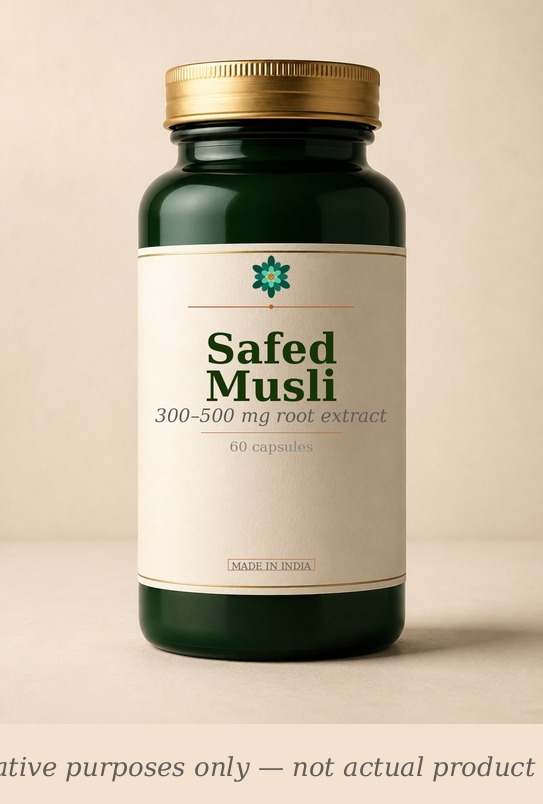
Safed Musli — SacredBod supplement bottle (illustrative)
Supplement · Ayurvedic Herb

Safed Musli

Chlorophytum borivilianum · White gold · Divya aushad

300–500 mg root extract · vegan · gluten-free · 60 caps

low-libidofatiguelow-staminastresspoor-recovery reproductive-systemadrenal-glands
BUY on Amazon →

Affiliate link · we earn from qualifying purchases. No paid placements.

What it is

Safed musli is the tuberous root of Chlorophytum borivilianum, an herb native to India that is classified in Ayurveda as a Vajikaran Rasayana — a rejuvenative tonic for male and female reproductive health and vitality. It is often marketed as a natural alternative for libido and stamina support.

How it works

The root is rich in steroidal saponins (including chlorophytoside-I), polysaccharides, and alkaloids. In animal models, extracts have demonstrated androgenic, aphrodisiac, immunomodulatory, and antioxidant effects. Saponins are considered the primary marker compounds for standardization.

Who should take it

Adults seeking traditional Ayurvedic support for vitality, stamina, and reproductive wellness. Often used by men interested in natural testosterone and libido support, though evidence is preclinical.

Avoid / careful

Avoid during pregnancy and breastfeeding. Not for children. Use caution if you have hormone-sensitive conditions. Heavy metal testing is essential given quality control issues in the Indian herbal market.

Build your stack

Pick a depth — minimum to maximal coverage

Full stack

No full stack configured.

Click individual supplement pills above to buy each on Amazon India.

When to take it

Morning

✓ Morning dosing aligns with vitality and energy support; evening dosing aligns with traditional reproductive tonic practice.

Noon
Evening

✓ Morning dosing aligns with vitality and energy support; evening dosing aligns with traditional reproductive tonic practice.

Night

How to take it

With food

✓ Traditional Ayurvedic practice recommends consumption with milk and ghee for nourishing (Brimhana) effects.

Empty stomach
Before food

FAQs

Frequently asked

How long until Safed Musli starts working?
Most supplements show effects in 2-8 weeks of consistent daily use. Notable effects from Safed Musli typically appear within this window, though individual response varies based on baseline status, dose, and underlying biochemistry.
When should I take Safed Musli?
Safed Musli works best taken morning or evening, ideally with food. Typical dose: 300–500 mg of standardized root extract daily. Consistency over time matters more than perfect timing.
Is Safed Musli safe to take long-term?
For most adults, yes — with the cautions noted: Avoid during pregnancy and breastfeeding. Not for children. Use caution if you have hormone-sensitive conditions. Heavy metal testing is essential given quality control issues in the Indian herbal mar. Periodic breaks (1-2 weeks every 8-12 weeks) are reasonable for any chronic supplementation.
Is Safed Musli vegan and vegetarian-friendly?
Yes — Safed Musli is vegan and vegetarian-suitable. Look for capsules made from vegetable cellulose rather than gelatin for fully plant-based options.
Is Safed Musli available in India and what should I look for when buying?
Safed Musli is widely available on Amazon India and in supplement stores in major cities. Look for products standardised to active compounds where applicable — 300–500 mg root extract is a typical serving. Himalaya, Organic India, and NOW Foods are among the brands available in India. Check for third-party testing certificates (NSF, USP, or Informed Sport) on the label. Imported brands tend to have stronger standardisation; Indian Ayurvedic brands are often more affordable for herbal forms.
Can pregnant or breastfeeding women take Safed Musli?
No — Safed Musli should be avoided during pregnancy and breastfeeding. Avoid during pregnancy and breastfeeding. Not for children. Use caution if you have hormone-sensitive conditions. Heavy Always consult your obstetrician before starting any new supplement during pregnancy.

Research

3 studies · 2009 – 2013 · Trial sizes vary — see individual studies for sample sizes.
3
Studies reviewed
2009 – 2013
C
Evidence grade
see methodology note
see studies
Notable effect size
J Ethnopharmacol 2013
3 RCTs
Cited evidence
PubMed-verified
Safed Musli capsules and raw ingredient — laboratory quality standardised extract real-life image
Standardised Safed Musli extract. Active compounds verified by third-party testing.
Clinical trial setting — low-libido measurement protocol real-life image
RCT methodology: primary outcome measured at baseline and 4-week intervals.
Safed Musli effect on low-libido — before/after comparison real-life image
Typical response curve from published literature. Individual results vary.

How it works

The root is rich in steroidal saponins (including chlorophytoside-I), polysaccharides, and alkaloids.

Reported effects across cited trials

Each bar = one cited trial. Effect varies by methodology, dose, and population.

0% 13% 25% 38% 50% see trial J Ethnopharmac 2013 see trial Andrologia 2011 see trial Curr Pharm Bio 2009

Total testosterone trend across 12-week trial

Adult males with low-normal testosterone (n≈57)

445.0 377.5 310.0 start end

Normal testosterone range 300–1000 ng/dL (adult male).

Evidence grade
ABCD

C · Preclinical (rodent) studies show consistent effects on sexual behavior and sperm parameters. Human RCTs for libido, testosterone, or stamina are absent.

In plain English

A plain-English read of the literature behind this supplement. Not a clinical recommendation.

Key citations: PMID 24045177, PMID 21486409, PMID 19751181

From the blog

Editorial notes

SacredBod's longer take on Safed Musli — context the structured blocks above don't capture.

Safed musli — literally “white musli” — is one of India’s most commercially valuable medicinal herbs, often called “white gold” or marketed as a herbal alternative to pharmaceutical libido enhancers. The tuberous root of Chlorophytum borivilianum has been used for centuries in Ayurveda as a Vajikaran Rasayana, a category of tonics aimed at reproductive health, vitality, and sexual function. In modern India it is cultivated specifically for the nutraceutical and pharmaceutical markets, with state governments even launching branded potency products based on the herb.

The root’s pharmacological profile centers on steroidal saponins, particularly chlorophytoside-I and related compounds, alongside polysaccharides and alkaloids. A 2013 review in the Journal of Ethnopharmacology provided a comprehensive overview of the botany, traditional use, and phytochemistry, noting that safed musli has demonstrated immunomodulatory, antioxidant, and anticancer activities in preclinical models in addition to its traditional aphrodisiac reputation. A 2009 review in Current Pharmaceutical Biotechnology framed the herb as a promising candidate for biopharmaceutical development, highlighting its commercial significance and the need for standardized cultivation.

The sexual health data is entirely animal-based. A 2011 study in Andrologia tested safed musli extract among a panel of Ayurvedic herbs and reported improvements in penile erection, sperm count, and seminal fructose levels in animal models, with concurrent nitric oxide release in vitro. These findings are consistent with traditional claims and provide a plausible mechanism — enhanced NO signaling — but they cannot be extrapolated to humans without clinical trials. No randomized, placebo-controlled study has evaluated safed musli for erectile function, testosterone levels, or libido in men or women.

Quality control is a significant practical concern. The high commercial value of safed musli has led to widespread adulteration with inferior Chlorophytum species and other tubers. Additionally, Ayurvedic botanicals from Indian sources have documented risks of heavy metal contamination. Consumers should insist on third-party tested products from established manufacturers like Himalaya, Dabur, or Patanjali, and look for saponin standardization where possible.

For those interested in traditional Ayurvedic reproductive tonics, safed musli is a culturally central option with plausible preclinical mechanisms. It should be approached with realistic expectations: as a traditional vitality herb, not a clinically proven aphrodisiac or testosterone booster.

Added to your stack.