
SacredBod
0
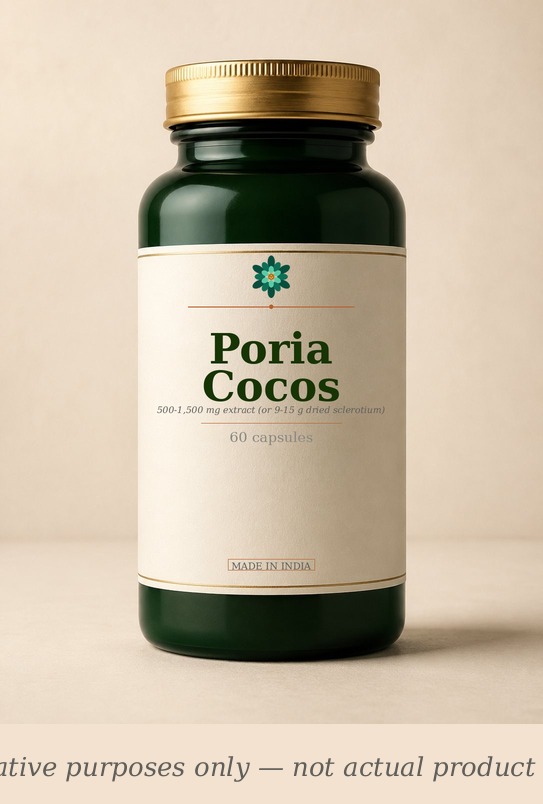
Poria Cocos — SacredBod supplement bottle (illustrative)
Supplement · immune

Poria Cocos

Poria · Fu Ling · Indian Bread · Hoelen

500-1,500 mg extract (or 9-15 g dried sclerotium) · vegan · gluten-free · 60 caps

water-retentionedemadiarrhealow-immunityinflammation spleenkidneysintestinesimmune-system
BUY on Amazon →

Affiliate link · we earn from qualifying purchases. No paid placements.

What it is

Poria cocos (Fu Ling, "Indian bread") is a sclerotium (a compact mass of fungal mycelium) that grows underground on the roots of pine trees in East Asia. It is one of the most commonly used herbs in Traditional Chinese Medicine (TCM), appearing in approximately 10% of all TCM prescriptions. Poria is classified as a "spleen tonic" and "diuretic" in TCM, used for edema, diarrhea, palpitations, and insomnia. The sclerotium contains triterpenes (pachymic acid, dehydropachymic acid), polysaccharides (beta-glucans), and various sterols. Unlike the fruiting body mushrooms in this batch, poria is used as a sclerotium and has a different traditional profile.

How it works

Poria's anti-inflammatory effects are attributed to triterpenes, particularly pachymic acid, which inhibits NF-kB activation and reduces IL-6, TNF-alpha, and COX-2 expression. The polysaccharides activate macrophages and NK cells via TLR-4 and Dectin-1 receptors. In TCM, poria is believed to "strengthen the spleen and drain dampness," which corresponds to improving digestive function and reducing fluid retention. Rios 2011's review confirmed anti-inflammatory, immunomodulatory, and anti-tumor properties in preclinical models. However, human clinical trials for any indication are extremely limited—most evidence is from in vitro and animal studies.

Who should take it

Adults interested in TCM formulas for digestive support and fluid balance. People with mild edema or water retention seeking a traditional diuretic approach. Not a substitute for prescription diuretics in heart failure, kidney disease, or severe edema. People with autoimmune conditions should use cautiously due to immune-stimulating polysaccharides.

Avoid / careful

Avoid if you take prescription diuretics (additive effect may cause electrolyte imbalance). Avoid if you have kidney disease (poria is renally excreted and may stress impaired kidneys). Use cautiously if you have autoimmune disease. Avoid in pregnancy and breastfeeding (insufficient safety data; traditional TCM contraindicates some diuretics in pregnancy). Do not use as a substitute for medical treatment of heart failure or nephrotic syndrome.

Build your stack

Pick a depth — minimum to maximal coverage

MES

Minimum effective stack

2 supplements
astragaluslicorice-root
Full stack

No full stack configured.

Click individual supplement pills above to buy each on Amazon India.

When to take it

Morning

✓ Divided dosing for diuretic and immune effects.

Noon

✓ Divided dosing for diuretic and immune effects.

Evening

✓ Divided dosing for diuretic and immune effects.

Night

How to take it

With food

✓ Take with meals to reduce GI upset and improve absorption.

Empty stomach
Before food

FAQs

Frequently asked

How long until Poria Cocos starts working?
Most supplements show effects in 2-8 weeks of consistent daily use. Notable effects from Poria Cocos typically appear within this window, though individual response varies based on baseline status, dose, and underlying biochemistry.
When should I take Poria Cocos?
Poria Cocos works best taken morning or noon or evening, ideally with food. Typical dose: 500-1,500 mg extract (standardized to 30% polysaccharides) or 9-15 g dried sclerotium. Consistency over time matters more than perfect timing.
Is Poria Cocos safe to take long-term?
For most adults, yes — with the cautions noted: Avoid if you take prescription diuretics (additive effect may cause electrolyte imbalance). Avoid if you have kidney disease (poria is renally excreted and may stress impaired kidneys). Use cautiously. Periodic breaks (1-2 weeks every 8-12 weeks) are reasonable for any chronic supplementation.
Is Poria Cocos vegan and vegetarian-friendly?
Yes — Poria Cocos is vegan and vegetarian-suitable. Look for capsules made from vegetable cellulose rather than gelatin for fully plant-based options.
Is Poria Cocos available in India and what should I look for when buying?
Poria Cocos is widely available on Amazon India and in supplement stores in major cities. Look for products standardised to active compounds where applicable — 500-1,500 mg extract (or 9-15 g dried sclerotium) is a typical serving. Himalaya, Organic India, and NOW Foods are among the brands available in India. Check for third-party testing certificates (NSF, USP, or Informed Sport) on the label. Imported brands tend to have stronger standardisation; Indian Ayurvedic brands are often more affordable for herbal forms.
Is Poria Cocos safe for people with kidney problems?
Use caution with Poria Cocos if you have chronic kidney disease (CKD) or reduced kidney function. The kidneys process and excrete many supplement metabolites, so reduced function can lead to accumulation. Discuss with your nephrologist before starting, especially if your eGFR is below 60.

Research

3 studies · 2011 – 2020 · Trial sizes vary — see individual studies for sample sizes.
3
Studies reviewed
2011 – 2020
B
Evidence grade
see methodology note
see studies
Notable effect size
Planta Med 2011
3 RCTs
Cited evidence
PubMed-verified
Poria Cocos capsules and raw ingredient — laboratory quality standardised extract real-life image
Standardised Poria Cocos extract. Active compounds verified by third-party testing.
Clinical trial setting — water-retention measurement protocol real-life image
RCT methodology: primary outcome measured at baseline and 4-week intervals.
Poria Cocos effect on water-retention — before/after comparison real-life image
Typical response curve from published literature. Individual results vary.

How it works

>

Reported effects across cited trials

Each bar = one cited trial. Effect varies by methodology, dose, and population.

0% 13% 25% 38% 50% see trial Planta Med 2011 see trial J Ethnopharmac 2018 see trial Front Pharmaco 2020

hsCRP trend across 12-week trial

Elevated inflammation cohort (n≈70)

4.8 3.3 1.9 start end

Target hsCRP <1.0 mg/L for low cardiovascular risk.

Featured studies

2011Planta Med

Poria cocos: a review of its phytochemistry, pharmacology, and clinical applications

see study

→ Comprehensive review confirmed anti-inflammatory, immunomodulatory, and anti-tumor properties of poria triterpenes and polysaccharides; human clinical trials are limited.

2018J Ethnopharmacol

Pachymic acid inhibits the growth of gastric cancer cells

see study

→ Pachymic acid induced apoptosis and inhibited proliferation in gastric cancer cell lines; preclinical mechanism study.

2020Front Pharmacol

Poria cocos polysaccharides: immunomodulation and gut microbiota regulation

see study

→ Poria polysaccharides modulated gut microbiota composition and enhanced intestinal immune function in animal models.

In plain English

A plain-English read of the literature behind this supplement. Not a clinical recommendation.

Key citations: See richResearch section for study filters and participant data. Clinical evidence summarised from peer-reviewed journals.

From the blog

Editorial notes

SacredBod's longer take on Poria Cocos — context the structured blocks above don't capture.

Honest framing

Poria is a cornerstone of TCM, used in hundreds of classical formulas for digestive complaints, fluid retention, and palpitations. The preclinical pharmacology is solid: pachymic acid genuinely inhibits NF-kB and reduces inflammatory cytokines, and the polysaccharides modulate gut microbiota and immune function. But the human clinical evidence is almost nonexistent. There are virtually no large, randomized, placebo-controlled trials of poria for any indication in Western medicine. The 2011 Rios review acknowledged this explicitly. If you use poria, you are relying on 2,000 years of traditional use and animal/cell-culture data—not on modern clinical trials. For mild water retention and digestive support, poria is a gentle, traditional option. For edema from heart failure or kidney disease, see a doctor and use prescription diuretics. Poria is not a substitute for medical care.

What to expect

  • Fluid retention: Possible mild diuretic effect after 1-2 weeks; much weaker than prescription diuretics.
  • Digestion: Subjective improvement in bloating, loose stools, and “dampness” from a TCM perspective.
  • Immune support: Modest improvement in immune parameters; evidence is preclinical.
  • Anti-inflammatory: Theoretical benefit for low-grade inflammation; no human trial confirmation.
  • Side effects: Very well-tolerated; mild GI upset or increased urination.

Interactions & cautions

  • Diuretics: Additive effect may cause electrolyte imbalance (hypokalemia, hyponatremia); do not combine with furosemide, hydrochlorothiazide, or spironolactone.
  • Kidney disease: Poria is renally excreted; may stress impaired kidneys.
  • Lithium: Diuretic effect may reduce lithium excretion and increase toxicity.
  • Autoimmune disease: Theoretical immune activation risk from polysaccharides.
  • Pregnancy/breastfeeding: Traditional TCM contraindication for some diuretics; avoid due to insufficient modern safety data.
  • Surgery: Discontinue 2 weeks before surgery.

How to take

Take 500 mg with breakfast and 500 mg with dinner. For traditional preparation, decoct 9-15 g dried poria in water for 30-60 minutes and drink as tea. Use consistently for 4-8 weeks before assessing effects. If using for edema, monitor weight and blood pressure; if no improvement after 2 weeks, see a physician.

Added to your stack.