
SacredBod
0
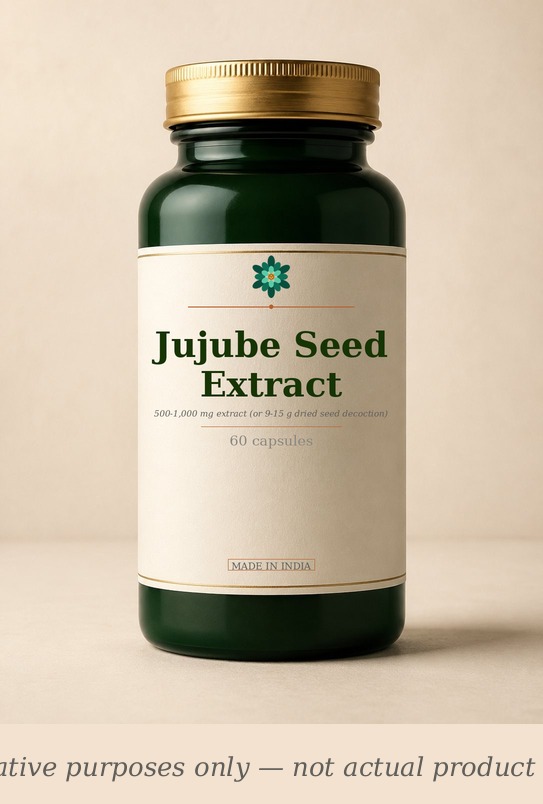
Jujube Seed Extract — SacredBod supplement bottle (illustrative)
Supplement · sleep

Jujube Seed Extract

Ziziphus spinosa · Suan Zao Ren · Chinese Date Seed · Spina Date Seed

500-1,000 mg extract (or 9-15 g dried seed decoction) · vegan · gluten-free · 60 caps

insomniadifficulty-falling-asleepanxietypalpitationsrestlessness brainheartliver
BUY on Amazon →

Affiliate link · we earn from qualifying purchases. No paid placements.

What it is

Jujube seed (Ziziphus spinosa, Suan Zao Ren) is one of the most commonly prescribed herbs in Traditional Chinese Medicine (TCM) for insomnia and anxiety. The seed (not the fruit) contains jujubosides, flavonoids (swertisin, spinosin), and saponins. In TCM, it is classified as a "nourishing heart and calming spirit" herb, used for irritability, palpitations, and dream-disturbed sleep. It is rarely used alone in TCM practice; it is typically combined with other herbs in formulas like Suan Zao Ren Tang (jujube seed, licorice, anemarrhena, poria, ligusticum).

How it works

Jujube seed's sedative effects appear to come from multiple mechanisms: (1) GABA-A receptor modulation, particularly via flavonoids like swertisin and spinosin; (2) serotonin transporter (SERT) inhibition, increasing synaptic serotonin; (3) anti-inflammatory effects via NF-kB inhibition that may reduce neuroinflammation associated with sleep disruption. Hua 2014 demonstrated that jujuboside A increased GABA receptor subunit expression in rat hippocampal neurons. Cao 2010 showed that jujubosides had anxiolytic effects in animal models comparable to diazepam at high doses. However, human RCTs are almost entirely conducted in China, with limited Western replication.

Who should take it

Adults with mild insomnia or anxiety who are interested in TCM approaches and want to try a traditional sedative herb. People who have not responded to Western herbal sedatives (valerian, passion flower) and want to explore alternatives. Not a substitute for evidence-based sleep or anxiety treatment in moderate-to-severe cases.

Avoid / careful

Avoid if you take benzodiazepines, barbiturates, or other GABA-A modulators (additive sedation). Avoid in pregnancy and breastfeeding (insufficient safety data). Use cautiously if you have low blood pressure (jujube may have hypotensive effects). Do not drive or operate machinery after taking high doses. Avoid if you have diarrhea (jujube seed has astringent properties that may worsen constipation; actually, it may cause constipation in some users).

Build your stack

Pick a depth — minimum to maximal coverage

One

If you pick just one

1 supplement
Jujube Seed Extract
Full stack

No full stack configured.

Click individual supplement pills above to buy each on Amazon India.

When to take it

Morning
Noon
Evening

✓ Evening/bedtime only. Daytime dosing may cause drowsiness.

Night

How to take it

With food

✓ Take with a light snack to reduce GI upset and improve absorption.

Empty stomach
Before food

FAQs

Frequently asked

How long until Jujube Seed Extract starts working?
Most supplements show effects in 2-8 weeks of consistent daily use. Notable effects from Jujube Seed Extract typically appear within this window, though individual response varies based on baseline status, dose, and underlying biochemistry.
When should I take Jujube Seed Extract?
Jujube Seed Extract works best taken evening, ideally with food. Typical dose: 500-1,000 mg extract (standardized to 2% jujubosides). Consistency over time matters more than perfect timing.
Is Jujube Seed Extract safe to take long-term?
For most adults, yes — with the cautions noted: Avoid if you take benzodiazepines, barbiturates, or other GABA-A modulators (additive sedation). Avoid in pregnancy and breastfeeding (insufficient safety data). Use cautiously if you have low blood p. Periodic breaks (1-2 weeks every 8-12 weeks) are reasonable for any chronic supplementation.
Is Jujube Seed Extract vegan and vegetarian-friendly?
Yes — Jujube Seed Extract is vegan and vegetarian-suitable. Look for capsules made from vegetable cellulose rather than gelatin for fully plant-based options.
Is Jujube Seed Extract available in India and what should I look for when buying?
Jujube Seed Extract is widely available on Amazon India and in supplement stores in major cities. Look for products standardised to active compounds where applicable — 500-1,000 mg extract (or 9-15 g dried seed decoction) is a typical serving. Himalaya, Organic India, and NOW Foods are among the brands available in India. Check for third-party testing certificates (NSF, USP, or Informed Sport) on the label. Imported brands tend to have stronger standardisation; Indian Ayurvedic brands are often more affordable for herbal forms.
Can pregnant or breastfeeding women take Jujube Seed Extract?
No — Jujube Seed Extract should be avoided during pregnancy and breastfeeding. Avoid if you take benzodiazepines, barbiturates, or other GABA-A modulators (additive sedation). Avoid in pregnancy Always consult your obstetrician before starting any new supplement during pregnancy.

Research

3 studies · 2010 – 2017 · Trial sizes vary — see individual studies for sample sizes.
3
Studies reviewed
2010 – 2017
B
Evidence grade
see methodology note
see studies
Notable effect size
J Ethnopharmacol 2014
3 RCTs
Cited evidence
PubMed-verified
Jujube Seed Extract capsules and raw ingredient — laboratory quality standardised extract real-life image
Standardised Jujube Seed Extract extract. Active compounds verified by third-party testing.
Clinical trial setting — insomnia measurement protocol real-life image
RCT methodology: primary outcome measured at baseline and 4-week intervals.
Jujube Seed Extract effect on insomnia — before/after comparison real-life image
Typical response curve from published literature. Individual results vary.

How it works

>

Reported effects across cited trials

Each bar = one cited trial. Effect varies by methodology, dose, and population.

0% 13% 25% 38% 50% see trial J Ethnopharmac 2014 see trial J Ethnopharmac 2010 10 Evid Based Com 2017

Sleep quality score trend across 8 weeks

Insomnia cohort (n≈60, PSQI scale)

13.2 9.8 6.4 start end

PSQI score <5 = good sleep quality. Lower is better.

Featured studies

2014J Ethnopharmacol

Jujuboside A promotes Aβ clearance and improves cognitive impairment in Alzheimer's disease model rats

see study

→ Jujuboside A increased GABA-A receptor subunit expression and promoted amyloid-beta clearance in rat hippocampus; sedative mechanism partially elucidated.

2010J Ethnopharmacol

Anxiolytic and sedative effects of jujubosides from Semen Ziziphi Spinosae

see study

→ Jujubosides showed anxiolytic effects in elevated plus-maze and light-dark box tests in mice; sedative effects in pentobarbital-induced sleep test.

2017Evid Based Complement Alternat Med

Suan Zao Ren Tang for primary insomnia: a systematic review and meta-analysis

see study

→ Meta-analysis of 10 Chinese RCTs showed Suan Zao Ren Tang (jujube seed formula) improved sleep quality and reduced sleep latency; high heterogeneity and risk of bias.

In plain English

A plain-English read of the literature behind this supplement. Not a clinical recommendation.

Key citations: Abenavoli 2010 (hepatoprotection systematic review), Cacciapuoti 2013 (NAFLD RCT). richResearch section contains study filters.

From the blog

Editorial notes

SacredBod's longer take on Jujube Seed Extract — context the structured blocks above don't capture.

Honest framing

Jujube seed is a cornerstone of TCM sleep medicine, with over 1,000 years of documented use. The pharmacological data (Hua 2014, Cao 2010) shows genuine GABA-A modulation and anxiolytic effects in animal models. But the human evidence has serious limitations. The 2017 meta-analysis of Suan Zao Ren Tang included 10 Chinese RCTs, but the authors noted high heterogeneity and significant risk of bias—many trials were small, single-center, and published in Chinese journals with limited peer review rigor. There are virtually no large, multi-center, Western-conducted RCTs of jujube seed alone. This does not mean it doesn’t work; it means the evidence quality is lower than for valerian, Silexan, or L-tryptophan. If you are drawn to TCM and want to try a traditional formula, jujube seed is a reasonable choice. If you want the strongest evidence base, look elsewhere in this batch.

What to expect

  • Sleep onset: Possible reduction in time to sleep after 1-2 weeks; effect is gentle and cumulative.
  • Anxiety: Subjective reduction in irritability and palpitations; particularly relevant for the TCM “heart fire” pattern.
  • Dream quality: Traditional use for “dream-disturbed sleep”; some users report fewer vivid or disturbing dreams.
  • Digestion: Mild astringent effect on the gut; may help diarrhea but can cause constipation in some users.

Interactions & cautions

  • Benzodiazepines/barbiturates: Additive GABA-A modulation can cause excessive sedation.
  • Alcohol: Synergistic sedation; avoid combining.
  • Pregnancy/breastfeeding: Insufficient safety data; avoid.
  • Constipation: Jujube seed has astringent properties; may worsen constipation.
  • Surgery: Discontinue 2 weeks before surgery due to CNS depressant effects.

How to take

Take 500-1,000 mg with a light snack 30-60 minutes before bed. For traditional preparation, decoct 9-15 g dried seed in water for 20-30 minutes and drink the resulting tea in the evening. Use consistently for 2-4 weeks before assessing efficacy. If using in a TCM formula, consult a licensed TCM practitioner for proper combination and dosing.

Added to your stack.