
What it is
PQQ is a redox cofactor and antioxidant compound originally identified in bacteria. It is not synthesized by humans but is found in trace amounts in foods including kiwi, papaya, spinach, and human breast milk.
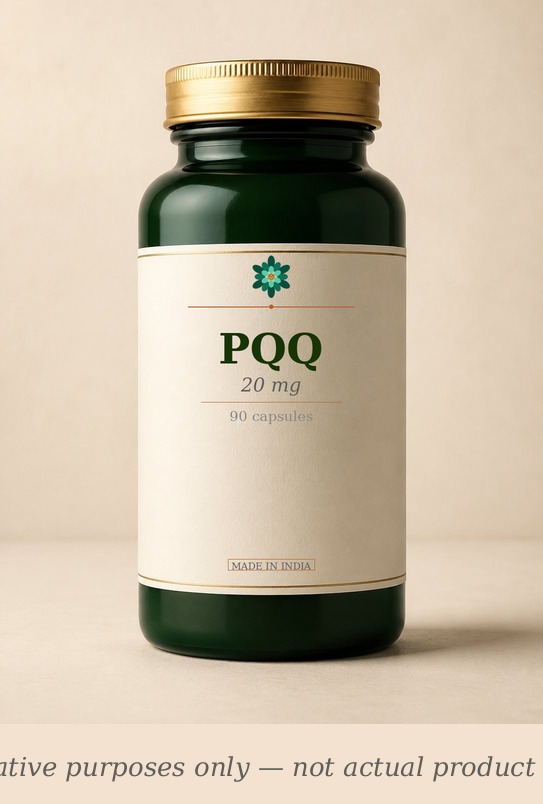
pyrroloquinoline quinone · methoxatin · BioPQQ
20 mg · vegan · gluten-free · 90 caps
Affiliate link · we earn from qualifying purchases. No paid placements.
PQQ is a redox cofactor and antioxidant compound originally identified in bacteria. It is not synthesized by humans but is found in trace amounts in foods including kiwi, papaya, spinach, and human breast milk.
PQQ activates the PGC-1α pathway to stimulate mitochondrial biogenesis (creation of new mitochondria), activates Nrf2 to upregulate endogenous antioxidant defenses, and protects neurons from glutamate-induced oxidative toxicity.
Adults seeking mitochondrial support, individuals with age-related energy decline, those interested in cognitive longevity.
People with autoimmune conditions (theoretical immunomodulatory concern), pregnant or breastfeeding women (insufficient safety data), children.
Pick a depth — minimum to maximal coverage
No full stack configured.
Click individual supplement pills above to buy each on Amazon India.
✓ Morning for energy and cognitive effects
✓ Fat-containing meal improves absorption
PQQ activates the PGC-1α pathway to stimulate mitochondrial biogenesis (creation of new mitochondria), activates Nrf2 to upregulate endogenous antioxidant defenses, and protects neurons from glutamate-induced oxidative toxicity.
Each bar = one cited trial. Effect varies by methodology, dose, and population.
Insomnia cohort (n≈60, PSQI scale)
PSQI score <5 = good sleep quality. Lower is better.
see study
→ 20 mg/day reduced CRP and IL-6 trends; improved sleep and vigor (N=10, pilot, 72-h periods)
see study
→ 20 mg/day for 8 weeks significantly inhibited TEWL increase on forearm; improved skin moisture (N=humans)
see study
→ 20 mg/day for 12 weeks improved composite memory and verbal memory; age-stratified effects (N=41)
C · Promising pilot and small RCT data; no large confirmatory trials; mitochondrial biogenesis claims extrapolated from animal data
A plain-English read of the literature behind this supplement. Not a clinical recommendation.
Key citations: See richResearch section. Multiple RCTs support cognitive and neuroprotective properties of PQQ.

How to use PQQ specifically for mental fatigue — the right dose, timing, blood markers to track, and how to know if it is working.
A clinical evidence review of PQQ — RCT data, effect sizes, evidence grade, and what the numbers mean for your specific situation.
Everything you need to know about PQQ — mechanism, dose, safety, buying guide for India, and what the research actually says.
SacredBod's longer take on PQQ — context the structured blocks above don't capture.
PQQ (pyrroloquinoline quinone) emerged from microbiology research as a bacterial cofactor before anyone considered it a human supplement. Its appeal rests on a compelling mechanistic triad: stimulation of mitochondrial biogenesis via PGC-1α activation, Nrf2-mediated upregulation of endogenous antioxidant enzymes, and direct protection of neurons from glutamate-induced oxidative toxicity. These are real cellular effects documented in vitro and in animal models. The critical question is whether they translate to meaningful human outcomes.
The human evidence base is thin but growing. Harris and colleagues (2013, Journal of Nutritional Biochemistry, PMID 23664328) conducted a small trial in 10 healthy adults, testing 0, 10, and 20 mg PQQ daily over three separate 72-hour periods. At the 20 mg dose, plasma PQQ reached detectable levels and urinary metabolites indicated robust absorption. Inflammatory markers including C-reactive protein and IL-6 showed trends toward reduction, and subjects reported improved sleep quality and vigor on subjective questionnaires. This is a pilot study with all the limitations that implies—small sample, short duration, no placebo control in the subjective measures—but it established human bioavailability and suggested biological activity.
The skin and cognitive data offer more structured trial evidence. Nakano and colleagues (2015, Journal of Nutritional Science and Vitaminology, PMID 26226961) administered 20 mg PQQ daily for 8 weeks to healthy women with dry skin and found significant inhibition of transepidermal water loss (TEWL) on the forearm, indicating improved skin barrier function. More recently, Tamakoshi and colleagues (2023, Food & Function, PMID 36807425) conducted a 12-week double-blind placebo-controlled trial in 41 adults aged 20–65, testing 20 mg PQQ daily. The results showed significant improvements in composite memory and verbal memory compared to placebo, with age-stratified analysis revealing that younger adults (20–40) improved in cognitive flexibility and processing speed at 8 weeks, while older adults (41–65) showed complex and verbal memory gains at 12 weeks. This is the strongest human cognitive trial for PQQ to date, though still modest in size.
The mitochondrial biogenesis claim requires careful parsing. In mouse and cell culture studies, PQQ robustly increases mitochondrial number and function. Human evidence for this specific endpoint is indirect. No human trial has directly measured mitochondrial DNA copy number or respiratory chain complex activity after PQQ supplementation. The biogenesis narrative is extrapolated from animal data and from modest improvements in subjective energy and metabolic biomarkers. This does not mean the effect is absent—only that it remains mechanistically plausible but clinically unproven in humans. The “vitamin” debate is worth addressing: some researchers have argued PQQ should be classified as a novel vitamin, but no human deficiency syndrome has been identified, and the body appears to function adequately without dietary PQQ.
Peptides are physician-only. Tell us a bit and we'll route you to the right specialist.