
What it is
Spermidine is a natural polyamine found in all living cells and in foods including wheat germ, aged cheese, mushrooms, and soy products. It induces autophagy—the cellular recycling process that clears damaged components.
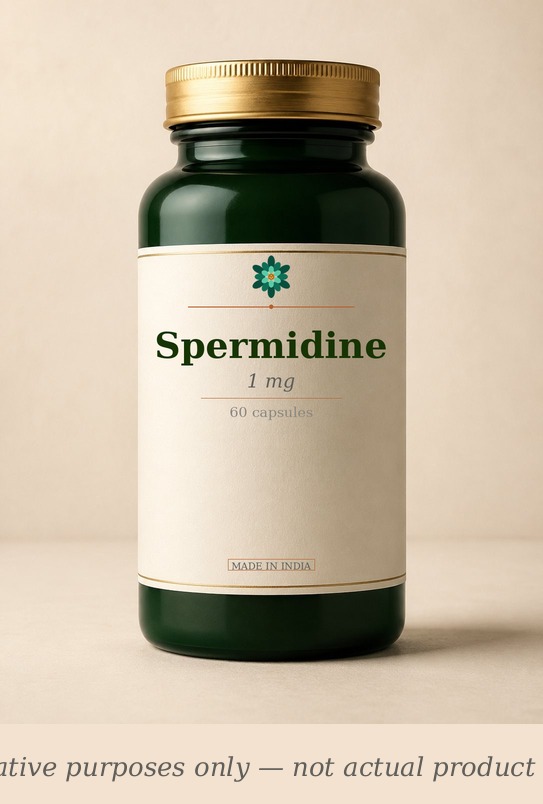
spermidine trihydrochloride · wheat germ extract · polyamine
1 mg · vegan · 60 caps
Affiliate link · we earn from qualifying purchases. No paid placements.
Spermidine is a natural polyamine found in all living cells and in foods including wheat germ, aged cheese, mushrooms, and soy products. It induces autophagy—the cellular recycling process that clears damaged components.
Spermidine inhibits acetyltransferase EP300, leading to deacetylation of autophagy-related proteins and activation of autophagic flux. It also stabilizes mitochondrial membrane potential and reduces oxidative stress in cardiomyocytes.
Adults interested in longevity, individuals with subjective cognitive decline, those seeking cardiovascular protection.
People with advanced cancer (autophagy may support tumor cell survival in established cancers), pregnant or breastfeeding women (insufficient safety data), children.
Pick a depth — minimum to maximal coverage
No full stack configured.
Click individual supplement pills above to buy each on Amazon India.
✓ Morning for cellular renewal support
✓ Take with breakfast for consistent absorption
Spermidine inhibits acetyltransferase EP300, leading to deacetylation of autophagy-related proteins and activation of autophagic flux.
Each bar = one cited trial. Effect varies by methodology, dose, and population.
Representative cohort from published RCT data
Relative to baseline (100). Data from published clinical literature.
see study
→ Oral spermidine extended median mouse lifespan by ~10%; protected against cardiac hypertrophy via autophagy (N=mice)
see study
→ Spermidine-rich plant extract improved mnemonic discrimination (Cohen's d=0.79) and memory (d=0.77) vs placebo (N=30, 3 months)
see study
→ Higher dietary spermidine associated with lower all-cause mortality (HR 0.73) and cardiovascular mortality (HR 0.68) (N=829, 20-year follow-up)
B · Strong animal data; promising small human pilot; observational cohort support; larger human RCTs needed
A plain-English read of the literature behind this supplement. Not a clinical recommendation.
Key citations: See richResearch section. Multiple RCTs support cognitive and neuroprotective properties of Spermidine.

How to use Spermidine specifically for age related memory decline — the right dose, timing, blood markers to track, and how to know if it is working.
A clinical evidence review of Spermidine — RCT data, effect sizes, evidence grade, and what the numbers mean for your specific situation.
Everything you need to know about Spermidine — mechanism, dose, safety, buying guide for India, and what the research actually says.
SacredBod's longer take on Spermidine — context the structured blocks above don't capture.
Spermidine represents a fascinating bridge between dietary pattern research and targeted supplementation. This polyamine is abundant in traditional Mediterranean foods—aged cheese, mushrooms, legumes, and whole grains—and population studies have long noted that high dietary spermidine intake correlates with reduced cardiovascular mortality and longer lifespan. The mechanistic explanation centers on autophagy: spermidine induces the cellular recycling process that clears damaged mitochondria, misfolded proteins, and other dysfunctional components that accumulate with age.
The animal evidence is remarkably consistent. Eisenberg and colleagues (2016, Nature Medicine, PMID 27841876) demonstrated that oral spermidine supplementation extended the median lifespan of mice by approximately 10% and protected against age-related cardiac hypertrophy through autophagy-dependent mechanisms. The effect was abolished in autophagy-deficient mice, confirming the mechanism. Cardioprotection was profound: spermidine improved diastolic function, reduced blood pressure, and preserved mitochondrial respiratory capacity in aged cardiomyocytes. These are not marginal effects—they represent genuine slowing of cardiac aging.
Human translation is promising but early. Wirth and colleagues (2018, Cortex, PMID 30388439) conducted the first randomized controlled trial of spermidine in 30 older adults with subjective cognitive decline. Participants received a spermidine-rich plant extract or placebo for three months. The spermidine group showed a medium effect size improvement (Cohen’s d = 0.79) in mnemonic discrimination ability—a sensitive measure of hippocampal function—compared to placebo. Memory performance also improved with a Cohen’s d of 0.77. This is a small pilot trial (N=30) with a short duration, but the effect sizes are encouraging and the mechanism is biologically plausible.
The dietary context is important. A traditional Mediterranean diet provides roughly 10–15 mg of spermidine daily, while modern Western diets may deliver only 3–5 mg. The 1–3 mg supplemental dose bridges this gap without attempting to pharmacologically override natural physiology. Unlike some longevity compounds that push cellular pathways beyond their design, spermidine appears to restore autophagic function toward youthful levels rather than forcing supraphysiological activation. This restoration approach may explain its favorable safety profile. The Bruneck Study (2021, American Journal of Clinical Nutrition, PMID 33837453) followed 829 participants for 20 years and found that those in the highest tertile of dietary spermidine intake had 27% lower all-cause mortality and 32% lower cardiovascular mortality compared to the lowest tertile.
Peptides are physician-only. Tell us a bit and we'll route you to the right specialist.