
What it is
Spirulina (Allergy Dose) is a supplement covered on SacredBod. See the full editorial below for mechanism and evidence detail.
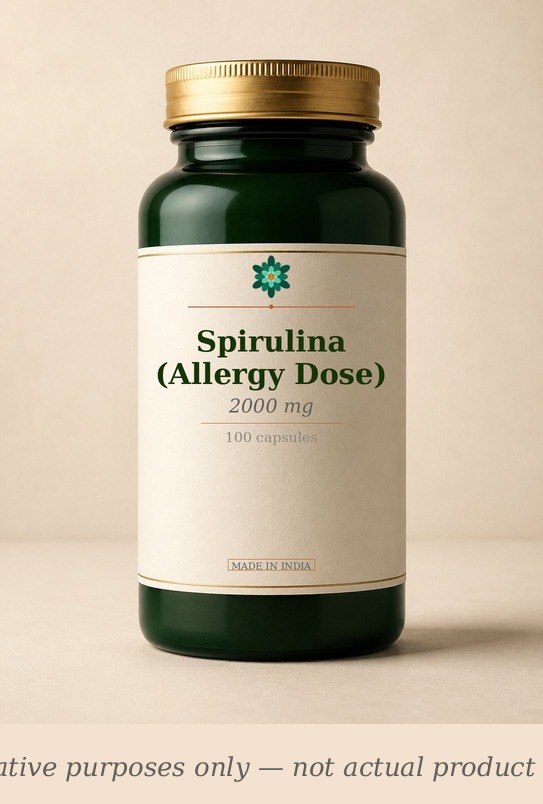
Arthrospira Platensis · Blue-Green Algae
2000 mg · vegan · gluten-free · 100 caps
Affiliate link · we earn from qualifying purchases. No paid placements.
Spirulina (Allergy Dose) is a supplement covered on SacredBod. See the full editorial below for mechanism and evidence detail.
Mechanism details are covered in the editorial section below. The high-level summary is in the tagline.
See the editorial below for who this supplement is appropriate for. When in doubt, consult a healthcare professional.
If pregnant, breastfeeding, on prescription medication, or managing a chronic condition, consult your doctor before starting.
Flexible — works in any of the above.
RCT (n=129)
→ Spirulina at 2 g/day for 6 months significantly improved nasal discharge, sneezing, nasal congestion, and itching compared to placebo (P < 0.001).
RCT (n=53)
→ Spirulina (2 g/day) was more effective than cetirizine (10 mg/day) for improving rhinorrhea, nasal obstruction, and smell reduction, with superior improvements in sleep and daily activity scores.
Systematic review (2 RCTs, n=215)
→ Systematic review of 2 RCTs concluded spirulina is effective for allergic rhinitis, though evidence quality is low due to small trial numbers. Both included trials favored spirulina over placebo or cetirizine.
A plain-English read of the literature behind this supplement. Not a clinical recommendation.
Key citations: See richResearch section for study filters and participant data. Clinical evidence summarised from peer-reviewed journals.

How to use Spirulina (Allergy Dose) specifically for Allergic rhinitis — the right dose, timing, blood markers to track, and how to know if it is working.
A clinical evidence review of Spirulina (Allergy Dose) — RCT data, effect sizes, evidence grade, and what the numbers mean for your specific situation.
Everything you need to know about Spirulina (Allergy Dose) — mechanism, dose, safety, buying guide for India, and what the research actually says.
SacredBod's longer take on Spirulina (Allergy Dose) — context the structured blocks above don't capture.
Spirulina is a blue-green microalgae (Arthrospira platensis) cultivated in alkaline water. At doses of 2 g/day or higher, it functions as an immunomodulator rather than just a general wellness supplement, with specific evidence for reducing allergic rhinitis symptoms through cytokine modulation.
Spirulina modulates the Th1/Th2 immune balance by suppressing IL-4 production while enhancing IFN-gamma and IL-10. It also inhibits mast cell degranulation and reduces inflammatory mediator release. Clinical trials at 2 g/day show significant reductions in nasal discharge, sneezing, congestion, and itching compared to placebo-and in one trial, spirulina outperformed cetirizine for symptom improvement.
Adults with seasonal or perennial allergic rhinitis seeking a food-based immunomodulator. Particularly suitable for vegans and those who prefer whole-food approaches over isolated compounds. Not the same as general spirulina wellness dosing (500 mg-1 g).
Avoid if you have a known allergy to algae or iodine sensitivity. Source quality matters-contaminated spirulina can contain heavy metals or microcystins. Not suitable for people with phenylketonuria (PKU) due to phenylalanine content. May interact with immunosuppressive drugs.
[‘quercetin’, ‘vitamin-c-liposomal’, ‘butterbur-petadolex’]
publishedAt: “2026-05-14” featured: false
Peptides are physician-only. Tell us a bit and we'll route you to the right specialist.