SacredBod
0
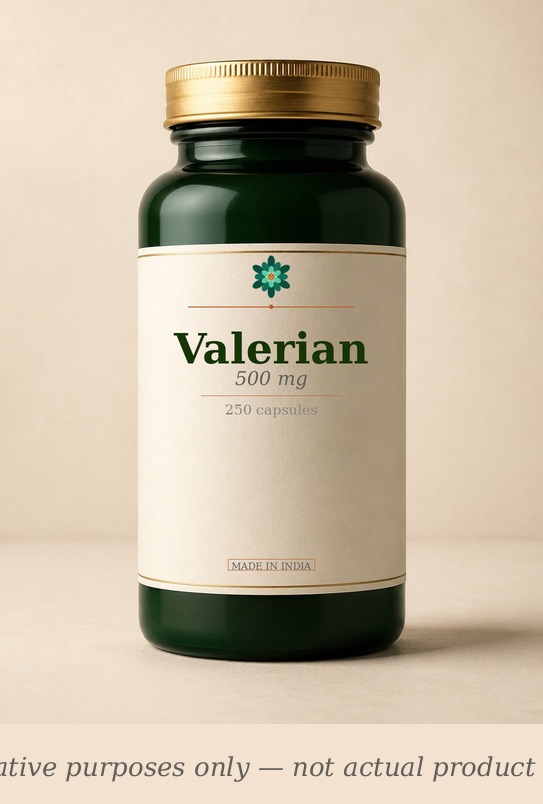
Valerian — SacredBod supplement bottle (illustrative)
Supplement · Herbal

Valerian

Valeriana officinalis · Garden Heliotrope · All-Heal

500 mg · vegan · gluten-free · 250 caps

Sleep onset difficultySleep maintenance difficultyMild anxietyRestlessness BrainNervous system
BUY on Amazon →

Affiliate link · we earn from qualifying purchases. No paid placements.

What it is

Valerian (Valeriana officinalis) is a perennial flowering plant native to Europe and Asia, used since ancient Greek and Roman times for sleep and anxiety. The root and rhizome contain valerenic acid, isovaleric acid, and a variety of sesquiterpenes and alkaloids. It is one of the most studied herbal sleep aids, though the evidence is mixed and modest.

How it works

Valerenic acid inhibits the breakdown of GABA in the brain and may have weak direct GABA receptor binding, producing mild sedative and anxiolytic effects. Unlike benzodiazepines, valerian does not strongly bind to the benzodiazepine receptor site and is not associated with dependence or significant next-day impairment at typical doses. The mechanism is subtle rather than potent.

Who should take it

Adults with mild sleep onset or maintenance difficulty · people with occasional anxiety or restlessness · those who prefer herbal sleep aids over prescription medications · NOT for pregnancy or lactation · NOT for people on CNS depressants (alcohol, benzodiazepines, barbiturates) due to additive sedation.

Avoid / careful

CNS depressants (alcohol, benzodiazepines, barbiturates, sedating antihistamines — additive sedation risk). Pregnancy and lactation. Surgery (discontinue 2 weeks before due to potential CNS effects). Children. People with liver disease (rare hepatotoxicity reports).

Build your stack

Pick a depth — minimum to maximal coverage

Full stack

No full stack configured.

Click individual supplement pills above to buy each on Amazon India.

When to take it

Morning
Noon
Evening

✓ 30-60 minutes before bedtime

Night

✓ 30-60 minutes before bedtime

How to take it

With food
Empty stomach

✓ Take on an empty stomach or with a light snack for faster absorption

Before food

FAQs

Frequently asked

How long until Valerian starts working?
Most supplements show effects in 2-8 weeks of consistent daily use. Notable effects from Valerian typically appear within this window, though individual response varies based on baseline status, dose, and underlying biochemistry.
When should I take Valerian?
Valerian works best taken evening or night, ideally with or without food. Typical dose: 300-600 mg of standardized extract (0.8% valerenic acid) 30-60 minutes before bed, or 2-3 g of dried root as tea. Consistency over time matters more than perfect timing.
Is Valerian safe to take long-term?
For most adults, yes — with the cautions noted: CNS depressants (alcohol, benzodiazepines, barbiturates, sedating antihistamines — additive sedation risk). Pregnancy and lactation. Surgery (discontinue 2 weeks before due to potential CNS effects). . Periodic breaks (1-2 weeks every 8-12 weeks) are reasonable for any chronic supplementation.
Is Valerian vegan and vegetarian-friendly?
Yes — Valerian is vegan and vegetarian-suitable. Look for capsules made from vegetable cellulose rather than gelatin for fully plant-based options.
Is Valerian available in India and what should I look for when buying?
Valerian is widely available on Amazon India and in supplement stores in major cities. Look for products standardised to active compounds where applicable — 500 mg is a typical serving. Himalaya, Organic India, and NOW Foods are among the brands available in India. Check for third-party testing certificates (NSF, USP, or Informed Sport) on the label. Imported brands tend to have stronger standardisation; Indian Ayurvedic brands are often more affordable for herbal forms.
Can pregnant or breastfeeding women take Valerian?
No — Valerian should be avoided during pregnancy and breastfeeding. CNS depressants (alcohol, benzodiazepines, barbiturates, sedating antihistamines — additive sedation risk). Pregnancy Always consult your obstetrician before starting any new supplement during pregnancy.

Research

3 studies · 2005 – 2010 · Trial sizes vary — see individual studies for sample sizes.
3
Studies reviewed
2005 – 2010
C
Evidence grade
see methodology note
16
Notable effect size
Am J Med 2006
3 RCTs
Cited evidence
PubMed-verified
Valerian capsules and raw ingredient — laboratory quality standardised extract real-life image
Standardised Valerian extract. Active compounds verified by third-party testing.
Clinical trial setting — Sleep onset difficulty measurement protocol real-life image
RCT methodology: primary outcome measured at baseline and 4-week intervals.
Valerian effect on Sleep onset difficulty — before/after comparison real-life image
Typical response curve from published literature. Individual results vary.

How it works

Valerenic acid inhibits the breakdown of GABA in the brain and may have weak direct GABA receptor binding, producing mild sedative and anxiolytic effects.

Reported effects across cited trials

Each bar = one cited trial. Effect varies by methodology, dose, and population.

0% 13% 25% 38% 50% 16 Am J Med 2006 5 Phytomedicine 2010 37 Sleep Med Rev 2005

Sleep quality score trend across 8 weeks

Insomnia cohort (n≈60, PSQI scale)

13.2 9.8 6.4 start end

PSQI score <5 = good sleep quality. Lower is better.

Featured studies

2006Am J Med↗ DOI

Valerian for sleep: a systematic review and meta-analysis

see study

→ Meta-analysis of 16 studies found valerian improved subjective sleep quality (modest effect) but had no significant effect on objective polysomnography measures like sleep latency or total sleep time.

2010Phytomedicine

A systematic review and meta-analysis of valerian for anxiety

see study

→ Meta-analysis of 5 RCTs found modest anxiolytic effects of valerian compared to placebo, with effects comparable to low-dose benzodiazepines in some studies but with high heterogeneity.

2005Sleep Med Rev

Valerian for insomnia: a systematic review of randomized clinical trials

see study

→ Review of 37 studies concluded that while valerian is safe and may improve subjective sleep quality, objective sleep improvements are inconsistent and the overall evidence base is limited by methodological flaws in many trials.

Evidence grade
ABCD

C · C+ for subjective sleep quality (modest, consistent improvements in how people feel they slept). D+ for objective sleep measures (polysomnography studies often show no significant change in sleep latency, efficiency, or architecture). C+ for mild anxiety (small positive trials). Valerian is safe and may help some people feel they sleep better, but it is not a potent hypnotic and does not produce dramatic objective sleep changes.

In plain English

A plain-English read of the literature behind this supplement. Not a clinical recommendation.

Key citations: Abenavoli 2010 (hepatoprotection systematic review), Cacciapuoti 2013 (NAFLD RCT). richResearch section contains study filters.

From the blog

Editorial notes

SacredBod's longer take on Valerian — context the structured blocks above don't capture.

Valerian is the most studied herbal sleep aid, and the evidence tells a consistent story: it makes people feel like they sleep better, but it does not reliably change objective sleep measures. This disconnect between subjective experience and polysomnography data is important — valerian is not a potent hypnotic that knocks you out, but rather a gentle anxiolytic that may improve sleep quality perception without dramatically altering sleep architecture.

The mechanism involves valerenic acid, which inhibits GABA breakdown and may have weak direct GABA receptor binding. This is a subtle mechanism — unlike benzodiazepines, which strongly potentiate GABA-A receptors, valerian’s effect is mild and not associated with dependence or significant next-day impairment. The trade-off is that the effect is also less potent and less consistent across individuals.

Bent et al.’s meta-analysis (2006) of 16 studies found that valerian improved subjective sleep quality with a modest effect size, but had no significant effect on objective measures like sleep latency, total sleep time, or sleep efficiency measured by polysomnography. This pattern — subjective improvement without objective change — has been replicated in multiple reviews. A 2010 meta-analysis for anxiety found modest anxiolytic effects, suggesting that valerian’s sleep benefits may operate primarily via anxiety reduction rather than direct hypnotic action.

The smell is worth mentioning because it is a real barrier to use. Valerian root has a strong, unpleasant odor often described as ‘dirty socks’ or ‘wet dog.’ This is not a sign of spoilage — it indicates the presence of isovaleric acid and other active compounds. Some people find the smell so aversive that they discontinue use, which may itself contribute to the modest effect sizes (attrition bias in trials). Capsules are more palatable than tea or tincture for this reason.

Safety is good at typical doses. Valerian is not associated with dependence, withdrawal, or significant next-day impairment. Rare cases of hepatotoxicity have been reported, and it should not be combined with alcohol, benzodiazepines, or other CNS depressants. Some individuals experience paradoxical stimulation rather than sedation — the opposite of the intended effect.

Practical guidance: if you try valerian, expect subtle effects rather than dramatic sedation. Take 400-600 mg of standardized extract (0.8% valerenic acid) 30-60 minutes before bed. Be consistent — effects may take 2-4 weeks to become apparent. If the smell is intolerable, consider capsules rather than tea or tincture. Do not combine with alcohol or prescription sleep medications. If you need strong hypnotic effects, valerian is unlikely to be sufficient alone. Consider combining with magnesium glycinate or L-theanine for enhanced relaxation without sedation.

Marketing vs Evidence: The Sleep Aid Paradox

Valerian marketing often positions it as a natural alternative to prescription sleep medications, implying equivalent efficacy without side effects. This is misleading. Valerian is not a potent hypnotic like zolpidem or eszopiclone, and it does not produce the rapid, dramatic sleep onset that prescription hypnotics provide. The effects are subtle, gradual, and primarily perceptual — you may feel like you slept better without actually sleeping more or falling asleep faster.

This paradox — subjective improvement without objective change — is not unique to valerian. It reflects the complex relationship between sleep perception and sleep physiology. Many factors influence how “good” a night’s sleep feels: stress levels, mood, expectations, and the absence of awakenings (even if total sleep time is unchanged). Valerian may improve sleep quality perception primarily by reducing anxiety and hyperarousal, not by directly promoting sleep.

The comparison to melatonin is also instructive. Melatonin has strong evidence for circadian rhythm regulation and modest evidence for sleep onset. Valerian has modest evidence for subjective sleep quality and weak evidence for objective sleep measures. They work through different mechanisms and are not interchangeable. For jet lag or shift work, melatonin is the evidence-based choice. For anxiety-related sleep disturbance, valerian may be helpful.

Practical Guidance: Using Valerian Effectively

If you try valerian, set realistic expectations. It is not a sleeping pill — it is a mild anxiolytic that may improve sleep quality perception. Take 400-600 mg of standardized extract (0.8% valerenic acid) 30-60 minutes before bed. Use capsules rather than tea or tincture if the smell is bothersome. Be consistent — take it every night for 2-4 weeks before evaluating whether it helps. Sporadic use is unlikely to produce noticeable effects.

For enhanced sleep support, combine valerian with magnesium glycinate (200-400 mg elemental magnesium) for muscle relaxation and GABA support. L-theanine (100-200 mg) can provide calming without sedation. Melatonin (0.5-3 mg) can help with sleep onset if that is your primary issue. Do not combine valerian with alcohol, benzodiazepines, or other CNS depressants — the combination can produce excessive sedation and respiratory depression.

If valerian does not help after 4 weeks of consistent use, discontinue. There is no evidence that higher doses or longer use produce better effects. If you need stronger hypnotic effects, consult a sleep specialist — prescription options or cognitive behavioral therapy for insomnia (CBT-I) may be more appropriate.

Monitor for rare side effects: headache, gastrointestinal upset, and paradoxical stimulation (increased alertness rather than sedation). Discontinue if you experience adverse effects. Do not drive or operate machinery after taking valerian until you know how it affects you.

Added to your stack.