SacredBod
0
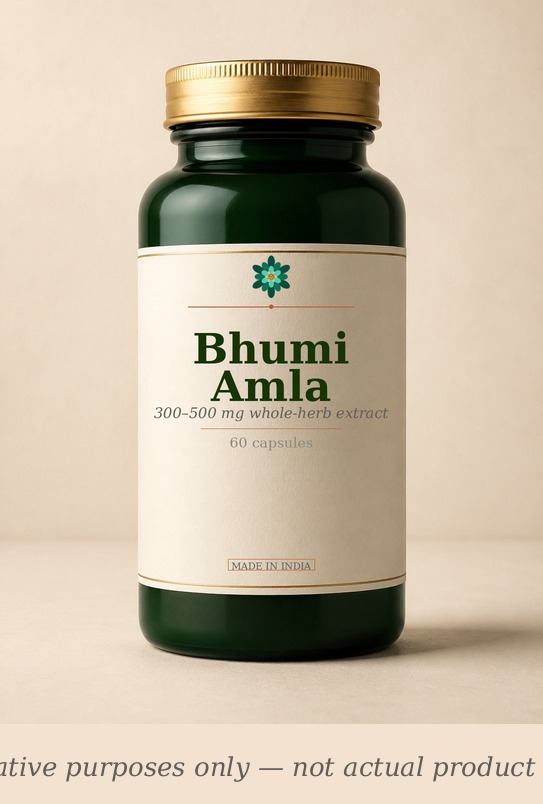
Bhumi Amla — SacredBod supplement bottle (illustrative)
Supplement · Ayurvedic Herb

Bhumi Amla

Phyllanthus niruri · Phyllanthus amarus · Stone breaker · Chanca piedra

300–500 mg whole-herb extract · vegan · gluten-free · 60 caps

liver-enzyme-elevationjaundicekidney-stone-riskviral-hepatitisfluid-retention liverkidneys
BUY on Amazon →

Affiliate link · we earn from qualifying purchases. No paid placements.

What it is

Bhumi amla is the whole herb of Phyllanthus niruri (sometimes P. amarus), a small annual plant used across Ayurveda, Siddha, and traditional Chinese medicine for liver disorders and kidney stones. It is one of the most researched Ayurvedic herbs for hepatitis B, though clinical results are mixed.

How it works

The herb contains lignans (phyllanthin, hypophyllanthin), alkaloids, flavonoids, and polyphenols. In vitro and animal studies show inhibition of hepatitis B virus DNA polymerase, hepatoprotective effects against carbon tetrachloride and paracetamol toxicity, and antilithic (stone-reducing) activity.

Who should take it

People interested in traditional liver support, those with chronic hepatitis B seeking adjunctive botanical options, and individuals prone to kidney stones. Should be used as an adjunct, not a replacement for standard medical care.

Avoid / careful

Avoid during pregnancy and breastfeeding. Do not discontinue standard antiviral therapy for hepatitis B without hepatologist guidance. Use caution with diabetes medications as it may lower blood glucose.

Build your stack

Pick a depth — minimum to maximal coverage

MES

Minimum effective stack

3 supplements
milk-thistleKutkiturmeric
Full stack

No full stack configured.

Click individual supplement pills above to buy each on Amazon India.

When to take it

Morning

✓ Divided dosing maintains more stable blood levels throughout the day.

Noon

✓ Divided dosing maintains more stable blood levels throughout the day.

Evening

✓ Divided dosing maintains more stable blood levels throughout the day.

Night

How to take it

With food

✓ Food reduces the bitter herb's potential for nausea and stomach upset.

Empty stomach
Before food

FAQs

Frequently asked

How long until Bhumi Amla starts working?
Most supplements show effects in 2-8 weeks of consistent daily use. Notable effects from Bhumi Amla typically appear within this window, though individual response varies based on baseline status, dose, and underlying biochemistry.
When should I take Bhumi Amla?
Bhumi Amla works best taken morning or noon or evening, ideally with food. Typical dose: 300–500 mg of standardized extract daily, or 2–3 g of traditional powder. Consistency over time matters more than perfect timing.
Is Bhumi Amla safe to take long-term?
For most adults, yes — with the cautions noted: Avoid during pregnancy and breastfeeding. Do not discontinue standard antiviral therapy for hepatitis B without hepatologist guidance. Use caution with diabetes medications as it may lower blood gluco. Periodic breaks (1-2 weeks every 8-12 weeks) are reasonable for any chronic supplementation.
Is Bhumi Amla vegan and vegetarian-friendly?
Yes — Bhumi Amla is vegan and vegetarian-suitable. Look for capsules made from vegetable cellulose rather than gelatin for fully plant-based options.
Is Bhumi Amla available in India and what should I look for when buying?
Bhumi Amla is widely available on Amazon India and in supplement stores in major cities. Look for products standardised to active compounds where applicable — 300–500 mg whole-herb extract is a typical serving. Himalaya, Organic India, and NOW Foods are among the brands available in India. Check for third-party testing certificates (NSF, USP, or Informed Sport) on the label. Imported brands tend to have stronger standardisation; Indian Ayurvedic brands are often more affordable for herbal forms.
Can pregnant or breastfeeding women take Bhumi Amla?
No — Bhumi Amla should be avoided during pregnancy and breastfeeding. Avoid during pregnancy and breastfeeding. Do not discontinue standard antiviral therapy for hepatitis B without hepatologist Always consult your obstetrician before starting any new supplement during pregnancy.

Research

3 studies · 1987 – 2016 · Trial sizes vary — see individual studies for sample sizes.
3
Studies reviewed
1987 – 2016
C
Evidence grade
see methodology note
see studies
Notable effect size
J Pharm Pharmacol 2006
3 RCTs
Cited evidence
PubMed-verified
Bhumi Amla capsules and raw ingredient — laboratory quality standardised extract real-life image
Standardised Bhumi Amla extract. Active compounds verified by third-party testing.
Clinical trial setting — liver-enzyme-elevation measurement protocol real-life image
RCT methodology: primary outcome measured at baseline and 4-week intervals.
Bhumi Amla effect on liver-enzyme-elevation — before/after comparison real-life image
Typical response curve from published literature. Individual results vary.

How it works

The herb contains lignans (phyllanthin, hypophyllanthin), alkaloids, flavonoids, and polyphenols.

Reported effects across cited trials

Each bar = one cited trial. Effect varies by methodology, dose, and population.

0% 13% 25% 38% 50% see trial J Pharm Pharma 2006 see trial Proc Natl Acad 1987 see trial J Pharm Pharma 2016

ALT trend across 12-week trial

Elevated liver enzymes cohort (n≈68)

62.0 46.0 30.0 start end

Target ALT <40 U/L (upper limit of normal).

Evidence grade
ABCD

C · Preclinical evidence for hepatoprotection and antiviral activity is strong. Human RCTs for hepatitis B show mixed results — some Indian trials positive, larger international replications weaker. Not a substitute for standard antiviral therapy.

In plain English

A plain-English read of the literature behind this supplement. Not a clinical recommendation.

Key citations: PMID 17331318, PMID 3467354, PMID 27283048

From the blog

Editorial notes

SacredBod's longer take on Bhumi Amla — context the structured blocks above don't capture.

Bhumi amla — Phyllanthus niruri — is one of the most intensively studied Ayurvedic herbs in modern pharmacology, particularly for its effects on hepatitis B virus and liver protection. The small annual herb grows wild across India and has been used in traditional medicine for jaundice, liver enlargement, and kidney stones (hence the Spanish name “chanca piedra,” or stone breaker). In the 1980s, Indian researchers demonstrated that aqueous extracts could inhibit HBV DNA polymerase in vitro and reduce viral markers in woodchuck carriers, sparking decades of research and commercial interest.

The phytochemical profile includes lignans (phyllanthin and hypophyllanthin), alkaloids, flavonoids, and polyphenols. A 2006 review in the Journal of Pharmacy and Pharmacology catalogued anti-hepatotoxic, anti-lithic, anti-hypertensive, anti-HIV, and anti-hepatitis B properties from preclinical studies. The hepatoprotective mechanism appears to involve reduction of lipid peroxidation, maintenance of glutathione levels, and modulation of inflammatory cytokines. A 2016 review reinforced these findings and added hypolipidaemic, hypoglycaemic, and anti-urolithiatic activities to the preclinical portfolio.

The clinical story for hepatitis B is more complicated. Early Indian trials reported encouraging results, with some patients clearing HBeAg or reducing HBV DNA after Phyllanthus treatment. However, larger international trials and a Cochrane systematic review found weaker or inconsistent effects when compared to standard antiviral drugs or placebo. The 2011 Cochrane review concluded there was insufficient evidence to support or refute Phyllanthus for chronic hepatitis B, noting that existing trials were small and at high risk of bias. This is a critical framing point: bhumi amla is not a proven cure for hepatitis B and should never replace lamivudine, tenofovir, or entecavir without specialist oversight.

For general liver support and kidney stone prevention, the risk-benefit profile is more favorable. Traditional use is extensive, preclinical data is supportive, and the herb has a long history of consumption as a tea and decoction. As with all Ayurvedic supplements, heavy metal testing and quality control are essential — the Indian herbal market has documented contamination issues that make third-party verification non-negotiable.

For consumers, bhumi amla is best viewed as a traditional hepatoprotective adjunct with interesting but unconfirmed antiviral potential. It fits into a liver wellness protocol alongside standard medical care, not as a replacement for it.

Added to your stack.