
What it is
Choline is an essential nutrient involved in methylation, neurotransmitter synthesis, phospholipid production, and liver fat metabolism. The body can synthesize small amounts, but dietary intake is necessary to meet requirements.
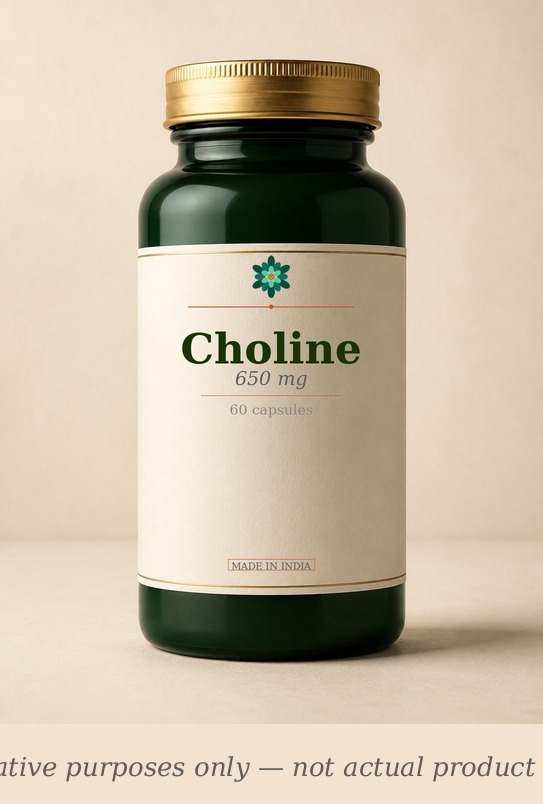
choline bitartrate · choline chloride · choline citrate
650 mg · vegan · gluten-free · 60 caps
Affiliate link · we earn from qualifying purchases. No paid placements.
Choline is an essential nutrient involved in methylation, neurotransmitter synthesis, phospholipid production, and liver fat metabolism. The body can synthesize small amounts, but dietary intake is necessary to meet requirements.
Choline serves as a substrate for acetylcholine synthesis via choline acetyltransferase, provides methyl groups for homocysteine metabolism via betaine, and is required for VLDL assembly in the liver to export triglycerides.
Adults with low choline intake, pregnant women (critical for fetal brain development), individuals with fatty liver, vegans and vegetarians (lower dietary choline).
People with trimethylaminuria (fish odor syndrome), those with severe liver disease, individuals taking methotrexate (may increase choline requirements).
Pick a depth — minimum to maximal coverage
No full stack configured.
Click individual supplement pills above to buy each on Amazon India.
✓ Morning for methylation support; with breakfast for GI comfort
✓ Food reduces GI discomfort and improves tolerance
Choline serves as a substrate for acetylcholine synthesis via choline acetyltransferase, provides methyl groups for homocysteine metabolism via betaine, and is required for VLDL assembly in the liver to export triglycerides.
Each bar = one cited trial. Effect varies by methodology, dose, and population.
Elevated liver enzymes cohort (n≈68)
Target ALT <40 U/L (upper limit of normal).
see study
→ 930 mg/day vs 480 mg: significantly faster saccade reaction time at 4, 7, 10, 13 months (N=26, RCT)
see study
→ Top quartile choline intake associated with 1.4-point higher WRAML2 score vs bottom quartile (N=895, observational)
see study
→ Comprehensive review: choline deficiency causes fatty liver and muscle damage; genetic variation in requirements
B · Strong prenatal RCT evidence; observational cohort support; choline deficiency syndrome well-established
A plain-English read of the literature behind this supplement. Not a clinical recommendation.
Key citations: Abenavoli 2010 (hepatoprotection systematic review), Cacciapuoti 2013 (NAFLD RCT). richResearch section contains study filters.

How to use Choline specifically for fatty liver — the right dose, timing, blood markers to track, and how to know if it is working.
A clinical evidence review of Choline — RCT data, effect sizes, evidence grade, and what the numbers mean for your specific situation.
Everything you need to know about Choline — mechanism, dose, safety, buying guide for India, and what the research actually says.
SacredBod's longer take on Choline — context the structured blocks above don't capture.
Choline is not merely a supplement—it is an essential nutrient with an official Adequate Intake (AI) set by the Institute of Medicine. Yet approximately 90% of Americans fail to meet the recommended intake of 425 mg/day for women and 550 mg/day for men. This widespread deficiency has real consequences: choline is required for acetylcholine synthesis, phosphatidylcholine production, betaine-mediated homocysteine reduction, and very-low-density lipoprotein (VLDL) assembly in the liver. Without adequate choline, fat accumulates in hepatocytes, homocysteine rises, and neural acetylcholine pools deplete.
The prenatal brain development evidence is particularly compelling. Caudill and colleagues (2018, The FASEB Journal, PMID 29801136) conducted a randomized controlled feeding trial in 26 pregnant women during the third trimester, comparing 480 mg/day choline (slightly above the AI) to 930 mg/day. Infants born to mothers in the higher choline group showed significantly faster information processing speed at 4, 7, 10, and 13 months of age—a marker of cognitive development that predicts later IQ. The effect was dose-dependent and robust, with Cohen’s d effect sizes ranging from 0.4 to 0.7. This trial fundamentally shifted thinking about choline requirements during pregnancy; the current AI may be insufficient for optimal fetal neural development.
Observational data from large cohorts supports this picture. Boeke and colleagues (2013, American Journal of Epidemiology, PMID 23425631) analyzed 895 mother-child pairs from the Project Viva cohort, finding that children of mothers in the highest quartile of second-trimester choline intake (>449 mg/day) scored 1.4 points higher on visual memory tests at age 7 compared to the lowest quartile (<237 mg/day). While this is an observational association that cannot prove causation, the effect size is approximately one-third of a standard deviation—meaningful in educational contexts—and the finding is consistent with the RCT data. The convergence of randomized trial and cohort evidence strengthens confidence in the prenatal benefit.
Choline bitartrate is the most economical form but not the most brain-bioavailable. Unlike alpha-GPC or citicoline, choline bitartrate does not readily cross the blood-brain barrier. Much of the choline from bitartrate is oxidized in the liver or used for peripheral phospholipid synthesis. For direct cognitive enhancement, alpha-GPC or citicoline are superior. However, choline bitartrate excels at supporting systemic choline needs: liver function, methylation, and providing a substrate pool that the brain can access over time. It is the appropriate choice for general nutritional adequacy rather than acute nootropic effect. The TMAO cardiovascular concern deserves context—choline supplementation at moderate doses (under 1,000 mg) has not been shown to increase cardiovascular risk in healthy individuals.
Peptides are physician-only. Tell us a bit and we'll route you to the right specialist.