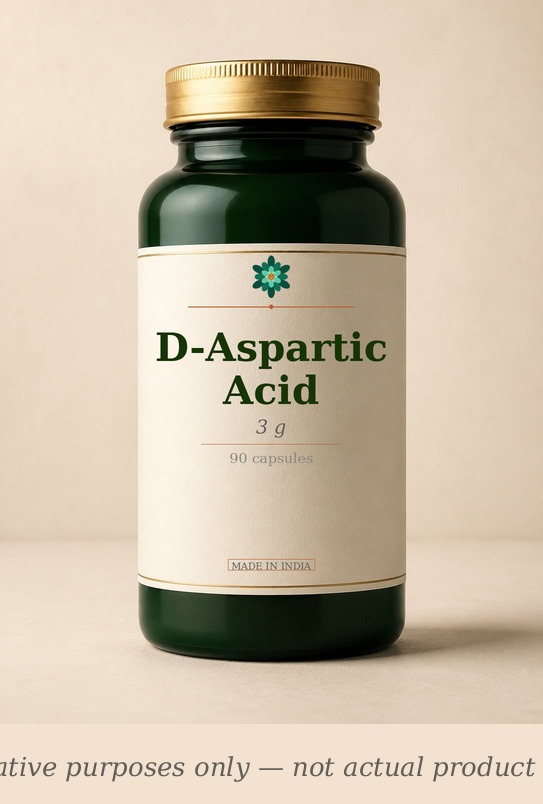
SacredBod's longer take on D-Aspartic Acid — context the structured blocks above don't capture.
D-aspartic acid is a cautionary tale in the supplement industry: a single promising study spawned an entire category of “natural testosterone boosters,” only to be largely dismantled by subsequent research. Understanding where DAA works — and where it does not — is essential for anyone considering it.
The original hype and the replication crisis
The 2009 study by Topo et al. gave 23 men 3.12 g/day of DAA for 12 days. Luteinizing hormone increased by 33% and testosterone by 42% — impressive numbers that fueled massive commercial interest. However, the participants were not resistance-trained athletes, and their baseline testosterone levels were not reported in detail.
The 2013 Willoughby study was designed specifically to test DAA in the population actually buying it: resistance-trained men. Twenty men took 3 g/day DAA or placebo during 28 days of heavy resistance training. Result: no change in total testosterone, free testosterone, LH, body composition, or strength compared with placebo. Training itself produced gains; DAA added nothing.
The 2017 Melville study extended this to 3 months and tested both 3 g and 6 g daily in 22 resistance-trained men. Again, no significant differences in testosterone, strength, or body composition. Notably, the 6 g dose actually showed a slight (non-significant) decrease in free testosterone at week 6, raising the possibility of a negative feedback effect at higher doses.
Who might benefit?
The evidence suggests DAA may produce a short-term LH/testosterone spike in men with:
- Below-normal baseline testosterone
- Sedentary lifestyle with no resistance training background
- Short-term use (under 2-4 weeks)
Even in this population, there is no evidence that the hormonal increase translates to muscle gain, fat loss, or improved sexual function. The effect is biochemical, not necessarily functional.
Cycling and safety
Given the lack of long-term safety data, cycling DAA (2-4 weeks on, 2-4 weeks off) is prudent. The amino acid is generally well tolerated, but some users report irritability, headaches, or sleep disturbance — possibly related to its excitatory neurotransmitter effects in the brain.
Honest comparison
For men seeking testosterone support, tongkat ali (eurycomanone-standardized) has more consistent human evidence. Zinc and vitamin D address common deficiencies that suppress testosterone. Ashwagandha has multiple RCTs showing modest testosterone increases plus stress reduction. DAA ranks below all of these in terms of evidence quality for the typical supplement buyer.