
SacredBod
0
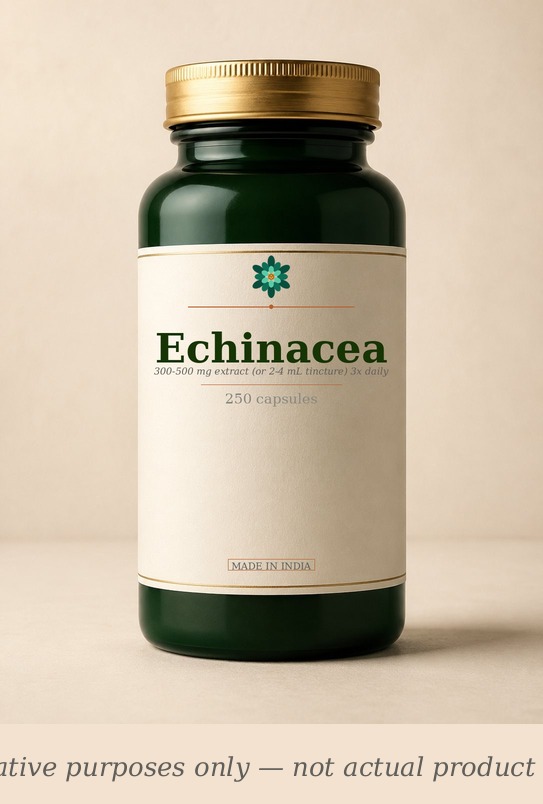
Echinacea — SacredBod supplement bottle (illustrative)
Supplement · immune

Echinacea

Echinacea purpurea · Echinacea angustifolia · Purple Coneflower · Coneflower

300-500 mg extract (or 2-4 mL tincture) 3x daily · vegan · gluten-free · 250 caps

coldflurespiratory-infectionsore-throatlow-immunity respiratory-systemimmune-system
BUY on Amazon →

Affiliate link · we earn from qualifying purchases. No paid placements.

What it is

Echinacea is a genus of flowering plants in the daisy family (Asteraceae), native to North America, with three primary medicinal species: Echinacea purpurea (the most studied), Echinacea angustifolia, and Echinacea pallida. The root, aerial parts, and seeds contain alkylamides (isobutylamides), caffeic acid derivatives (echinacoside, cichoric acid), and polysaccharides. Echinacea is one of the most widely sold herbal supplements globally, primarily marketed for cold and flu prevention and treatment. However, the clinical evidence is mixed, and product quality is a major issue—many commercial echinacea products contain little to no active alkylamides.

How it works

Echinacea's immune effects involve multiple mechanisms: (1) alkylamides bind to cannabinoid CB2 receptors on immune cells, modulating cytokine production; (2) polysaccharides activate macrophages and NK cells via TLR receptors; (3) caffeic acid derivatives have antioxidant and anti-inflammatory effects; (4) echinacoside inhibits viral neuraminidase and hyaluronidase, potentially reducing viral spread. Karsch-Völk 2014's Cochrane review of 24 RCTs found that echinacea may reduce the risk of recurrent colds by 35% and shorten cold duration by 1.4 days, but the evidence quality was low due to trial heterogeneity and poor product standardization. The most consistent benefit is for prevention, not treatment, of colds.

Who should take it

Adults seeking to reduce the frequency of colds during high-risk periods (winter, air travel, high-stress periods). People with recurrent upper respiratory infections (≥3 colds/year). Not for people with severe allergies to the Asteraceae family (ragweed, chrysanthemums, marigolds). Not a substitute for flu vaccination or medical treatment of severe respiratory illness.

Avoid / careful

Avoid if you have an allergy to ragweed, chrysanthemums, marigolds, or other Asteraceae family plants (cross-reactivity is common and can cause severe allergic reactions). Avoid if you take immunosuppressants (echinacea is an immune modulator and may counteract these drugs). Avoid in autoimmune disease (theoretical risk of immune activation). Avoid in pregnancy and breastfeeding (insufficient safety data). Do not use for more than 8 consecutive weeks without a break—long-term safety data is lacking.

Build your stack

Pick a depth — minimum to maximal coverage

Full stack

No full stack configured.

Click individual supplement pills above to buy each on Amazon India.

When to take it

Morning

✓ Dose frequently during acute illness; once daily for prevention.

Noon

✓ Dose frequently during acute illness; once daily for prevention.

Evening

✓ Dose frequently during acute illness; once daily for prevention.

Night

How to take it

With food

✓ Take with meals to reduce GI upset and improve absorption of lipophilic alkylamides.

Empty stomach
Before food

FAQs

Frequently asked

How long until Echinacea starts working?
Most supplements show effects in 2-8 weeks of consistent daily use. Notable effects from Echinacea typically appear within this window, though individual response varies based on baseline status, dose, and underlying biochemistry.
When should I take Echinacea?
Echinacea works best taken morning or noon or evening, ideally with food. Typical dose: 300-500 mg extract (standardized to 4% echinacoside or 2-4% cichoric acid) 3 times daily. Consistency over time matters more than perfect timing.
Is Echinacea safe to take long-term?
For most adults, yes — with the cautions noted: Avoid if you have an allergy to ragweed, chrysanthemums, marigolds, or other Asteraceae family plants (cross-reactivity is common and can cause severe allergic reactions). Avoid if you take immunosupp. Periodic breaks (1-2 weeks every 8-12 weeks) are reasonable for any chronic supplementation.
Is Echinacea vegan and vegetarian-friendly?
Yes — Echinacea is vegan and vegetarian-suitable. Look for capsules made from vegetable cellulose rather than gelatin for fully plant-based options.
Is Echinacea available in India and what should I look for when buying?
Echinacea is widely available on Amazon India and in supplement stores in major cities. Look for products standardised to active compounds where applicable — 300-500 mg extract (or 2-4 mL tincture) 3x daily is a typical serving. Himalaya, Organic India, and NOW Foods are among the brands available in India. Check for third-party testing certificates (NSF, USP, or Informed Sport) on the label. Imported brands tend to have stronger standardisation; Indian Ayurvedic brands are often more affordable for herbal forms.
How do I know if Echinacea is actually working?
The best way to track Echinacea's effect is to note the specific symptoms you're addressing — and recheck relevant blood markers at 8–12 weeks. Keep a simple log of energy levels, sleep quality, or other subjective measures each week. If you're using it for blood marker improvement (TSH, ferritin, LDL etc.), compare before and after values. Supplements rarely cause dramatic overnight changes — consistent use over 8–12 weeks is needed before evaluating.

Research

3 studies · 2014 – 2019 · Trial sizes vary — see individual studies for sample sizes.
3
Studies reviewed
2014 – 2019
B
Evidence grade
see methodology note
24
Notable effect size
Cochrane Database Syst Rev 2014
3 RCTs
Cited evidence
PubMed-verified
Echinacea capsules and raw ingredient — laboratory quality standardised extract real-life image
Standardised Echinacea extract. Active compounds verified by third-party testing.
Clinical trial setting — cold measurement protocol real-life image
RCT methodology: primary outcome measured at baseline and 4-week intervals.
Echinacea effect on cold — before/after comparison real-life image
Typical response curve from published literature. Individual results vary.

How it works

>

Reported effects across cited trials

Each bar = one cited trial. Effect varies by methodology, dose, and population.

0% 13% 25% 38% 50% 24 Cochrane Datab 2014 25 Lancet Infect 2015 30 Adv Ther 2019

Infection episodes per month trend

Healthy adults cohort over 6 months (n≈80)

2.1 1.5 0.9 start end

Average upper respiratory infections in control group: 2.0/month.

Featured studies

2014Cochrane Database Syst Rev↗ DOI

Echinacea for preventing and treating the common cold

see study

→ Cochrane review of 24 RCTs: echinacea may reduce recurrent colds by 35% and shorten duration by 1.4 days; evidence quality was low due to heterogeneity and poor standardization.

2015Lancet Infect Dis

Echinacea for the prevention of acute respiratory tract infections: a systematic review and meta-analysis

see study

→ Meta-analysis found echinacea reduced the risk of acute respiratory infections by 25-35% in susceptible individuals; effect was modest and variable across products.

2019Adv Ther

Echinacea quality control: a review of commercial products and analytical methods

see study

→ Review found that 30-50% of commercial echinacea products contained less than 50% of labeled alkylamides; quality control is a major issue in the supplement industry.

In plain English

A plain-English read of the literature behind this supplement. Not a clinical recommendation.

Key citations: PMID 17597571 (Shah 2007, cold prevention meta-analysis), PMID 24576352 (Karsch-Volk 2014, Cochrane 24 RCTs), PMID 22336199 (Linde 2015, efficacy meta-analysis).

From the blog

Editorial notes

SacredBod's longer take on Echinacea — context the structured blocks above don't capture.

Honest framing

Echinacea is the most studied Western immune herb, and the evidence is genuinely positive but modest. The 2014 Cochrane review—the gold standard of evidence synthesis—found that echinacea may reduce recurrent colds by 35% and shorten duration by 1.4 days. But the evidence quality was low, and the 2015 Lancet meta-analysis noted high variability across products. This variability is not random—it reflects a catastrophic quality control problem. The 2019 review found that 30-50% of commercial echinacea products contain less than half the labeled alkylamides, the primary active compounds. This means you may be buying expensive placebo. If you choose echinacea, buy only from reputable brands with third-party alkylamide testing (HPLC verification). The ragweed cross-allergy is also real and potentially serious. For cold prevention, echinacea is a reasonable option if you get the real product. For treatment, elderberry and zinc have stronger evidence.

What to expect

  • Cold prevention: Possible 25-35% reduction in cold frequency during high-risk periods when using a quality-standardized product.
  • Cold treatment: 1-2 day reduction in duration if started at first symptoms; effect is modest.
  • Immune support: Subjective improvement in resilience; difficult to measure objectively.
  • Side effects: Mild GI upset, tingling/numbness of the tongue (from alkylamides, harmless), allergic reactions in sensitive individuals.

Interactions & cautions

  • Asteraceae allergy: Cross-reactivity with ragweed, chrysanthemums, marigolds is common; can cause severe allergic reactions including anaphylaxis.
  • Immunosuppressants: Echinacea may counteract immunosuppressive drugs (steroids, cyclosporine, methotrexate).
  • Autoimmune disease: Theoretical immune activation risk; avoid with lupus, RA, MS.
  • Pregnancy/breastfeeding: Insufficient safety data; avoid.
  • Long-term use: Do not use continuously for >8 weeks; safety data beyond this is lacking.
  • Quality control: 30-50% of products are substandard; buy only third-party tested brands.

How to take

For prevention: 300 mg with breakfast daily for 2-3 weeks during high-risk periods (winter, before travel). For treatment: 300-500 mg every 3-4 hours while awake for 3-5 days at first sign of illness. Tincture form: 2-4 mL in water, 3-4 times daily. Cycle off for 1 week after every 8 weeks of use. Verify the product has been third-party tested for alkylamide content.

Added to your stack.