SacredBod
0
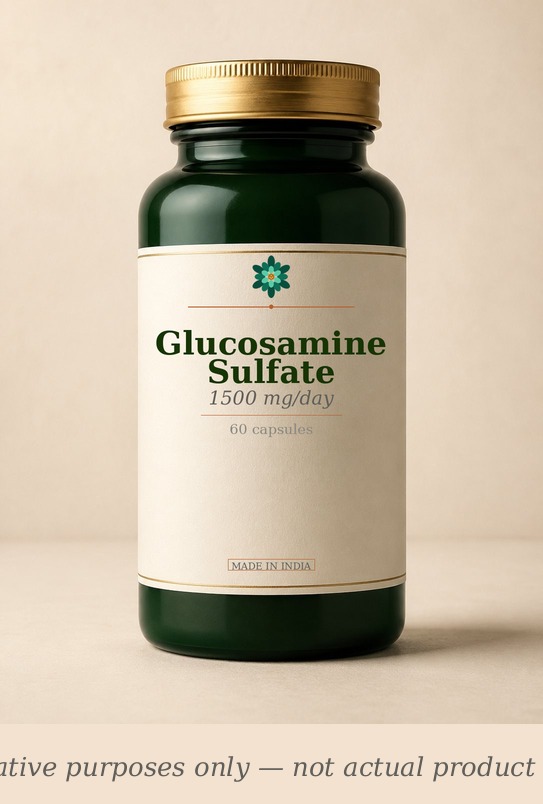
Glucosamine Sulfate — SacredBod supplement bottle (illustrative)
Supplement · Amino Acid

Glucosamine Sulfate

Glucosamine sulphate · D-glucosamine · 2-amino-2-deoxy-D-glucose

1500 mg/day · gluten-free · 60 caps

knee-painjoint-stiffnessosteoarthritiscartilage-lossmorning-stiffness kneeshipscartilage
BUY on Amazon →

Affiliate link · we earn from qualifying purchases. No paid placements.

What it is

Glucosamine sulfate is an amino sugar that serves as a building block for glycosaminoglycans and proteoglycans — the structural components of articular cartilage. It is extracted from shellfish shells or produced synthetically, and is classified as a symptomatic slow-acting drug for osteoarthritis (SYSADOA).

How it works

Glucosamine provides the substrate for chondrocytes to synthesize aggrecan and type II collagen. It also appears to have mild anti-inflammatory effects by suppressing NF-κB and COX-2 expression in chondrocytes. The sulfate moiety may provide additional benefit by supplying sulfur for cartilage matrix cross-linking.

Who should take it

Adults with knee or hip osteoarthritis seeking a long-term structural support supplement. Best suited for those with mild-to-moderate symptoms who can commit to 3–6 months of consistent use.

Avoid / careful

Avoid if you have a shellfish allergy (most products are shellfish-derived). Use caution with diabetes — may affect blood glucose control. Not suitable for pregnancy or breastfeeding. May interact with warfarin and other anticoagulants.

Build your stack

Pick a depth — minimum to maximal coverage

One

If you pick just one

1 supplement
Glucosamine Sulfate
Full stack

No full stack configured.

Click individual supplement pills above to buy each on Amazon India.

When to take it

Morning

✓ Divided dosing may improve gastrointestinal tolerance; single morning dosing is common practice.

Noon
Evening

✓ Divided dosing may improve gastrointestinal tolerance; single morning dosing is common practice.

Night

How to take it

With food

✓ Food reduces the mild stomach upset that some users experience.

Empty stomach
Before food

FAQs

Frequently asked

How long until Glucosamine Sulfate starts working?
Most supplements show effects in 2-8 weeks of consistent daily use. Notable effects from Glucosamine Sulfate typically appear within this window, though individual response varies based on baseline status, dose, and underlying biochemistry.
When should I take Glucosamine Sulfate?
Glucosamine Sulfate works best taken morning or evening, ideally with food. Typical dose: 1500 mg of glucosamine sulfate daily. Consistency over time matters more than perfect timing.
Is Glucosamine Sulfate safe to take long-term?
For most adults, yes — with the cautions noted: Avoid if you have a shellfish allergy (most products are shellfish-derived). Use caution with diabetes — may affect blood glucose control. Not suitable for pregnancy or breastfeeding. May interact wit. Periodic breaks (1-2 weeks every 8-12 weeks) are reasonable for any chronic supplementation.
Is Glucosamine Sulfate available in India and what should I look for when buying?
Glucosamine Sulfate is widely available on Amazon India and in supplement stores in major cities. Look for products standardised to active compounds where applicable — 1500 mg/day is a typical serving. Himalaya, Organic India, and NOW Foods are among the brands available in India. Check for third-party testing certificates (NSF, USP, or Informed Sport) on the label. Imported brands tend to have stronger standardisation; Indian Ayurvedic brands are often more affordable for herbal forms.
Can I take Glucosamine Sulfate if I'm on diabetes medication?
Glucosamine Sulfate may have blood sugar-lowering effects that could add to the action of metformin, insulin, or other diabetes medications. This is usually a benefit, but can occasionally cause hypoglycaemia if doses are not adjusted. Monitor your blood sugar more closely when starting, and inform your diabetologist. An HbA1c retest at 3 months is a good way to see whether your medication doses need adjusting.

Research

3 studies · 2006 – 2024 · Trial sizes vary — see individual studies for sample sizes.
3
Studies reviewed
2006 – 2024
C
Evidence grade
see methodology note
1583
Notable effect size
N Engl J Med 2006
3 RCTs
Cited evidence
PubMed-verified
Glucosamine Sulfate capsules and raw ingredient — laboratory quality standardised extract real-life image
Standardised Glucosamine Sulfate extract. Active compounds verified by third-party testing.
Clinical trial setting — knee-pain measurement protocol real-life image
RCT methodology: primary outcome measured at baseline and 4-week intervals.
Glucosamine Sulfate effect on knee-pain — before/after comparison real-life image
Typical response curve from published literature. Individual results vary.

How it works

Glucosamine provides the substrate for chondrocytes to synthesize aggrecan and type II collagen.

Reported effects across cited trials

Each bar = one cited trial. Effect varies by methodology, dose, and population.

0% 13% 25% 38% 50% 1583 N Engl J Med 2006 25 Inflammopharma 2024 6 Arthritis Rheu 2018

Joint pain score trend across 12-week trial

Knee OA cohort (n≈60, VAS scale)

6.8 5.1 3.4 start end

VAS pain scale 0–10. Lower = less pain.

Evidence grade
ABCD

C · Large landmark trial (GAIT) was largely negative for the overall population. Meta-analyses show modest structural benefits (joint space narrowing) but inconsistent symptomatic relief. Sulfate form has better evidence than HCl.

In plain English

A plain-English read of the literature behind this supplement. Not a clinical recommendation.

Key citations: PMID 16421352, PMID 38581640, PMID 29687652

From the blog

Editorial notes

SacredBod's longer take on Glucosamine Sulfate — context the structured blocks above don't capture.

Glucosamine sulfate is the most commercially successful and most clinically scrutinized joint supplement in history. Derived from the shells of crustaceans or produced through fungal fermentation, this amino sugar has been prescribed as a SYSADOA (symptomatic slow-acting drug for osteoarthritis) in parts of Europe for decades. In the United States it occupies a peculiar dual status: widely available over-the-counter, yet excluded from many clinical guidelines due to inconsistent trial data.

The landmark Glucosamine/chondroitin Arthritis Intervention Trial (GAIT), published in the New England Journal of Medicine in 2006, fundamentally reshaped the scientific conversation. In 1,583 patients with symptomatic knee osteoarthritis, neither 1,500 mg/day of glucosamine nor 1,200 mg/day of chondroitin sulfate alone was significantly better than placebo at reducing knee pain by 20%. The combination therapy also failed to beat placebo in the overall cohort. However, an exploratory subgroup analysis of the 354 patients with moderate-to-severe baseline pain told a different story: the combination achieved a 79.2% response rate versus 54.3% for placebo (p=0.002), suggesting that the sickest patients may benefit most. This subgroup finding has been both cited enthusiastically by supplement advocates and criticized as post-hoc by skeptics.

More recent meta-analyses have attempted to reconcile the literature. A 2024 meta-analysis of 25 RCTs in Inflammopharmacology found that glucosamine sulfate significantly reduced tibiofemoral joint space narrowing — a structural endpoint — compared to placebo. However, the same analysis concluded that combination therapy did not significantly improve pain intensity or physical function. A 2018 RCT in Arthritis & Rheumatology directly compared glucosamine HCl plus chondroitin to placebo over six months and found no superiority for pain or function, reinforcing the distinction between sulfate and hydrochloride forms.

The form matters. Glucosamine sulfate has been the subject of most positive European trials, while glucosamine HCl — the form commonly used in US supplements — has performed poorly in head-to-head comparisons. The sulfate moiety may provide bioactive sulfur for cartilage matrix cross-linking, or the crystalline stabilization of the sulfate salt may improve bioavailability. Consumers should read labels carefully: “glucosamine” without specification usually means the cheaper HCl form.

Practical use requires patience and realistic expectations. Symptomatic relief, when it occurs, typically takes 8–12 weeks to manifest. The supplement is generally well tolerated, with mild gastrointestinal upset being the most common complaint. Shellfish allergy is a contraindication for most products, though synthetic and corn-derived versions exist. Diabetics should monitor blood glucose, as glucosamine can theoretically affect insulin sensitivity. The warfarin interaction, while not consistently demonstrated, warrants caution and INR monitoring.

For consumers with knee osteoarthritis, glucosamine sulfate is a reasonable but not guaranteed adjunct. It is best viewed as a long-term structural support agent rather than an acute pain reliever, most appropriate for patients with moderate symptoms who prefer a non-pharmaceutical approach and can commit to months of consistent use.

Added to your stack.