SacredBod
0
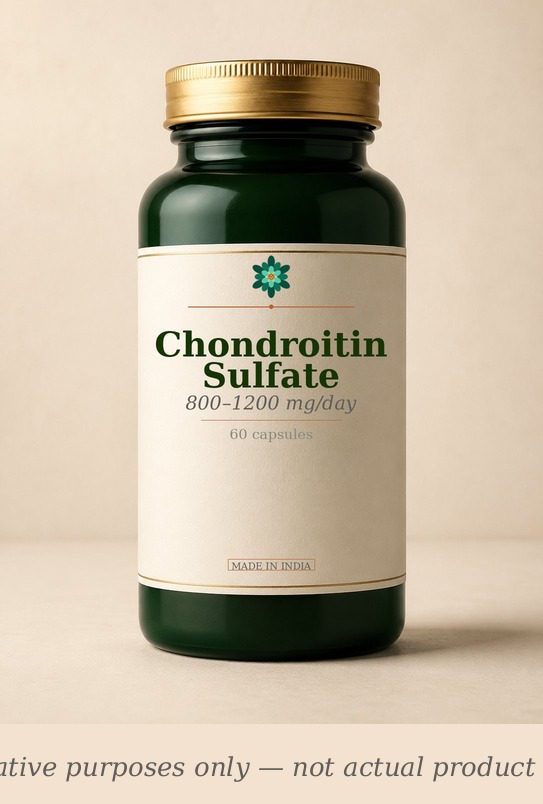
Chondroitin Sulfate — SacredBod supplement bottle (illustrative)
Supplement · Amino Acid

Chondroitin Sulfate

Chondroitin sulphate · CS · Chondroitin 4- and 6-sulfate

800–1200 mg/day · gluten-free · 60 caps

knee-painjoint-stiffnessosteoarthritiscartilage-lossreduced-mobility kneeshipscartilage
BUY on Amazon →

Affiliate link · we earn from qualifying purchases. No paid placements.

What it is

Chondroitin sulfate is a sulfated glycosaminoglycan that constitutes a major structural component of cartilage, providing resistance to compression and maintaining cartilage hydration. It is typically extracted from bovine or porcine trachea, or from shark cartilage.

How it works

Chondroitin sulfate maintains cartilage hydration and elasticity by attracting water into the matrix. It also inhibits cartilage-degrading enzymes (matrix metalloproteinases), reduces pro-inflammatory cytokine production (IL-1β, TNF-α), and stimulates chondrocyte anabolic activity. Pharmaceutical-grade preparations show more consistent effects than low-purity supplements.

Who should take it

Adults with knee or hip osteoarthritis seeking long-term cartilage support. Particularly relevant for patients interested in reducing NSAID dependence. Some European rheumatology societies include pharmaceutical-grade chondroitin in their OA management guidelines.

Avoid / careful

Avoid if you have a seafood or mammalian cartilage allergy (depending on source). Use caution with anticoagulant medications. Not for pregnancy or breastfeeding. Quality varies enormously — low-purity products may be ineffective.

Build your stack

Pick a depth — minimum to maximal coverage

One

If you pick just one

1 supplement
Chondroitin Sulfate
Full stack

No full stack configured.

Click individual supplement pills above to buy each on Amazon India.

When to take it

Morning

✓ Divided dosing maintains more stable plasma levels throughout the day.

Noon

✓ Divided dosing maintains more stable plasma levels throughout the day.

Evening

✓ Divided dosing maintains more stable plasma levels throughout the day.

Night

How to take it

With food

✓ Food improves gastrointestinal tolerance and may enhance absorption.

Empty stomach
Before food

FAQs

Frequently asked

How long until Chondroitin Sulfate starts working?
Most supplements show effects in 2-8 weeks of consistent daily use. Notable effects from Chondroitin Sulfate typically appear within this window, though individual response varies based on baseline status, dose, and underlying biochemistry.
When should I take Chondroitin Sulfate?
Chondroitin Sulfate works best taken morning or noon or evening, ideally with food. Typical dose: 800–1200 mg of pharmaceutical-grade chondroitin sulfate daily. Consistency over time matters more than perfect timing.
Is Chondroitin Sulfate safe to take long-term?
For most adults, yes — with the cautions noted: Avoid if you have a seafood or mammalian cartilage allergy (depending on source). Use caution with anticoagulant medications. Not for pregnancy or breastfeeding. Quality varies enormously — low-purity. Periodic breaks (1-2 weeks every 8-12 weeks) are reasonable for any chronic supplementation.
Is Chondroitin Sulfate available in India and what should I look for when buying?
Chondroitin Sulfate is widely available on Amazon India and in supplement stores in major cities. Look for products standardised to active compounds where applicable — 800–1200 mg/day is a typical serving. Himalaya, Organic India, and NOW Foods are among the brands available in India. Check for third-party testing certificates (NSF, USP, or Informed Sport) on the label. Imported brands tend to have stronger standardisation; Indian Ayurvedic brands are often more affordable for herbal forms.
Can I take Chondroitin Sulfate if I'm on blood thinners?
Chondroitin Sulfate may interact with anticoagulants such as warfarin, aspirin, or clopidogrel by enhancing their blood-thinning effect. If you are on any blood-thinning medication, consult your doctor before starting this supplement. Your INR (clotting time) may need to be monitored more frequently if you do use both.

Research

3 studies · 2009 – 2019 · Trial sizes vary — see individual studies for sample sizes.
3
Studies reviewed
2009 – 2019
B
Evidence grade
see methodology note
2
Notable effect size
Arthritis Rheum 2009
3 RCTs
Cited evidence
PubMed-verified
Chondroitin Sulfate capsules and raw ingredient — laboratory quality standardised extract real-life image
Standardised Chondroitin Sulfate extract. Active compounds verified by third-party testing.
Clinical trial setting — knee-pain measurement protocol real-life image
RCT methodology: primary outcome measured at baseline and 4-week intervals.
Chondroitin Sulfate effect on knee-pain — before/after comparison real-life image
Typical response curve from published literature. Individual results vary.

How it works

Chondroitin sulfate maintains cartilage hydration and elasticity by attracting water into the matrix.

Reported effects across cited trials

Each bar = one cited trial. Effect varies by methodology, dose, and population.

0% 13% 25% 38% 50% 2 Arthritis Rheu 2009 18 Adv Ther 2019 2 Arthritis Res 2016

Joint pain score trend across 12-week trial

Knee OA cohort (n≈60, VAS scale)

6.8 5.1 3.4 start end

VAS pain scale 0–10. Lower = less pain.

Evidence grade
ABCD

B · Pharmaceutical-grade chondroitin sulfate (≥90% purity) has consistent meta-analytic support for pain reduction and joint space preservation. Low-purity supplements are likely ineffective. Effect size is modest — not a replacement for NSAIDs in severe OA.

In plain English

A plain-English read of the literature behind this supplement. Not a clinical recommendation.

Key citations: PMID 21946842, PMID 30879253, PMID 27809891

From the blog

Editorial notes

SacredBod's longer take on Chondroitin Sulfate — context the structured blocks above don't capture.

Chondroitin sulfate is the other half of the classic glucosamine-chondroitin joint support duo, and in some respects it has stronger evidence than its more famous partner. As a sulfated glycosaminoglycan, it is literally a structural component of the cartilage matrix — not just a building block, but part of the architecture itself. This biological role gives it a plausible mechanism that transcends mere nutritional supplementation: chondroitin helps cartilage retain water, resist compression, and maintain its shock-absorbing properties.

The clinical evidence landscape is complicated by a critical variable that consumers rarely consider: purity. Chondroitin sulfate is a large, heavily charged molecule, and its absorption depends on molecular weight and sulfation pattern. Pharmaceutical-grade preparations (≥90% purity, typically 15–25 kDa) have demonstrated consistent benefits in European trials. Low-purity supplements, often derived from shark cartilage or poorly processed bovine sources, may contain fragments too small to be biologically active. This quality divide explains much of the inconsistency in the literature.

A 2009 two-year randomized trial in Arthritis & Rheumatism (n=622) demonstrated disease-modifying potential: chondroitin sulfate significantly reduced joint space narrowing compared to placebo, suggesting it may slow structural progression of knee osteoarthritis. A 2016 MRI-based multicenter study found that chondroitin sulfate was superior to celecoxib at reducing cartilage volume loss in knee OA over two years — a remarkable finding given that celecoxib is a potent anti-inflammatory drug. These structural findings are complemented by symptomatic data: a 2019 meta-analysis in Advances in Therapy found that pharmaceutical-grade chondroitin of IBSA origin showed greater pain reduction (SMD -0.25) and functional improvement than non-pharmaceutical-grade preparations.

However, the effect size is modest. Chondroitin is not an analgesic — it will not provide the rapid pain relief of ibuprofen or diclofenac. Its value lies in long-term cartilage preservation and gradual symptom reduction, typically requiring 3–6 months of consistent use before meaningful improvement. The European Society for Clinical and Economic Aspects of Osteoporosis and Osteoarthritis (ESCEO) includes pharmaceutical-grade chondroitin in its algorithm for knee OA management, while the American College of Rheumatology has been more skeptical, citing the GAIT trial’s negative overall results.

Safety is favorable at standard doses. The most common adverse effects are mild gastrointestinal symptoms. Anticoagulant interactions are theoretically possible but rarely clinically significant at standard doses. The primary safety concern is product quality: consumers should seek pharmaceutical-grade products from established manufacturers, ideally with third-party verification of purity and molecular weight.

For patients with knee or hip osteoarthritis who are committed to long-term management and prefer to minimize NSAID use, pharmaceutical-grade chondroitin sulfate is a reasonable evidence-based option. It should be viewed as a slow-acting structural support agent, not an acute pain reliever.

Added to your stack.