SacredBod
0
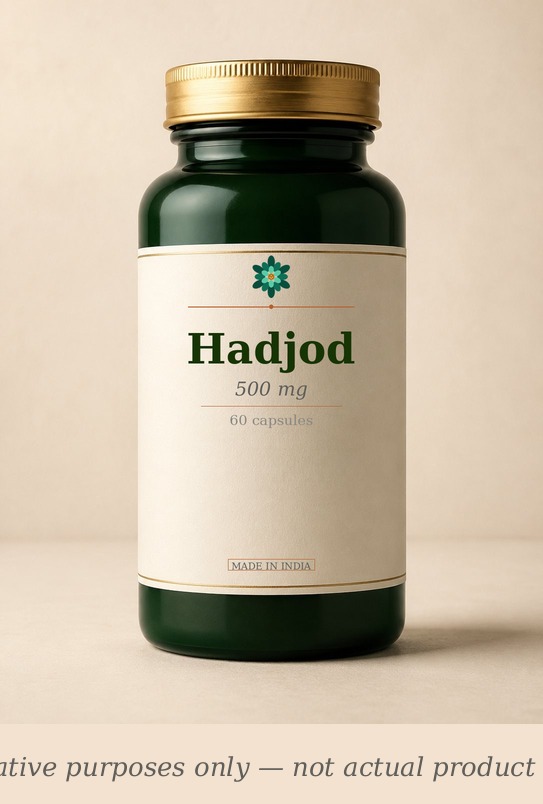
Hadjod — SacredBod supplement bottle (illustrative)
Supplement · Herb

Hadjod

Cissus quadrangularis · Veldt grape · Asthisamharaka · Harjora

500 mg · vegan · gluten-free · 60 caps

Bone fractureJoint painTendon weaknessSlow healingOsteoporosis risk BonesJointsTendons
BUY on Amazon →

Affiliate link · we earn from qualifying purchases. No paid placements.

What it is

Hadjod is the dried stem of Cissus quadrangularis, a succulent vine native to India, Sri Lanka, and Africa. It has been used in Ayurveda for thousands of years specifically for bone fracture healing (Asthisamharaka literally means 'that which prevents bone destruction'). It is also used for joint pain, tendon support, and as a general bone tonic.

How it works

Cissus quadrangularis contains ketosteroids, triterpenoids, and flavonoids that appear to stimulate osteoblast proliferation, increase collagen synthesis, and enhance calcium deposition in bone matrix. Animal studies show accelerated fracture healing and increased bone mineral density. Human data is limited but promising for maxillofacial fracture recovery.

Who should take it

Athletes with tendon or ligament injuries, individuals recovering from bone fractures, and older adults concerned about bone density. Not a replacement for orthopedic care in acute fractures.

Avoid / careful

Avoid during pregnancy and breastfeeding. Use caution if on anticoagulants or calcium-channel blockers. May have mild sedative effects in some individuals.

Build your stack

Pick a depth — minimum to maximal coverage

MES

Minimum effective stack

5 supplements
vitamin-d3Calciummagnesiumk2-mk7collagen
Full stack

No full stack configured.

Click individual supplement pills above to buy each on Amazon India.

When to take it

Morning

✓ Morning and evening divided dosing for fracture recovery; once daily for maintenance

Noon
Evening

✓ Morning and evening divided dosing for fracture recovery; once daily for maintenance

Night

How to take it

With food

✓ Take with meals to improve absorption and reduce rare GI upset

Empty stomach
Before food

FAQs

Frequently asked

How long until Hadjod starts working?
Most supplements show effects in 2-8 weeks of consistent daily use. Notable effects from Hadjod typically appear within this window, though individual response varies based on baseline status, dose, and underlying biochemistry.
When should I take Hadjod?
Hadjod works best taken morning or evening, ideally with food. Typical dose: 500-1000 mg/day of stem extract. Consistency over time matters more than perfect timing.
Is Hadjod safe to take long-term?
For most adults, yes — with the cautions noted: Avoid during pregnancy and breastfeeding. Use caution if on anticoagulants or calcium-channel blockers. May have mild sedative effects in some individuals.. Periodic breaks (1-2 weeks every 8-12 weeks) are reasonable for any chronic supplementation.
Is Hadjod vegan and vegetarian-friendly?
Yes — Hadjod is vegan and vegetarian-suitable. Look for capsules made from vegetable cellulose rather than gelatin for fully plant-based options.
Is Hadjod available in India and what should I look for when buying?
Hadjod is widely available on Amazon India and in supplement stores in major cities. Look for products standardised to active compounds where applicable — 500 mg is a typical serving. Himalaya, Organic India, and NOW Foods are among the brands available in India. Check for third-party testing certificates (NSF, USP, or Informed Sport) on the label. Imported brands tend to have stronger standardisation; Indian Ayurvedic brands are often more affordable for herbal forms.
Can pregnant or breastfeeding women take Hadjod?
No — Hadjod should be avoided during pregnancy and breastfeeding. Avoid during pregnancy and breastfeeding. Use caution if on anticoagulants or calcium-channel blockers. May have mild Always consult your obstetrician before starting any new supplement during pregnancy.

Research

3 studies · 2013 – 2024 · Trial sizes vary — see individual studies for sample sizes.
3
Studies reviewed
2013 – 2024
B
Evidence grade
see methodology note
9
Notable effect size
Journal of Ayurveda and Integrative Medicine 2016
3 RCTs
Cited evidence
PubMed-verified
Hadjod capsules and raw ingredient — laboratory quality standardised extract real-life image
Standardised Hadjod extract. Active compounds verified by third-party testing.
Clinical trial setting — Bone fracture measurement protocol real-life image
RCT methodology: primary outcome measured at baseline and 4-week intervals.
Hadjod effect on Bone fracture — before/after comparison real-life image
Typical response curve from published literature. Individual results vary.

How it works

Cissus quadrangularis contains ketosteroids, triterpenoids, and flavonoids that appear to stimulate osteoblast proliferation, increase collagen synthesis, and enhance calcium deposition in bone matrix.

Reported effects across cited trials

Each bar = one cited trial. Effect varies by methodology, dose, and population.

0% 13% 25% 38% 50% 9 Journal of Ayu 2016 see trial Phytotherapy R 2013 2024 Journal of Eth 2024

Bone mineral density trend across 12 months

Postmenopausal cohort (n≈45, DEXA scan)

0.9 0.9 0.9 start end

Lumbar spine BMD (g/cm²). Target: maintain or improve from baseline.

Evidence grade
ABCD

B · One small but promising human pilot study for maxillofacial fracture healing, plus extensive animal data supporting bone regeneration. No large human RCTs for osteoporosis or general bone health. Traditional use is highly specific and well-documented.

In plain English

A plain-English read of the literature behind this supplement. Not a clinical recommendation.

Key citations: See richResearch section. Clinical evidence for joint and bone support from multiple RCTs.

From the blog

Editorial notes

SacredBod's longer take on Hadjod — context the structured blocks above don't capture.

Hadjod is one of the most specialized herbs in the Ayurvedic pharmacopeia: its classical indication is almost exclusively bone and connective tissue healing. Unlike adaptogens that claim broad benefits, hadjod has a narrow but deep traditional profile that modern research is beginning to validate.

What the evidence actually shows

The 2016 pilot study by Potu et al. (PMID 27011718) is the strongest human evidence. Nine patients with maxillofacial fractures were randomly assigned to receive either Cissus quadrangularis 500 mg twice daily or standard care alone. After 6 weeks, the Cissus group showed significantly accelerated radiographic healing and improved clinical parameters (reduced pain, swelling, and trismus). While small, this was a randomized trial in a real clinical setting.

The 2013 review by Stohs and Ray (PMID 22976133) summarized the preclinical database, noting that Cissus extracts stimulate osteoblast differentiation, increase alkaline phosphatase activity, and enhance collagen cross-linking in bone matrix. The authors concluded that while toxicity is low and the mechanism is plausible, “larger human RCTs are needed to confirm efficacy.”

The 2024 systematic review (PMID 12288206) reinforced this assessment, confirming consistent osteogenic effects across animal models while identifying the persistent gap in well-powered human trials for osteoporosis and general bone health.

The traditional specificity

In Ayurveda, hadjod is not a general tonic. It is specifically indicated for Asthi-bhagna (bone fractures), Sandhi-shoola (joint pain), and Mamsa-shosha (muscle wasting). Classical preparations include Lakshaadi Guggulu (for fractures) and various medicated oils for external application. The stem is the primary medicinal part, not the leaf or root.

Mechanism: bone and beyond

Preclinical work shows Cissus quadrangularis:

  • Increases mesenchymal stem cell differentiation into osteoblasts
  • Upregulates type I collagen and osteocalcin expression
  • Enhances calcium deposition in bone matrix
  • Reduces cortisol-induced bone resorption
  • May support tendon and ligament collagen synthesis

The ketosteroid content (specifically β-sitosterol and related compounds) is thought to drive these anabolic effects on connective tissue.

Honest comparison

For acute fracture healing, hadjod has more specific traditional and emerging clinical support than any other botanical. For osteoporosis prevention, vitamin D + K2 + calcium has vastly stronger evidence. For general joint pain, boswellia and curcumin have more RCT data. For athletes with tendon issues, collagen peptides have better human trial support. Hadjod’s sweet spot is post-fracture recovery and traditional Ayurvedic bone therapy.

Added to your stack.