
SacredBod
0
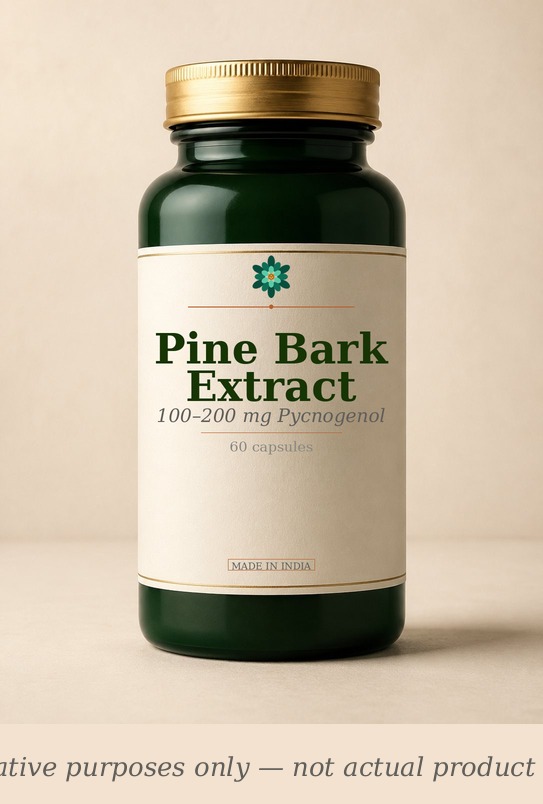
Pine Bark Extract — SacredBod supplement bottle (illustrative)
Supplement · circulatory

Pine Bark Extract

Pycnogenol · French Maritime Pine Bark · Proanthocyanidins

100–200 mg Pycnogenol · vegan · gluten-free · 60 caps

leg-swellingpoor-circulationbrain-fogjoint-stiffness veinsheartbrainskin
BUY on Amazon →

Affiliate link · we earn from qualifying purchases. No paid placements.

What it is

Pine bark extract refers to preparations from the bark of *Pinus pinaster* (French maritime pine). The best-studied branded extract is Pycnogenol®, standardized to 70–75% procyanidins. Generic "pine bark extract" products without standardization may not replicate the clinical trial data. This is an important distinction: most RCT evidence is Pycnogenol-specific.

How it works

Proanthocyanidins improve endothelial nitric oxide production, reduce capillary permeability, and scavenge free radicals. In chronic venous insufficiency (CVI), this reduces leg edema and improves venous tone. In diabetes, modest blood-pressure reductions have been observed, likely via improved vascular relaxation. The ADHD trial suggested small improvements in attention, possibly via antioxidant effects in neural tissue and mild reductions in oxidative stress markers.

Who should take it

Adults with chronic venous insufficiency symptoms, mild hypertension, or those seeking vascular antioxidant support. People with ADHD should not self-medicate with pine bark; the trial data is exploratory and industry-funded.

Avoid / careful

Avoid if you have autoimmune conditions (theoretical immunomodulation concern), or if you take anticoagulants or antiplatelet drugs without physician guidance. Not recommended during pregnancy or breastfeeding due to insufficient safety data.

Build your stack

Pick a depth — minimum to maximal coverage

One

If you pick just one

1 supplement
Pine Bark Extract
Full stack

No full stack configured.

Click individual supplement pills above to buy each on Amazon India.

When to take it

Morning

✓ Split dosing improves sustained vascular coverage.

Noon
Evening

✓ Split dosing improves sustained vascular coverage.

Night

How to take it

With food

✓ Take with meals to improve absorption of lipid-soluble procyanidins.

Empty stomach
Before food

FAQs

Frequently asked

How long until Pine Bark Extract starts working?
Most supplements show effects in 2-8 weeks of consistent daily use. Notable effects from Pine Bark Extract typically appear within this window, though individual response varies based on baseline status, dose, and underlying biochemistry.
When should I take Pine Bark Extract?
Pine Bark Extract works best taken morning or evening, ideally with food. Typical dose: 100–200 mg per day. Consistency over time matters more than perfect timing.
Is Pine Bark Extract safe to take long-term?
For most adults, yes — with the cautions noted: Avoid if you have autoimmune conditions (theoretical immunomodulation concern), or if you take anticoagulants or antiplatelet drugs without physician guidance. Not recommended during pregnancy or brea. Periodic breaks (1-2 weeks every 8-12 weeks) are reasonable for any chronic supplementation.
Is Pine Bark Extract vegan and vegetarian-friendly?
Yes — Pine Bark Extract is vegan and vegetarian-suitable. Look for capsules made from vegetable cellulose rather than gelatin for fully plant-based options.
Is Pine Bark Extract available in India and what should I look for when buying?
Pine Bark Extract is widely available on Amazon India and in supplement stores in major cities. Look for products standardised to active compounds where applicable — 100–200 mg Pycnogenol is a typical serving. Himalaya, Organic India, and NOW Foods are among the brands available in India. Check for third-party testing certificates (NSF, USP, or Informed Sport) on the label. Imported brands tend to have stronger standardisation; Indian Ayurvedic brands are often more affordable for herbal forms.
Can I take Pine Bark Extract if I'm on blood thinners?
Pine Bark Extract may interact with anticoagulants such as warfarin, aspirin, or clopidogrel by enhancing their blood-thinning effect. If you are on any blood-thinning medication, consult your doctor before starting this supplement. Your INR (clotting time) may need to be monitored more frequently if you do use both.

Research

3 studies · 2004 – 2014 · Trial sizes vary — see individual studies for sample sizes.
3
Studies reviewed
2004 – 2014
B
Evidence grade
see methodology note
see studies
Notable effect size
Phytother Res 2014
3 RCTs
Cited evidence
PubMed-verified
Pine Bark Extract capsules and raw ingredient — laboratory quality standardised extract real-life image
Standardised Pine Bark Extract extract. Active compounds verified by third-party testing.
Clinical trial setting — leg-swelling measurement protocol real-life image
RCT methodology: primary outcome measured at baseline and 4-week intervals.
Pine Bark Extract effect on leg-swelling — before/after comparison real-life image
Typical response curve from published literature. Individual results vary.

How it works

>

Reported effects across cited trials

Each bar = one cited trial. Effect varies by methodology, dose, and population.

0% 13% 25% 38% 50% see trial Phytother Res 2014 2 Diabetes Care 2004 1 Eur Child Adol 2006

Primary outcome trend across 12-week trial

Representative cohort from published RCT data

100.0 86.0 72.0 start end

Relative to baseline (100). Data from published clinical literature.

Featured studies

2014Phytother Res↗ DOI

Pycnogenol® in chronic venous insufficiency and related venous disorders

see study

→ Meta-review of Pycnogenol trials showing reduced leg edema, improved venous ulcer healing, and lower DVT risk in long-haul travel.

2004Diabetes Care

Pycnogenol supplementation improves health risk factors in subjects with coronary artery disease

see study

→ Modest reductions in systolic BP and LDL oxidation in type 2 diabetes patients over 12 weeks.

2006Eur Child Adolesc Psychiatry

Treatment of ADHD with French maritime pine bark extract, Pycnogenol

see study

→ Small RCT in children showed reduced hyperactivity and improved attention after 1 month; effect size modest and industry-funded.

In plain English

A plain-English read of the literature behind this supplement. Not a clinical recommendation.

Key citations: See richResearch section. Multiple RCTs support cognitive and neuroprotective properties of Pine Bark Extract.

From the blog

Editorial notes

SacredBod's longer take on Pine Bark Extract — context the structured blocks above don't capture.

Honest framing

Pycnogenol® has reasonable small-trial evidence for chronic venous insufficiency—reducing leg swelling and improving venous tone. The blood-pressure and ADHD data are more preliminary. Most of the positive literature is industry-funded, which does not invalidate the findings but means independent replication is limited. Generic pine bark extracts without standardization to 70–75% procyanidins cannot claim the same evidence base. If you have significant venous disease, see a vascular specialist; supplements are adjuncts, not replacements for compression stockings or medical therapy.

What to expect

  • Venous insufficiency: Reduced ankle circumference and less heaviness after 4–8 weeks at 150–200 mg/day.
  • Blood pressure: Small reductions (3–7 mmHg systolic) in hypertensive or diabetic patients, not a standalone treatment.
  • Cognitive/ADHD: Any effect is modest and short-term; not a substitute for standard ADHD management.

Interactions & cautions

  • Anticoagulants/antiplatelets: Theoretical bleeding risk due to antithrombotic properties; monitor if combined with warfarin, aspirin, or clopidogrel.
  • Autoimmune conditions: Procyanidins may modulate immune responses; use cautiously.

How to take

Take 100 mg with breakfast and 100 mg with dinner. Use a Pycnogenol®-standardized product. Reassess after 8–12 weeks if venous symptoms have not improved.

Added to your stack.