SacredBod's longer take on Vasaka — context the structured blocks above don't capture.
Vasaka is the respiratory cornerstone of Ayurvedic medicine — a herb so central to cough and asthma management that it appears in virtually every classical text on the subject. Its traditional use is not merely folkloric; it is supported by a well-defined pharmacological mechanism involving vasicine, a quinazoline alkaloid with genuine bronchodilatory activity.
What the evidence actually shows
The 2011 clinical review (PMID 3202261) published in AYU evaluated multiple traditional formulations of Vasa (Adhatoda vasica) in the treatment of Tamaka Shwasa (asthma). The review compared Vasa Swarasa (fresh juice), Vasa Kwatha (decoction), Vasa Ghana (solid extract), Vasa Ghrita (medicated ghee), Vasarishta (fermented preparation), Vasavaleha (herbal jam), and Vasa Vati (tablet). The findings: Vasa Swarasa and Kwatha — the forms richest in vasicine and vasicinone — showed the most consistent clinical improvement across symptoms including Shwasa Kashtata (difficulty breathing), Kasa (cough), and Kanthodhvansa (throat irritation). Vasa Avaleha also performed well, likely because the honey and ghee base soothes inflamed mucosa while delivering the active alkaloids.
The 2022 systematic ethnobotanical review (PMID 35809281) confirmed bronchodilator, expectorant, and antitussive uses across multiple traditional medicine systems while explicitly noting the need for modern RCTs to validate these indications with contemporary methodology.
The 2008 analytical study by Avula et al. (PMID 18271297) developed and validated a method for quantifying vasicine and vasicinone in Adhatoda vasica extracts. This is critical for standardization — without knowing the alkaloid content, supplement quality is guesswork. The study confirmed that these two alkaloids are indeed the principal bioactive markers and can be reliably measured.
The vasicine mechanism
Vasicine is a quinazoline alkaloid that acts as a mild bronchodilator by relaxing smooth muscle in the bronchial tubes. In animal models, it increases the ciliary beat frequency in respiratory epithelium, enhancing mucus clearance. Vasicinone, its oxidation product, potentiates this effect while also reducing the viscosity of bronchial secretions. Together, they improve both airflow (bronchodilation) and mucus clearance (mucolytic + expectorant) — a dual action that explains vasaka’s traditional effectiveness.
Ayurveda does not use vasaka as a standalone powder in most cases. The classical preparations include:
- Vasarishta: Fermented decoction for chronic cough and weakness
- Vasavaleha: Herbal jam with honey and ghee for soothing dry cough
- Vasa Ghrita: Medicated ghee for deep tissue nourishment in chronic respiratory disease
- Sitopaladi churna: Combination powder with pippali, cardamom, and cinnamon for acute cough
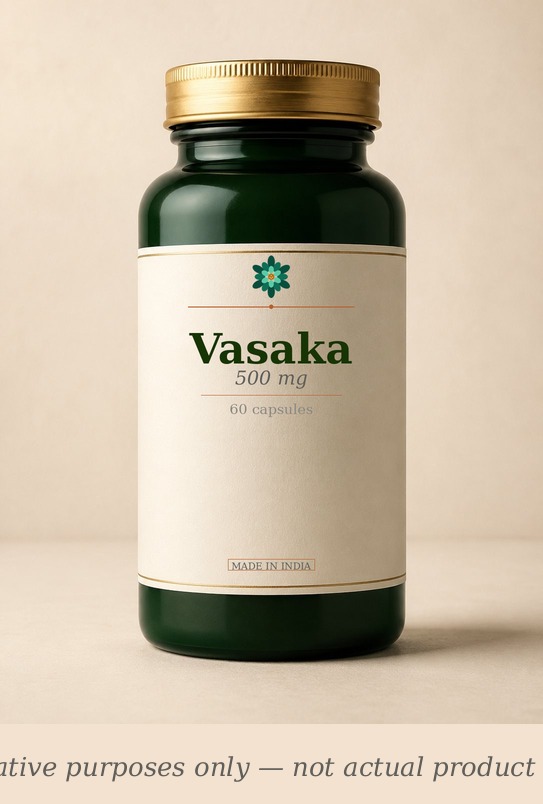
Modern capsules containing 500 mg of leaf extract are a convenience product, but they may not replicate the traditional synergy of combined formulations.
Honest comparison
For acute bronchitis and productive cough, mulethi (licorice root) has more modern clinical trial support. For asthma, prescription bronchodilators (salbutamol, formoterol) are vastly more reliable. For general respiratory immune support, tulsi has broader evidence. Vasaka’s value is in its specific bronchodilatory-expectorant mechanism and its deep integration into Ayurvedic respiratory practice — it is a specialist herb for congestion and airflow limitation, not a general immune tonic.