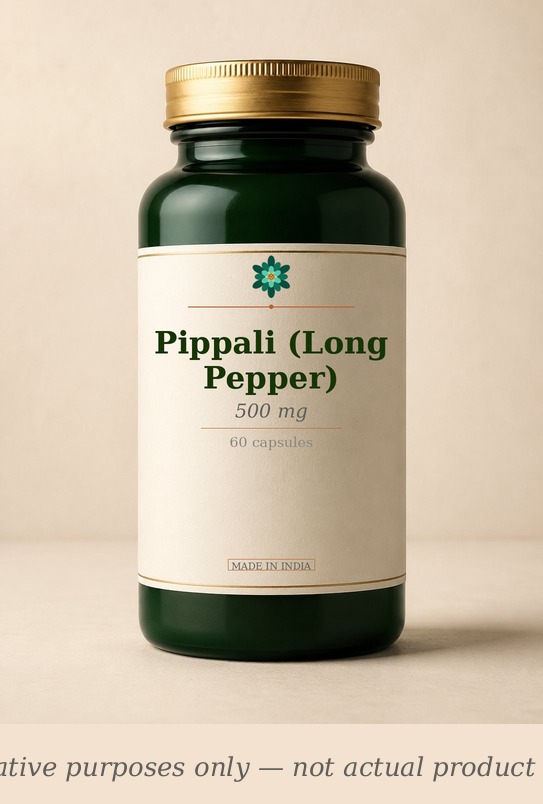
SacredBod's longer take on Pippali (Long Pepper) — context the structured blocks above don't capture.
Pippali is the less-famous sibling of black pepper, yet in Ayurvedic medicine it holds higher therapeutic status. Where black pepper is primarily a kitchen spice, pippali is a dedicated medicine — used for respiratory conditions, digestive disorders, and as a bioavailability enhancer in complex formulations.
The bioenhancement effect
The 2018 review by Kesarwani et al. (PMID 28827948) documented that piperine — the primary alkaloid in both black pepper and pippali — is the most clinically validated natural bioavailability enhancer. Human pharmacokinetic studies show it increases curcumin absorption by approximately 2000%, resveratrol by 229%, and berberine by approximately 100%. It does this by inhibiting intestinal and hepatic glucuronidation, blocking P-glycoprotein efflux pumps, and increasing intestinal permeability.
This is not a theoretical benefit — it is a measurable, reproducible pharmacokinetic effect that has been leveraged in pharmaceutical formulations (e.g., Bioperine®) and traditional Ayurvedic prescriptions for centuries. When taking poorly absorbed supplements like curcumin or resveratrol, adding pippali or piperine is one of the most evidence-based ways to increase their efficacy.
Respiratory and anti-inflammatory potential
The 2019 study (PMID 6777695) demonstrated that piperlongumine — a compound more abundant in pippali than in black pepper — significantly reduced airway inflammation, mucus hypersecretion, and NF-κB activation in an ovalbumin-induced asthma mouse model. This supports the traditional Ayurvedic use of pippali for Shwasa (asthma) and Kasa (cough).
The 2018 network pharmacology analysis (PMID 5761900) mapped pippali’s phytochemical landscape, identifying piperlongumine, piperine, and related amides as key nodes interacting with inflammatory, respiratory, and neuroprotective pathways. While network pharmacology is computational rather than clinical, it provides a mechanistic rationale for traditional indications.
Traditional use in Trikatu
Pippali is rarely used alone in Ayurveda. Its most famous combination is Trikatu — equal parts pippali, black pepper (maricha), and ginger (shunti). This trio is considered the ultimate digestive and metabolic stimulant, used to enhance absorption of other medicines (anupana), clear congestion (shleshma-hara), and increase digestive fire (agni-deepana). Modern supplement formulations often replicate this combination.
Safety and cycling
Pippali is heating (Ushna virya) and can irritate the gastric mucosa at high doses or with continuous use. Traditional practice recommends cycling — for example, 4 weeks on followed by 1 week off — to prevent tolerance and irritation. The bioenhancement effect on drug metabolism means anyone on prescription medications (especially those metabolized by CYP3A4) should consult their physician before using pippali supplements.
Honest comparison
For bioavailability enhancement, pippali/piperine is the gold standard among natural agents — superior to liposomal delivery for some compounds. For respiratory support, vasaka (Adhatoda vasica) has more specific bronchodilatory traditional evidence. For digestion, ginger has stronger human clinical trial data. Pippali’s unique value is as a bioenhancer that simultaneously provides traditional respiratory and digestive benefits.