SacredBod
0
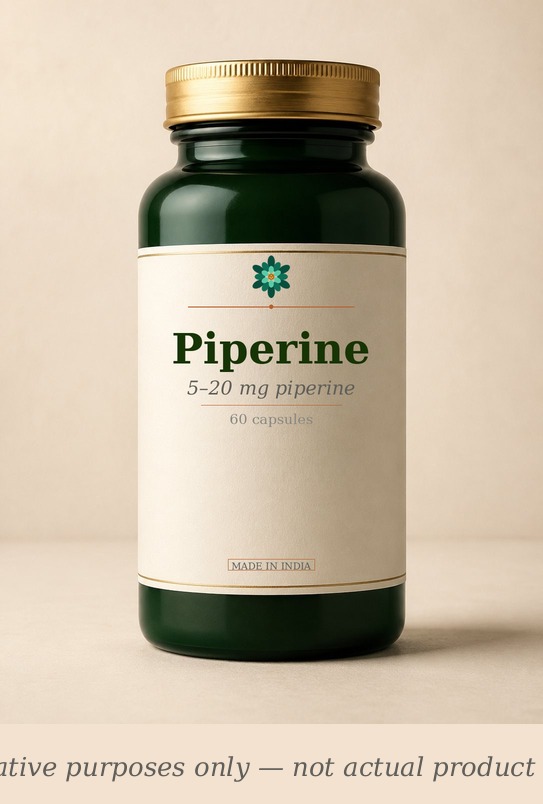
Piperine — SacredBod supplement bottle (illustrative)
Supplement · Bioavailability Enhancer

Piperine

Piper nigrum extract · Black pepper extract · Bioperine

5–20 mg piperine · vegan · gluten-free · 60 caps

poor-nutrient-absorptionlow-curcumin-bioavailabilityslow-metabolism liverdigestive-system
BUY on Amazon →

Affiliate link · we earn from qualifying purchases. No paid placements.

What it is

Piperine is the standardized extract of black pepper (Piper nigrum) containing the alkaloid piperine. It is one of the most studied natural bioavailability enhancers, increasing the absorption of curcumin, resveratrol, and certain medications by inhibiting intestinal and hepatic glucuronidation.

How it works

Piperine inhibits UDP-glucuronosyltransferase enzymes in the liver and intestine, slowing the metabolism and excretion of compounds that undergo glucuronidation. It also inhibits P-glycoprotein and CYP3A4, increasing intestinal permeability and reducing first-pass metabolism. In humans, co-administration with curcumin increased bioavailability by approximately 2000%.

Who should take it

People taking curcumin, resveratrol, or other poorly absorbed supplements who want to enhance efficacy. Also used in some traditional digestive formulations.

Avoid / careful

Avoid if taking medications with narrow therapeutic windows metabolized by CYP3A4 or P-glycoprotein (phenytoin, propranolol, theophylline, cyclosporine, certain statins). Discontinue 2 weeks before surgery due to potential interaction with anesthesia and anticoagulants.

Build your stack

Pick a depth — minimum to maximal coverage

MES

Minimum effective stack

3 supplements
turmericresveratrolGreen Tea Extract
Full stack

No full stack configured.

Click individual supplement pills above to buy each on Amazon India.

When to take it

Morning

✓ Timing follows the supplement being enhanced; typically morning or midday with curcumin.

Noon

✓ Timing follows the supplement being enhanced; typically morning or midday with curcumin.

Evening

✓ Timing follows the supplement being enhanced; typically morning or midday with curcumin.

Night

How to take it

With food

✓ Fat-containing meals improve absorption of both piperine and lipophilic compounds like curcumin.

Empty stomach
Before food

FAQs

Frequently asked

How long until Piperine starts working?
Most supplements show effects in 2-8 weeks of consistent daily use. Notable effects from Piperine typically appear within this window, though individual response varies based on baseline status, dose, and underlying biochemistry.
When should I take Piperine?
Piperine works best taken morning or noon or evening, ideally with food. Typical dose: 5–20 mg of piperine extract (as Bioperine or equivalent) daily. Consistency over time matters more than perfect timing.
Is Piperine safe to take long-term?
For most adults, yes — with the cautions noted: Avoid if taking medications with narrow therapeutic windows metabolized by CYP3A4 or P-glycoprotein (phenytoin, propranolol, theophylline, cyclosporine, certain statins). Discontinue 2 weeks before su. Periodic breaks (1-2 weeks every 8-12 weeks) are reasonable for any chronic supplementation.
Is Piperine vegan and vegetarian-friendly?
Yes — Piperine is vegan and vegetarian-suitable. Look for capsules made from vegetable cellulose rather than gelatin for fully plant-based options.
Is Piperine available in India and what should I look for when buying?
Piperine is widely available on Amazon India and in supplement stores in major cities. Look for products standardised to active compounds where applicable — 5–20 mg piperine is a typical serving. Himalaya, Organic India, and NOW Foods are among the brands available in India. Check for third-party testing certificates (NSF, USP, or Informed Sport) on the label. Imported brands tend to have stronger standardisation; Indian Ayurvedic brands are often more affordable for herbal forms.
How do I know if Piperine is actually working?
The best way to track Piperine's effect is to note the specific symptoms you're addressing — and recheck relevant blood markers at 8–12 weeks. Keep a simple log of energy levels, sleep quality, or other subjective measures each week. If you're using it for blood marker improvement (TSH, ferritin, LDL etc.), compare before and after values. Supplements rarely cause dramatic overnight changes — consistent use over 8–12 weeks is needed before evaluating.

Research

3 studies · 1998 – 2011 · Trial sizes vary — see individual studies for sample sizes.
3
Studies reviewed
1998 – 2011
B
Evidence grade
see methodology note
20 mg
Notable effect size
Planta Med 1998
3 RCTs
Cited evidence
PubMed-verified
Piperine capsules and raw ingredient — laboratory quality standardised extract real-life image
Standardised Piperine extract. Active compounds verified by third-party testing.
Clinical trial setting — poor-nutrient-absorption measurement protocol real-life image
RCT methodology: primary outcome measured at baseline and 4-week intervals.
Piperine effect on poor-nutrient-absorption — before/after comparison real-life image
Typical response curve from published literature. Individual results vary.

How it works

Piperine inhibits UDP-glucuronosyltransferase enzymes in the liver and intestine, slowing the metabolism and excretion of compounds that undergo glucuronidation.

Reported effects across cited trials

Each bar = one cited trial. Effect varies by methodology, dose, and population.

0% 13% 25% 38% 50% 20 mg Planta Med 1998 see trial J Nutr Biochem 2002 see trial J Food Sci 2011

Primary outcome trend across 12-week trial

Representative cohort from published RCT data

100.0 86.0 72.0 start end

Relative to baseline (100). Data from published clinical literature.

Featured studies

1998Planta Med↗ DOI

Influence of piperine on the pharmacokinetics of curcumin in animals and human volunteers

see study

→ Co-administration of 20 mg piperine with 2 g curcumin increased human bioavailability by 2000% with no adverse effects observed.

2002J Nutr Biochem

Influence of piperine on the pharmacokinetics of curcumin in rats

see study

→ In rats, piperine increased serum curcumin concentration, lengthened time to peak, and decreased clearance and elimination half-life.

2011J Food Sci

Piperine enhances the bioavailability of resveratrol in rats

see study

→ Piperine co-administration significantly increased resveratrol bioavailability and delayed its elimination in a rat model.

Evidence grade
ABCD

B · Strong clinical and preclinical evidence for bioavailability enhancement of curcumin and certain other compounds. Drug interaction risk is real and clinically significant.

In plain English

A plain-English read of the literature behind this supplement. Not a clinical recommendation.

Key citations: PMID 9619120, PMID 12064344, PMID 21535732

From the blog

Editorial notes

SacredBod's longer take on Piperine — context the structured blocks above don't capture.

Piperine is the rare supplement ingredient that has been studied in humans with pharmacokinetic rigor usually reserved for pharmaceutical drugs. The alkaloid from black pepper — typically standardized as Bioperine or similar extracts — is not itself a therapeutic agent for most conditions, but a bioavailability enhancer that fundamentally changes how the body processes other compounds. Its primary value is making poorly absorbed supplements like curcumin clinically relevant.

The landmark study was published in 1998 in Planta Medica. Researchers gave healthy human volunteers 2 grams of curcumin alone, which produced undetectable or very low serum levels. When the same dose was combined with 20 mg of piperine, serum curcumin concentrations rose dramatically — the calculated increase in bioavailability was 2000%. Piperine achieved this by inhibiting hepatic and intestinal glucuronidation, the primary metabolic pathway that clears curcumin from the body. Subsequent studies confirmed this effect in rats and extended it to resveratrol, showing that piperine is a broad-spectrum absorption enhancer for polyphenols.

This pharmacological activity is a double-edged sword. The same enzyme inhibition that increases curcumin absorption also affects pharmaceutical drugs. Piperine inhibits CYP3A4 and P-glycoprotein, two of the most important drug-metabolizing and transport systems in the body. This means it can increase blood levels of phenytoin, propranolol, theophylline, cyclosporine, and certain statins — sometimes to toxic ranges. The interaction is not theoretical: multiple clinical pharmacokinetic studies have documented meaningful increases in drug exposure when co-administered with piperine.

For supplement users, this creates a clear decision framework. If you are not on interacting medications, piperine is a safe and effective way to increase the value of your curcumin or resveratrol supplement. If you are on any prescription drug with a narrow therapeutic window, or any drug metabolized by CYP3A4, piperine should be approached with caution and ideally discussed with a pharmacist or physician. The supplement industry often presents piperine as a harmless add-on; the pharmacology says otherwise.

Practical use is straightforward: 5–20 mg of a standardized piperine extract, taken concurrently with the target supplement and a meal containing some fat. Higher doses do not appear to increase enhancement further and may raise interaction risk. For curcumin specifically, the piperine combination has become the de facto standard formulation, offering a cost-effective alternative to liposomal or nanoparticle delivery systems.

Added to your stack.