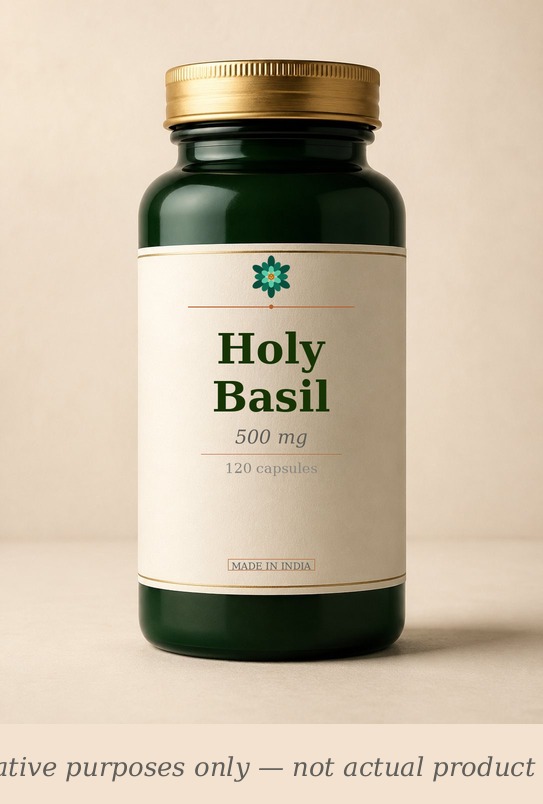
Holy basil (tulsi) occupies a unique position in the supplement space: it's simultaneously one of the most culturally significant plants in the world and one of the more modestly evidenced adaptogens in clinical literature. The gap between reverence and evidence needs to be stated clearly.
The Agrawal 1996 trial is the glucose keystone: 40 type 2 diabetics took 2.5 g holy basil leaf powder daily for 4 weeks. Fasting glucose dropped 17.6%, postprandial glucose 7.3%, and total cholesterol fell significantly. The Somasundaram 2012 trial (n=30, 8 weeks) replicated the glucose and lipid improvements with an extract. These are real but modest effects — not a replacement for metformin, but a reasonable adjunct.
The Bhattacharyya 2008 trial is the stress keystone: 35 adults with generalized anxiety disorders took 500 mg holy basil extract BID for 60 days. Stress scores dropped significantly, and attention/memory improved. The trial was small and not placebo-controlled (it was compared to a control group receiving standard care), so the evidence quality is lower than ashwagandha's RCTs. But the effect direction is consistent with traditional use.
The cultural context matters. Tulsi is not just another supplement ingredient in India — it's a sacred plant worshipped in homes and temples, consumed daily as tea by millions. This doesn't make it more clinically effective, but it does mean the safety record is extraordinary. Generations of continuous use provide a level of real-world safety validation that short clinical trials cannot match.
Practical guidance: 500–1500 mg/day of a standardized leaf extract (look for ursolic acid or eugenol standardization). For traditional use, 2–3 g dried leaf as tea. Take with food to reduce GI upset. Stack with ashwagandha for a layered stress approach, or use alone if you find ashwagandha too strong. Monitor blood sugar if diabetic. The whole-leaf tea form has the longest safety history.
Keystone references: Agrawal et al. 1996 (Int J Clin Pharmacol Ther, PMID 8880292 — glucose trial in diabetics); Bhattacharyya et al. 2008 (Nepal Med Coll J, PMID 19253862 — anxiety trial); Somasundaram et al. 2012 (J Ethnopharmacol, PMID 22634239 — glucose and lipid trial).