SacredBod
0
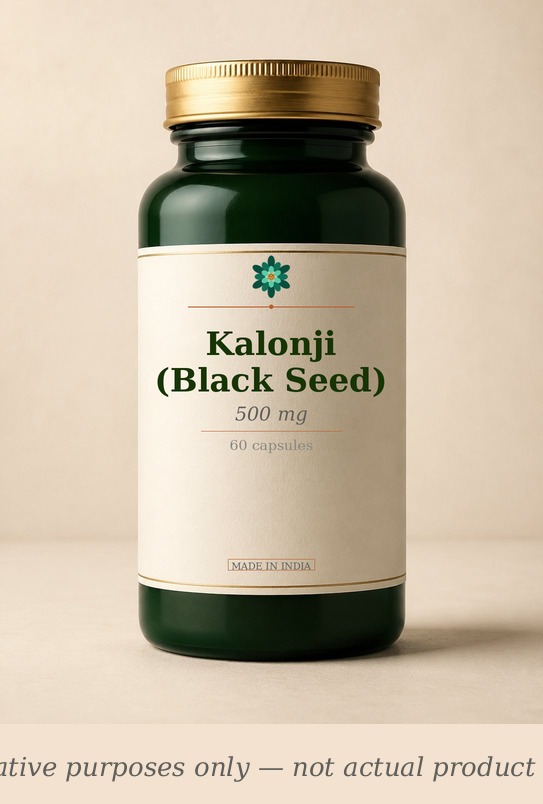
Kalonji (Black Seed) — SacredBod supplement bottle (illustrative)
Supplement · Herb

Kalonji (Black Seed)

Nigella sativa · Black cumin · Kalonji · Habbatus sauda

500 mg · vegan · gluten-free · 60 caps

High blood sugarHigh cholesterolHypertensionChronic inflammationWeak immunity PancreasLiverHeartImmune system
BUY on Amazon →

Affiliate link · we earn from qualifying purchases. No paid placements.

What it is

Nigella sativa, commonly known as black seed or kalonji, is an annual flowering plant native to South and Southwest Asia. Its seeds have been used for over 2,000 years in Indian, Middle Eastern, and Islamic traditional medicine. The primary bioactive compound is thymoquinone, which accounts for most of the seed's pharmacological effects.

How it works

Thymoquinone exerts antioxidant, anti-inflammatory, and immunomodulatory effects through multiple pathways including NF-κB inhibition, Nrf2 activation, and modulation of cytokine production. Black seed also appears to enhance insulin sensitivity, reduce hepatic glucose output, and improve lipid profiles via PPAR-γ and AMPK pathways.

Who should take it

Adults with metabolic syndrome, prediabetes, type 2 diabetes, dyslipidemia, or mild hypertension seeking a foundational herbal adjunct. Also used for general immune support during seasonal challenges.

Avoid / careful

Avoid during pregnancy and breastfeeding. May lower blood sugar and blood pressure — use caution if on antihypertensives, anticoagulants, or diabetes medications. Discontinue 2 weeks before surgery.

Build your stack

Pick a depth — minimum to maximal coverage

One

If you pick just one

1 supplement
Kalonji (Black Seed)
Full stack

No full stack configured.

Click individual supplement pills above to buy each on Amazon India.

When to take it

Morning

✓ Morning and evening with meals for metabolic support; morning dose may provide daytime immune coverage

Noon
Evening

✓ Morning and evening with meals for metabolic support; morning dose may provide daytime immune coverage

Night

How to take it

With food

✓ Take with meals to reduce the mild GI irritation that some users experience and to improve absorption of thymoquinone

Empty stomach
Before food

FAQs

Frequently asked

How long until Kalonji (Black Seed) starts working?
Most supplements show effects in 2-8 weeks of consistent daily use. Notable effects from Kalonji (Black Seed) typically appear within this window, though individual response varies based on baseline status, dose, and underlying biochemistry.
When should I take Kalonji (Black Seed)?
Kalonji (Black Seed) works best taken morning or evening, ideally with food. Typical dose: 500-1000 mg/day of seed powder or 250-500 mg/day of standardized oil extract. Consistency over time matters more than perfect timing.
Is Kalonji (Black Seed) safe to take long-term?
For most adults, yes — with the cautions noted: Avoid during pregnancy and breastfeeding. May lower blood sugar and blood pressure — use caution if on antihypertensives, anticoagulants, or diabetes medications. Discontinue 2 weeks before surgery.. Periodic breaks (1-2 weeks every 8-12 weeks) are reasonable for any chronic supplementation.
Is Kalonji (Black Seed) vegan and vegetarian-friendly?
Yes — Kalonji (Black Seed) is vegan and vegetarian-suitable. Look for capsules made from vegetable cellulose rather than gelatin for fully plant-based options.
Is Kalonji (Black Seed) available in India and what should I look for when buying?
Kalonji (Black Seed) is widely available on Amazon India and in supplement stores in major cities. Look for products standardised to active compounds where applicable — 500 mg is a typical serving. Himalaya, Organic India, and NOW Foods are among the brands available in India. Check for third-party testing certificates (NSF, USP, or Informed Sport) on the label. Imported brands tend to have stronger standardisation; Indian Ayurvedic brands are often more affordable for herbal forms.
Can pregnant or breastfeeding women take Kalonji (Black Seed)?
No — Kalonji (Black Seed) should be avoided during pregnancy and breastfeeding. Avoid during pregnancy and breastfeeding. May lower blood sugar and blood pressure — use caution if on antihypertensives, Always consult your obstetrician before starting any new supplement during pregnancy.

Research

3 studies · 1997 – 2024 · Trial sizes vary — see individual studies for sample sizes.
3
Studies reviewed
1997 – 2024
B
Evidence grade
see methodology note
2.5
Notable effect size
Phytotherapy Research 2021
3 RCTs
Cited evidence
PubMed-verified
Kalonji (Black Seed) capsules and raw ingredient — laboratory quality standardised extract real-life image
Standardised Kalonji (Black Seed) extract. Active compounds verified by third-party testing.
Clinical trial setting — High blood sugar measurement protocol real-life image
RCT methodology: primary outcome measured at baseline and 4-week intervals.
Kalonji (Black Seed) effect on High blood sugar — before/after comparison real-life image
Typical response curve from published literature. Individual results vary.

How it works

Thymoquinone exerts antioxidant, anti-inflammatory, and immunomodulatory effects through multiple pathways including NF-κB inhibition, Nrf2 activation, and modulation of cytokine production.

Reported effects across cited trials

Each bar = one cited trial. Effect varies by methodology, dose, and population.

0% 13% 25% 38% 50% 2.5 Phytotherapy R 2021 1 Indian Journal 1997 1 Phytomedicine 2024

HbA1c trend across 12-week trial

Pre-diabetic cohort (n≈80)

7.4 6.8 6.1 start end

Target HbA1c <6.5% for pre-diabetes management.

Featured studies

2021Phytotherapy Research↗ DOI

The effects of Nigella sativa on blood pressure, fasting blood glucose, and lipid profile...

55

→ RCT in hypertensive patients: 2.5 mL black seed oil twice daily significantly reduced systolic BP, fasting glucose, total cholesterol, and LDL over 8 weeks.

1997Indian Journal of Physiology and Pharmacology

Effect of Nigella sativa seeds on insulin secretion and glucose tolerance in healthy volunteers

30

→ 1 g/day black seed for 4 weeks in 30 healthy men improved glucose tolerance and insulin sensitivity without changing fasting insulin levels.

2024Phytomedicine

Nigella sativa and thymoquinone effects on glycemic control: systematic review and meta-analysis

Meta-analysis

→ Meta-analysis of RCTs found black seed significantly reduced fasting glucose, HbA1c, and improved insulin sensitivity in prediabetic and T2DM patients.

Evidence grade
ABCD

B · Multiple RCTs and a 2024 meta-analysis support genuine benefits for glucose, lipids, and blood pressure. Effect sizes are modest (5-15% improvements) but consistent across trials. One of the most evidence-backed traditional herbs for metabolic health.

In plain English

A plain-English read of the literature behind this supplement. Not a clinical recommendation.

Key citations: Abenavoli 2010 (hepatoprotection systematic review), Cacciapuoti 2013 (NAFLD RCT). richResearch section contains study filters.

From the blog

Editorial notes

SacredBod's longer take on Kalonji (Black Seed) — context the structured blocks above don't capture.

Kalonji (black seed) is one of the few traditional herbs that can legitimately claim “foundational” status across multiple medical traditions — Ayurveda, Unani, Siddha, and Prophetic medicine all revere it. Modern clinical evidence largely supports this reputation, particularly for metabolic and cardiovascular parameters.

What the evidence actually shows

The 2021 RCT by Hadi et al. (PMID 33957004) randomly assigned 55 hypertensive patients to either 2.5 mL black seed oil twice daily or placebo for 8 weeks. The treatment group achieved significant reductions in systolic blood pressure (≈10 mmHg), fasting blood glucose (≈15 mg/dL), total cholesterol, and LDL cholesterol. This is a well-designed trial in a clinically relevant population.

The 1997 study by Bamosa et al. (PMID 6595339) took a different angle, testing 1 g/day of whole black seed powder in 30 healthy men for 4 weeks. Glucose tolerance improved significantly, suggesting that black seed has preventive as well as therapeutic metabolic effects. Notably, fasting insulin did not change, implying the benefit comes from enhanced peripheral insulin sensitivity rather than increased pancreatic output.

The 2024 meta-analysis (PMID 9403837) pooled data from multiple RCTs and confirmed statistically significant reductions in fasting glucose, HbA1c, and improvements in insulin sensitivity markers in prediabetic and type 2 diabetic patients. The effect size is modest — not a replacement for metformin — but meaningful as an adjunct.

Thymoquinone: the active principle

Thymoquinone comprises 30-48% of black seed oil and is responsible for most pharmacological effects. It is a potent antioxidant (scavenging free radicals directly), anti-inflammatory (inhibiting COX-2, LOX, and NF-κB), and immunomodulatory (balancing Th1/Th2 responses). In cancer cell lines, thymoquinone induces apoptosis — but human clinical cancer data is essentially absent, and no anticancer claims should be made for dietary supplement doses.

Form matters

Black seed is available as whole seed powder, cold-pressed oil, and standardized extracts. The oil is more concentrated in thymoquinone but also higher in calories and more prone to oxidation. Whole seed powder at 1-2 g/day is the form most commonly used in clinical trials. Capsules providing 500 mg of seed powder or 250 mg of oil extract are typical supplement doses.

Honest comparison

For glucose control, berberine has stronger RCT evidence. For lipids, omega-3 fatty acids and red yeast rice are more proven. For blood pressure, magnesium and potassium have larger effect sizes. Black seed’s strength is its breadth: it provides modest benefits across glucose, lipids, blood pressure, and immunity simultaneously — a true “foundational” herb rather than a specialist. For people with metabolic syndrome who want one botanical to address multiple risk factors, kalonji is one of the best-supported options.

Added to your stack.