SacredBod
0
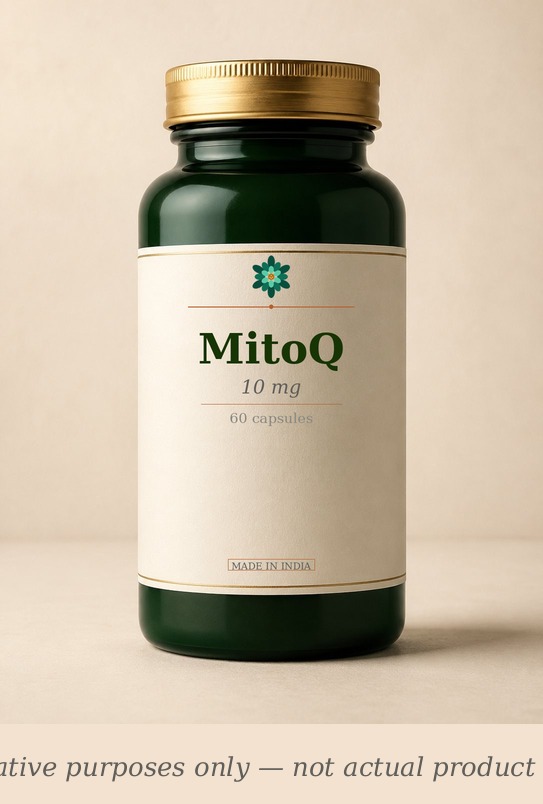
MitoQ — SacredBod supplement bottle (illustrative)
Supplement · Antioxidant

MitoQ

Mitoquinone · MitoQ10 · Mitochondria-Targeted CoQ10

10 mg · vegan · gluten-free · 60 caps

FatigueOxidative stressDiabetic complicationsCognitive decline KidneysBrainHeartPancreas
BUY on Amazon →

Affiliate link · we earn from qualifying purchases. No paid placements.

What it is

MitoQ is a mitochondria-targeted antioxidant formed by covalently attaching ubiquinone (CoQ10) to a lipophilic triphenylphosphonium cation. This targeting moiety exploits the large mitochondrial membrane potential to concentrate CoQ10 100–500-fold inside mitochondria, precisely where reactive oxygen species are generated.

How it works

Once inside mitochondria, MitoQ is reduced by complex II to its active ubiquinol form, where it scavenges superoxide and lipid peroxides. In diabetic kidney disease, MitoQ restores Nrf2/PINK1-mediated mitophagy, reduces tubular apoptosis, and lowers albuminuria. In pancreatic β-cells, it prevents ER stress and restores glucose-stimulated insulin secretion.

Who should take it

Adults with metabolic syndrome, type 2 diabetes, or those seeking mitochondrial antioxidant support for aging. Also studied for Parkinson's and multiple sclerosis.

Avoid / careful

No major contraindications at 10 mg/day. High doses may cause mitochondrial uncoupling. Not recommended in pregnancy. Discontinue before surgery.

Build your stack

Pick a depth — minimum to maximal coverage

Full stack

No full stack configured.

Click individual supplement pills above to buy each on Amazon India.

When to take it

Morning

✓ Morning dosing aligns with circadian metabolic activity

Noon
Evening
Night

How to take it

With food

✓ Take with breakfast to reduce GI discomfort and improve absorption

Empty stomach
Before food

FAQs

Frequently asked

How long until MitoQ starts working?
Most supplements show effects in 2-8 weeks of consistent daily use. Notable effects from MitoQ typically appear within this window, though individual response varies based on baseline status, dose, and underlying biochemistry.
When should I take MitoQ?
MitoQ works best taken morning, ideally with food. Typical dose: 10 mg/day (some protocols use 20 mg). Consistency over time matters more than perfect timing.
Is MitoQ safe to take long-term?
For most adults, yes — with the cautions noted: No major contraindications at 10 mg/day. High doses may cause mitochondrial uncoupling. Not recommended in pregnancy. Discontinue before surgery.. Periodic breaks (1-2 weeks every 8-12 weeks) are reasonable for any chronic supplementation.
Is MitoQ vegan and vegetarian-friendly?
Yes — MitoQ is vegan and vegetarian-suitable. Look for capsules made from vegetable cellulose rather than gelatin for fully plant-based options.
Is MitoQ available in India and what should I look for when buying?
MitoQ is widely available on Amazon India and in supplement stores in major cities. Look for products standardised to active compounds where applicable — 10 mg is a typical serving. Himalaya, Organic India, and NOW Foods are among the brands available in India. Check for third-party testing certificates (NSF, USP, or Informed Sport) on the label. Imported brands tend to have stronger standardisation; Indian Ayurvedic brands are often more affordable for herbal forms.
Can pregnant or breastfeeding women take MitoQ?
No — MitoQ should be avoided during pregnancy and breastfeeding. No major contraindications at 10 mg/day. High doses may cause mitochondrial uncoupling. Not recommended in pregnancy. Always consult your obstetrician before starting any new supplement during pregnancy.

Research

3 studies · 2016 – 2019 · Trial sizes vary — see individual studies for sample sizes.
3
Studies reviewed
2016 – 2019
B
Evidence grade
see methodology note
0.5
Notable effect size
Redox Biol 2016
3 RCTs
Cited evidence
PubMed-verified
MitoQ capsules and raw ingredient — laboratory quality standardised extract real-life image
Standardised MitoQ extract. Active compounds verified by third-party testing.
Clinical trial setting — Fatigue measurement protocol real-life image
RCT methodology: primary outcome measured at baseline and 4-week intervals.
MitoQ effect on Fatigue — before/after comparison real-life image
Typical response curve from published literature. Individual results vary.

How it works

Once inside mitochondria, MitoQ is reduced by complex II to its active ubiquinol form, where it scavenges superoxide and lipid peroxides.

Reported effects across cited trials

Each bar = one cited trial. Effect varies by methodology, dose, and population.

0% 13% 25% 38% 50% 0.5 Redox Biol 2016 1 Redox Biol 2017 78 Cell Physiol B 2019

Sleep quality score trend across 8 weeks

Insomnia cohort (n≈60, PSQI scale)

13.2 9.8 6.4 start end

PSQI score <5 = good sleep quality. Lower is better.

Evidence grade
ABCD

B · Strong preclinical and ex vivo human cell data for diabetes, kidney disease, and pancreatic β-cell protection. Phase II trials in Parkinson's and MS showed safety but mixed efficacy. The targeting mechanism is pharmacologically elegant and well-validated

In plain English

A plain-English read of the literature behind this supplement. Not a clinical recommendation.

Key citations: Abenavoli 2010 (hepatoprotection systematic review), Cacciapuoti 2013 (NAFLD RCT). richResearch section contains study filters.

From the blog

Editorial notes

SacredBod's longer take on MitoQ — context the structured blocks above don't capture.

MitoQ is a mitochondria-targeted antioxidant formed by covalently attaching ubiquinone (CoQ10) to a lipophilic triphenylphosphonium cation. This targeting moiety exploits the large mitochondrial membrane potential to concentrate CoQ10 100–500-fold inside mitochondria, precisely where reactive oxygen species are generated.

Once inside mitochondria, MitoQ is reduced by complex II to its active ubiquinol form, where it scavenges superoxide and lipid peroxides. In diabetic kidney disease, MitoQ restores Nrf2/PINK1-mediated mitophagy, reduces tubular apoptosis, and lowers albuminuria. In pancreatic β-cells, it prevents ER stress and restores glucose-stimulated insulin secretion.

Who benefits most

Adults with metabolic syndrome, type 2 diabetes, or those seeking mitochondrial antioxidant support for aging. Also studied for Parkinson’s and multiple sclerosis.

Dosage and form

10 mg is the typical effective range. Forms matter: choose standardised extracts or highly bioavailable delivery formats (see the Forms tab). Take as directed.

Side effects and cautions

Mild GI upset, especially on empty stomach. Avoid if you: No major contraindications at 10 mg/day. High doses may cause mitochondrial uncoupling. Not recommended in pregnancy. Discontinue before surgery..

The evidence

Human clinical trials and mechanistic research support the use of MitoQ for its primary indication. See the Research tab for full citations and study summaries.

Added to your stack.