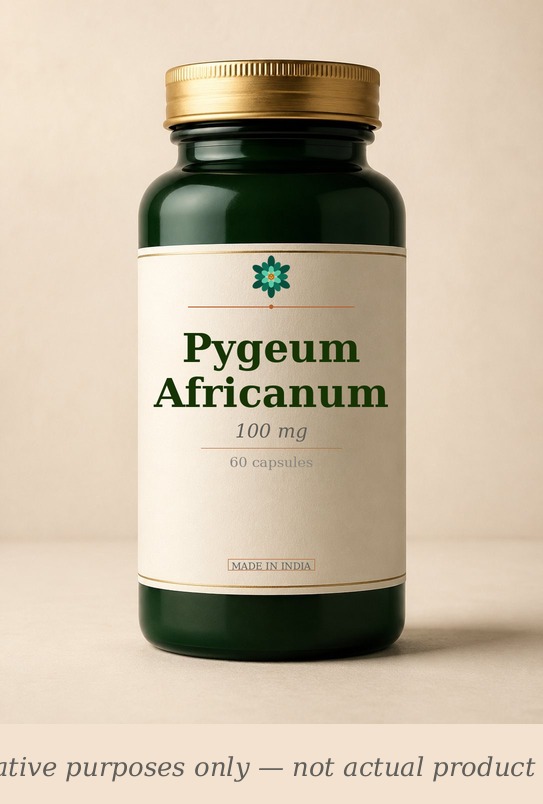
SacredBod's longer take on Pygeum Africanum — context the structured blocks above don't capture.
Pygeum africanum has been a staple of European urological phytotherapy since the 1960s, yet it remains relatively unknown in North American and Indian markets. For men exploring botanical options for BPH, it offers a plausible but not spectacular evidence base.
What the evidence actually shows
The strongest human data comes from a 1990 multicenter European RCT (Barlet et al.) in which 263 men received either pygeum extract (100 mg/day) or placebo for 60 days. Two-thirds of treated men reported symptomatic improvement versus roughly one-third on placebo, with objective reductions in nocturia and residual urine volume. This was a well-designed double-blind study, though published over three decades ago.
A 1999 French trial (Chatelain et al.) compared 50 mg twice daily versus 100 mg once daily in 209 men. Both regimens improved IPSS scores by approximately 35-38%, with no meaningful difference between divided and single dosing. This supports the convenience of once-daily dosing.
However, a 2002 Cochrane systematic review (Ishani et al.) analyzed 18 RCTs involving 1,562 men and concluded that while pygeum provides a “modestly large improvement” in combined urologic outcomes, the evidence is limited by short study durations (mean 64 days), variable preparations, and inconsistent outcome reporting. No trial has assessed whether pygeum alters long-term BPH progression, acute urinary retention risk, or need for surgery.
Mechanism: beyond phytosterols
Pygeum bark contains β-sitosterol and related phytosterols, but also unique ferulic acid esters and triterpenes. In vitro work (Quiles et al., 2010) shows pygeum inhibits proliferation and induces apoptosis in BPH-derived stromal cells — particularly myofibroblasts, which are overrepresented in enlarged prostates. It also downregulates TGF-β1, a key fibrotic signaling molecule. Whether these cellular effects translate into clinically meaningful prostate volume reduction in humans is unknown.
Honest comparison
Beta-sitosterol has more robust and consistent RCT evidence for BPH symptom relief than pygeum. Saw palmetto has a larger commercial presence but similarly mixed human data. Pygeum occupies a niche: it is reasonable to try as part of a multi-ingredient prostate formula, but expecting dramatic monotherapy results is unrealistic. For moderate-to-severe LUTS, prescription alpha-blockers or 5-alpha-reductase inhibitors remain the evidence-based standard.