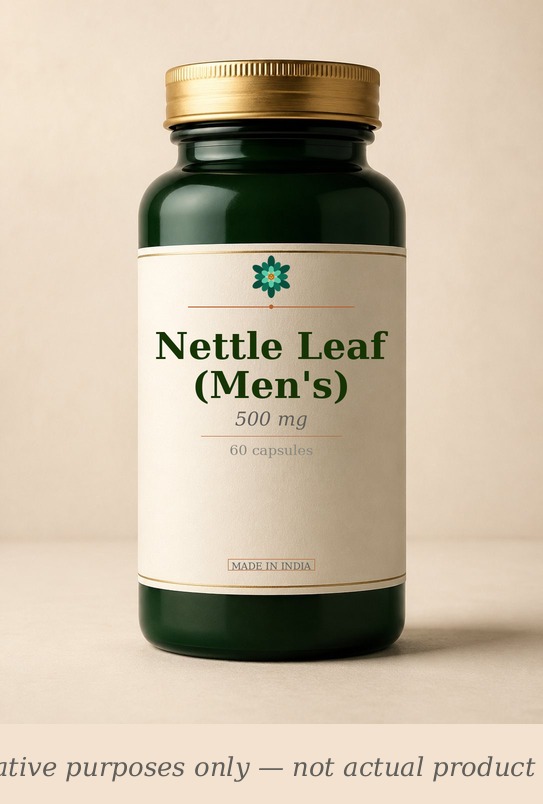
SacredBod's longer take on Nettle Leaf (Men's) — context the structured blocks above don't capture.
Nettle is one of the most underappreciated herbs in men’s health because its benefits are subtle and mechanistic rather than dramatic. It does not boost testosterone into the stratosphere or shrink the prostate overnight. Instead, it quietly modulates the hormonal environment — reducing SHBG’s grip on free testosterone, dampening aromatase activity, and providing anti-inflammatory support.
The SHBG mechanism
Sex hormone-binding globulin (SHBG) binds circulating testosterone and estradiol, rendering them inactive. In BPH, SHBG not only transports hormones but also binds to prostate membrane receptors and triggers proliferative signaling. The 1995 Hryb study demonstrated that aqueous nettle root extract inhibits this SHBG-receptor interaction in a dose-dependent manner — a unique mechanism not shared by saw palmetto or beta-sitosterol.
For men with elevated SHBG (common in aging, liver disease, and hyperthyroidism), this mechanism may be particularly relevant. High SHBG means low free testosterone even if total testosterone looks normal. Nettle does not lower SHBG production, but it blocks SHBG’s pathological signaling in prostate tissue.
Aromatase inhibition
The 1995 Gansser study identified multiple compounds in nettle root — including secoisolariciresinol, oleanolic acid, and ursolic acid — that inhibit aromatase, the enzyme converting testosterone to estradiol. This is a weak effect in vitro and unquantified in humans, but it adds to nettle’s hormonal balance profile. For men concerned about estrogen dominance (gynecomastia, water retention, mood changes), nettle is a gentle adjunct, not a pharmaceutical-grade aromatase inhibitor.
Leaf vs. root
This profile focuses on nettle leaf, which is more widely available as a supplement and tea than root extracts. The leaf contains higher levels of flavonoids, chlorophyll, and minerals (iron, magnesium, calcium) and has documented anti-inflammatory effects. The root contains higher concentrations of the lignans responsible for SHBG and aromatase effects. For maximum prostate benefit, root extracts are theoretically preferable; for general hormonal and anti-inflammatory support, leaf is excellent.
Clinical evidence gap
The 2007 Chrubasik review summarized approximately 40,000 men treated with nettle root in European clinical studies, but noted that most were open-label and uncontrolled. Only a small number of RCTs exist, and they typically test nettle in combination with saw palmetto rather than as monotherapy. The evidence grade reflects this: plausible mechanisms, modest clinical validation.
Honest comparison
For BPH symptom relief, beta-sitosterol and saw palmetto have more RCT support than nettle. For testosterone optimization, tongkat ali and zinc are more direct. Nettle’s niche is in hormonal fine-tuning: men with high SHBG, signs of estrogen dominance, or those building a comprehensive prostate stack where nettle’s unique mechanisms complement better-studied ingredients.