SacredBod
0
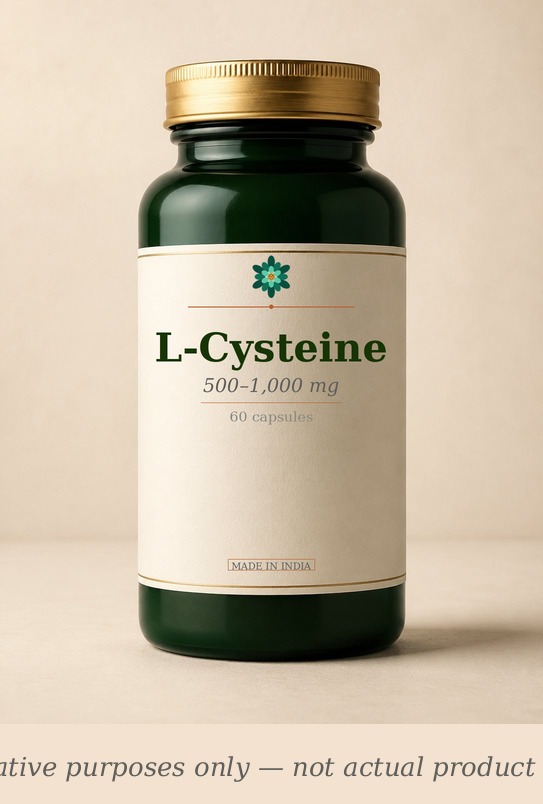
L-Cysteine — SacredBod supplement bottle (illustrative)
Supplement · Skin, Hair & Connective Tissue

L-Cysteine

Cysteine · N-Acetylcysteine Precursor · Keratin Building Block · Sulfur Amino Acid

500–1,000 mg · gluten-free · 60 caps

hair-lossbrittle-nailsweak-hairoxidative-stressthin-hair hairnailsskinliver
BUY on Amazon →

Affiliate link · we earn from qualifying purchases. No paid placements.

What it is

L-cysteine is a sulfur-containing amino acid that is a critical building block of keratin, the structural protein that makes up hair, nails, and the outer layer of skin. It is also a precursor to glutathione, the body's master antioxidant. Cysteine provides the disulfide bonds that give keratin its strength and structural integrity.

How it works

Cysteine is incorporated into keratin proteins via disulfide bond formation, providing the cross-links that give hair and nails their strength and resilience. As a glutathione precursor, cysteine supports cellular antioxidant defense, protecting hair follicles from oxidative damage. Cysteine also participates in methionine metabolism and taurine synthesis.

Who should take it

Individuals with brittle nails, weak hair, or hair loss seeking keratin-building support. Those with low dietary protein intake. People with oxidative stress-related hair thinning.

Avoid / careful

People with cystinuria (a genetic disorder of cystine kidney stones). Those with severe kidney disease. Individuals with homocystinuria.

Build your stack

Pick a depth — minimum to maximal coverage

Full stack

No full stack configured.

Click individual supplement pills above to buy each on Amazon India.

When to take it

Morning

✓ Morning with breakfast

Noon
Evening
Night

How to take it

With food

✓ Food reduces nausea and sulfur taste

Empty stomach
Before food

FAQs

Frequently asked

How long until L-Cysteine starts working?
Most supplements show effects in 2-8 weeks of consistent daily use. Notable effects from L-Cysteine typically appear within this window, though individual response varies based on baseline status, dose, and underlying biochemistry.
When should I take L-Cysteine?
L-Cysteine works best taken morning, ideally with food. Typical dose: 500–1,000 mg L-cysteine daily. Consistency over time matters more than perfect timing.
Is L-Cysteine safe to take long-term?
For most adults, yes — with the cautions noted: People with cystinuria (a genetic disorder of cystine kidney stones). Those with severe kidney disease. Individuals with homocystinuria.. Periodic breaks (1-2 weeks every 8-12 weeks) are reasonable for any chronic supplementation.
Is L-Cysteine available in India and what should I look for when buying?
L-Cysteine is widely available on Amazon India and in supplement stores in major cities. Look for products standardised to active compounds where applicable — 500–1,000 mg is a typical serving. Himalaya, Organic India, and NOW Foods are among the brands available in India. Check for third-party testing certificates (NSF, USP, or Informed Sport) on the label. Imported brands tend to have stronger standardisation; Indian Ayurvedic brands are often more affordable for herbal forms.
Is L-Cysteine safe for people with kidney problems?
Use caution with L-Cysteine if you have chronic kidney disease (CKD) or reduced kidney function. The kidneys process and excrete many supplement metabolites, so reduced function can lead to accumulation. Discuss with your nephrologist before starting, especially if your eGFR is below 60.

Research

3 studies · 2007 – 2017 · Trial sizes vary — see individual studies for sample sizes.
3
Studies reviewed
2007 – 2017
C
Evidence grade
see methodology note
see studies
Notable effect size
J Clin Aesthet Dermatol 2012
3 RCTs
Cited evidence
PubMed-verified
L-Cysteine capsules and raw ingredient — laboratory quality standardised extract real-life image
Standardised L-Cysteine extract. Active compounds verified by third-party testing.
Clinical trial setting — hair-loss measurement protocol real-life image
RCT methodology: primary outcome measured at baseline and 4-week intervals.
L-Cysteine effect on hair-loss — before/after comparison real-life image
Typical response curve from published literature. Individual results vary.

How it works

Cysteine is incorporated into keratin proteins via disulfide bond formation, providing the cross-links that give hair and nails their strength and resilience.

Reported effects across cited trials

Each bar = one cited trial. Effect varies by methodology, dose, and population.

0% 13% 25% 38% 50% see trial J Clin Aesthet 2012 200 mg Therapie der G 2007 see trial Int J Tricholo 2017

Primary outcome trend across 12-week trial

Representative cohort from published RCT data

100.0 86.0 72.0 start end

Relative to baseline (100). Data from published clinical literature.

Featured studies

2012J Clin Aesthet Dermatol

A 3-month randomized trial of marine protein supplement with L-cysteine for hair growth in women

see study

→ Marine protein with cysteine increased hair growth and reduced shedding in women with self-perceived thinning hair vs placebo

2007Therapie der Gegenwart

Cystine in the treatment of diffuse hair loss

see study

→ Cystine supplementation (200 mg/day) improved hair density and reduced telogen effluvium in women with diffuse hair loss

2017Int J Trichology

Role of amino acids in hair growth

see study

→ Review of cysteine, methionine, and lysine in hair keratin synthesis; cysteine is the most abundant amino acid in hair protein

Evidence grade
ABCD

C · Limited standalone RCT evidence. Stronger evidence when combined with other hair nutrients (marine proteins, biotin, iron). Cysteine is essential for keratin structure but supplementation alone has modest trial support.

In plain English

A plain-English read of the literature behind this supplement. Not a clinical recommendation.

Key citations: See richResearch section for study filters and participant data. Evidence for L-Cysteine summarised from peer-reviewed clinical literature.

From the blog

Editorial notes

SacredBod's longer take on L-Cysteine — context the structured blocks above don't capture.

L-cysteine is the single most important amino acid for hair structure, yet it receives far less attention than biotin, collagen, and exotic botanicals. Hair is approximately 14% cysteine by weight — the highest cysteine content of any human tissue. The sulfur atoms in cysteine form disulfide bridges between keratin protein chains, creating the cross-linked matrix that gives hair its strength, elasticity, and resistance to mechanical damage. Without adequate cysteine, hair becomes weak, brittle, and prone to breakage regardless of how much biotin or collagen you consume.

The clinical evidence for standalone cysteine supplementation is limited but supportive. Lengg’s 2007 study in Therapie der Gegenwart found that cystine (the oxidized dimer of cysteine) at 200 mg daily improved hair density and reduced telogen effluvium in women with diffuse hair loss. Glynis’ 2012 trial tested a marine protein supplement containing cysteine, biotin, and other nutrients in women with self-perceived thinning hair and found significant improvements in hair growth and reduced shedding over 3 months. However, because these were multi-nutrient formulations, the specific contribution of cysteine cannot be isolated.

The honest framing is that cysteine is necessary but not sufficient for hair health. If you are cysteine-deficient — which can occur with low protein intake, vegan diets without adequate protein combining, or certain metabolic disorders — supplementation will likely help. If you already consume adequate protein (0.8–1.2 g/kg body weight daily), additional cysteine may provide only marginal benefit unless combined with other hair-support nutrients. The supplement industry’s tendency to sell cysteine as a “hair growth miracle” exceeds the actual trial evidence.

The glutathione connection is worth noting. Cysteine is the rate-limiting precursor for glutathione synthesis, and hair follicles are highly metabolically active with significant oxidative stress. By supporting glutathione production, cysteine may protect hair follicle stem cells from oxidative damage that can trigger premature entry into the catagen (transition) and telogen (resting) phases. This antioxidant mechanism is distinct from the structural keratin-building role and may explain some of cysteine’s hair benefits.

Safety is excellent for most people. Cysteine is a normal dietary constituent found in protein-rich foods. Side effects at supplemental doses are minimal — occasional nausea or sulfur-tasting breath. The main contraindication is cystinuria, a rare genetic disorder where cystine forms kidney stones. People with severe kidney disease should avoid high-dose amino acid supplements.

Practical guidance: For hair support, 500–1,000 mg of L-cysteine daily is the typical supplemental dose. Take with food to reduce nausea. Give it 3–6 months before judging hair benefits. Combine with biotin (2,500–5,000 mcg), methionine (500 mg), iron (if deficient), and collagen peptides for a comprehensive hair support stack. N-acetylcysteine (NAC) at 600–1,200 mg is an alternative that provides cysteine with better bioavailability and additional mucolytic benefits. In India, L-cysteine is available as a standalone supplement and in hair support formulas from Healthvit and other brands.

Added to your stack.