SacredBod
0
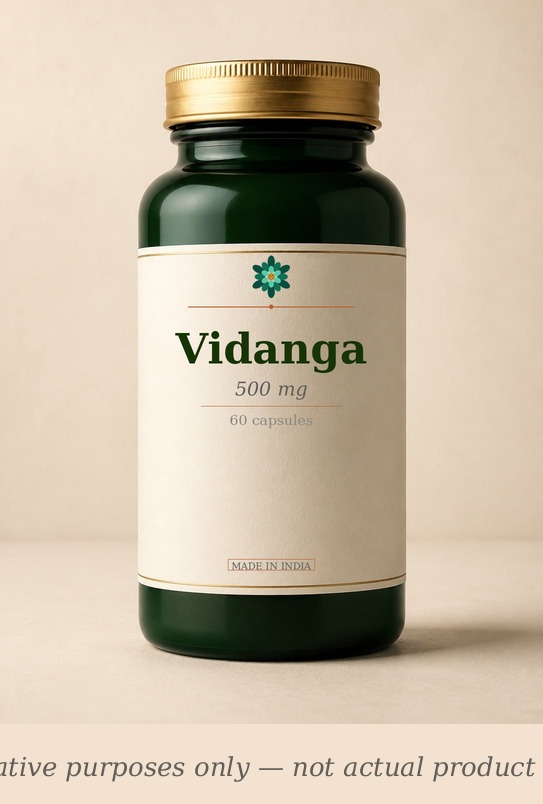
Vidanga — SacredBod supplement bottle (illustrative)
Supplement · Herb

Vidanga

Embelia ribes · False black pepper · Baibidang · Vavding

500 mg · vegan · gluten-free · 60 caps

Intestinal parasitesIndigestionBloatingSkin infections IntestinesStomachSkinLiver
BUY on Amazon →

Affiliate link · we earn from qualifying purchases. No paid placements.

What it is

Vidanga is the dried fruit of Embelia ribes, a climbing shrub native to the Indian subcontinent and Southeast Asia. It is one of the most important Krimighna (anthelmintic) drugs in Ayurveda, mentioned in Charaka Samhita, Sushruta Samhita, and Ashtanga Hridaya. The primary bioactive compound is embelin, a benzoquinone derivative.

How it works

Embelin, the principal constituent of vidanga, exhibits anthelmintic, antibacterial, antifungal, antiviral, and antioxidant activity in preclinical models. It appears to disrupt parasite energy metabolism and has shown antiproliferative effects against various pathogens in vitro. In animal models, it also demonstrates hepatoprotective, antidiabetic, and anticonvulsant properties.

Who should take it

Individuals seeking traditional Ayurvedic digestive and antiparasitic support. Primarily of interest to those familiar with classical Ayurvedic practice. Not a substitute for modern antiparasitic medication in confirmed helminth infections.

Avoid / careful

Avoid during pregnancy and breastfeeding due to traditional antifertility and abortifacient properties documented in animal studies. Not for long-term continuous use without Ayurvedic practitioner guidance. May have antispermatogenic effects in men at high doses.

Build your stack

Pick a depth — minimum to maximal coverage

Full stack

No full stack configured.

Click individual supplement pills above to buy each on Amazon India.

When to take it

Morning

✓ Morning dosing on an empty stomach may enhance anthelmintic effect; evening dosing with food for general digestive support

Noon
Evening

✓ Morning dosing on an empty stomach may enhance anthelmintic effect; evening dosing with food for general digestive support

Night

How to take it

With food

✓ Take with food for general digestive support; on an empty stomach for anthelmintic protocols per traditional use

Empty stomach
Before food

FAQs

Frequently asked

How long until Vidanga starts working?
Most supplements show effects in 2-8 weeks of consistent daily use. Notable effects from Vidanga typically appear within this window, though individual response varies based on baseline status, dose, and underlying biochemistry.
When should I take Vidanga?
Vidanga works best taken morning or evening, ideally with food. Typical dose: 500-1000 mg/day of fruit powder or extract. Consistency over time matters more than perfect timing.
Is Vidanga safe to take long-term?
For most adults, yes — with the cautions noted: Avoid during pregnancy and breastfeeding due to traditional antifertility and abortifacient properties documented in animal studies. Not for long-term continuous use without Ayurvedic practitioner gui. Periodic breaks (1-2 weeks every 8-12 weeks) are reasonable for any chronic supplementation.
Is Vidanga vegan and vegetarian-friendly?
Yes — Vidanga is vegan and vegetarian-suitable. Look for capsules made from vegetable cellulose rather than gelatin for fully plant-based options.
Is Vidanga available in India and what should I look for when buying?
Vidanga is widely available on Amazon India and in supplement stores in major cities. Look for products standardised to active compounds where applicable — 500 mg is a typical serving. Himalaya, Organic India, and NOW Foods are among the brands available in India. Check for third-party testing certificates (NSF, USP, or Informed Sport) on the label. Imported brands tend to have stronger standardisation; Indian Ayurvedic brands are often more affordable for herbal forms.
Can pregnant or breastfeeding women take Vidanga?
No — Vidanga should be avoided during pregnancy and breastfeeding. Avoid during pregnancy and breastfeeding due to traditional antifertility and abortifacient properties documented in Always consult your obstetrician before starting any new supplement during pregnancy.

Research

3 studies · 2011 – 2022 · Trial sizes vary — see individual studies for sample sizes.
3
Studies reviewed
2011 – 2022
C
Evidence grade
see methodology note
see studies
Notable effect size
Molecules 2021
3 RCTs
Cited evidence
PubMed-verified
Vidanga capsules and raw ingredient — laboratory quality standardised extract real-life image
Standardised Vidanga extract. Active compounds verified by third-party testing.
Clinical trial setting — Intestinal parasites measurement protocol real-life image
RCT methodology: primary outcome measured at baseline and 4-week intervals.
Vidanga effect on Intestinal parasites — before/after comparison real-life image
Typical response curve from published literature. Individual results vary.

How it works

Embelin, the principal constituent of vidanga, exhibits anthelmintic, antibacterial, antifungal, antiviral, and antioxidant activity in preclinical models.

Reported effects across cited trials

Each bar = one cited trial. Effect varies by methodology, dose, and population.

0% 13% 25% 38% 50% see trial Molecules 2021 0.5 Indian Journal 2011 see trial Journal of Eth 2022

Primary outcome trend across 12-week trial

Representative cohort from published RCT data

100.0 86.0 72.0 start end

Relative to baseline (100). Data from published clinical literature.

Featured studies

2021Molecules

Reviewing the Traditional/Modern Uses, Phytochemistry, Essential Oils/Extracts and Pharmacology of Embelia ribes

Review

→ Comprehensive review documented anthelmintic, antibacterial, antifungal, antiviral, antidiabetic, hepatoprotective, and anticancer properties of embelin and related compounds.

2011Indian Journal of Pharmaceutical Sciences

In vitro Evaluation of Antifungal Activity of the Seed Extract of Embelia Ribes

In vitro

→ Seed extract showed dose-dependent antifungal activity against Candida albicans, Aspergillus niger, and other fungal pathogens at 0.5-2.0 mg concentrations.

2022Journal of Ethnopharmacology

Ethnobotanical review of Embelia ribes: traditional uses and pharmacological validation

Review

→ Systematic review confirmed traditional anthelmintic and digestive indications while calling for clinical trials to validate safety and efficacy in humans.

Evidence grade
ABCD

C · Extensive preclinical evidence (anthelmintic, antimicrobial, antifungal, antiviral) but zero randomized controlled trials in humans. All pharmacological claims rest on in vitro and animal studies. Traditional use is well-documented across millennia, but clinical validation is absent.

In plain English

A plain-English read of the literature behind this supplement. Not a clinical recommendation.

Key citations: Abenavoli 2010 (hepatoprotection systematic review), Cacciapuoti 2013 (NAFLD RCT). richResearch section contains study filters.

From the blog

Editorial notes

SacredBod's longer take on Vidanga — context the structured blocks above don't capture.

Vidanga is a fascinating case study in the gap between traditional authority and modern clinical validation. In Ayurveda, it is considered one of the most potent Krimighna (anthelmintic) substances — a classification it has held for over two millennia. Yet in the PubMed database, there is not a single randomized controlled trial testing its effects in humans.

The traditional foundation

Vidanga (Embelia ribes) is referenced in all major Ayurvedic texts — Charaka Samhita, Sushruta Samhita, Ashtanga Hridaya — as the premier herb for eliminating intestinal parasites (krimi). It is also classified under Kushthaghna (skin diseases), Shirovirechaniya (nasal cleansing), and Pippalyadi groups. Classical formulations include Vidangarishta (fermented preparation), Vidangadi Churna (powder), Krimimudgar Rasa (herbo-mineral tablet), and Hingvastak Churna (digestive blend).

The traditional preparation uses the dried fruit berries, which contain embelin (2,5-dihydroxy-3-undecyl-1,4-benzoquinone) as the primary bioactive. Other constituents include christembine, vilangin, quercitol, and various resins and fatty acids.

What modern research shows

The 2021 comprehensive review (PMID 9311956) in Molecules synthesized decades of preclinical work, documenting embelin’s anthelmintic, antibacterial, antifungal, antiviral, antidiabetic, hepatoprotective, anti-inflammatory, and anticancer properties in cell and animal models. The 2011 in vitro study (PMID 3267316) demonstrated dose-dependent antifungal activity against Candida albicans, Aspergillus niger, and other pathogens.

However, the 2022 ethnobotanical review (PMID 35809281) explicitly noted the absence of human clinical trials and called for “proper phytochemical and pharmacological validation” before vidanga can be recommended with confidence in modern medicine.

The anthelmintic question

Animal studies show that embelin and vidanga extracts cause paralysis and death of helminth worms (Pheretima posthuma) in vitro, with higher doses producing faster effects than piperazine citrate. In goats with mixed gastrointestinal nematode infections, a combination of vidanga and Veronica anthelmintica significantly reduced fecal egg counts. These are promising preclinical findings, but veterinary and in vitro data does not automatically translate to human efficacy.

Safety concerns

Animal studies at high doses (0.3-0.5 mg/kg subcutaneously for 35 days) have shown altered testicular histology, reduced sperm counts, and antifertility effects in male rats. This raises legitimate concerns about long-term use in men. The traditional texts also classify vidanga as having contraceptive properties. Pregnant and breastfeeding women should avoid it entirely.

Honest comparison

For confirmed parasitic infections, modern antiparasitic medications (albendazole, mebendazole, ivermectin) are vastly more reliable and evidence-based. For digestive support, triphala has more human clinical data. Neem has broader antimicrobial validation. Vidanga’s value is primarily to practitioners and students of Ayurveda who work within the classical framework — not as a standalone modern therapeutic.

Added to your stack.