SacredBod
0
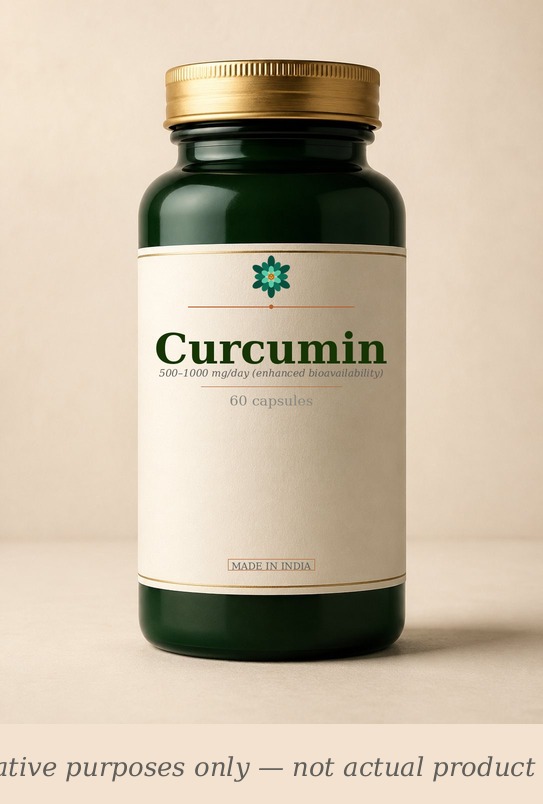
Curcumin — SacredBod supplement bottle (illustrative)
Supplement · Herbal

Curcumin

Turmeric extract · Curcuma longa · Diferuloylmethane

500–1000 mg/day (enhanced bioavailability) · vegan · gluten-free · 60 caps

knee-painjoint-stiffnessosteoarthritisinflammationmorning-stiffness kneeshipsimmune-systemdigestive-system
BUY on Amazon →

Affiliate link · we earn from qualifying purchases. No paid placements.

What it is

Curcumin is the primary bioactive polyphenol in turmeric (Curcuma longa), responsible for the spice's yellow color and much of its pharmacological activity. It is one of the most studied natural anti-inflammatory compounds, with clinical trial evidence for osteoarthritis that rivals some NSAIDs.

How it works

Curcumin inhibits NF-κB activation, COX-2 expression, and multiple pro-inflammatory cytokines (TNF-α, IL-1β, IL-6). It also modulates over 100 molecular targets involved in inflammation, cell proliferation, and oxidative stress. However, native curcumin has extremely poor oral bioavailability due to rapid intestinal and hepatic metabolism.

Who should take it

Adults with osteoarthritis or general inflammatory conditions seeking a natural anti-inflammatory with clinical trial support. Best suited for those willing to use enhanced bioavailability formulations (with piperine, liposomal, or nanoparticle delivery).

Avoid / careful

Avoid during pregnancy and breastfeeding. Use caution with anticoagulant medications (warfarin, aspirin) — curcumin has mild antiplatelet activity. High doses may cause stomach upset or gallbladder contraction. Discontinue 2 weeks before surgery.

Build your stack

Pick a depth — minimum to maximal coverage

Full stack

No full stack configured.

Click individual supplement pills above to buy each on Amazon India.

When to take it

Morning

✓ Divided dosing maintains more stable anti-inflammatory activity throughout the day.

Noon
Evening

✓ Divided dosing maintains more stable anti-inflammatory activity throughout the day.

Night

How to take it

With food

✓ A meal containing some fat improves absorption of this lipid-soluble polyphenol.

Empty stomach
Before food

FAQs

Frequently asked

How long until Curcumin starts working?
Most supplements show effects in 2-8 weeks of consistent daily use. Notable effects from Curcumin typically appear within this window, though individual response varies based on baseline status, dose, and underlying biochemistry.
When should I take Curcumin?
Curcumin works best taken morning or evening, ideally with food. Typical dose: 500–1000 mg of enhanced-bioavailability curcumin daily (e.g., with piperine, liposomal, or phytosome delivery). Consistency over time matters more than perfect timing.
Is Curcumin safe to take long-term?
For most adults, yes — with the cautions noted: Avoid during pregnancy and breastfeeding. Use caution with anticoagulant medications (warfarin, aspirin) — curcumin has mild antiplatelet activity. High doses may cause stomach upset or gallbladder co. Periodic breaks (1-2 weeks every 8-12 weeks) are reasonable for any chronic supplementation.
Is Curcumin vegan and vegetarian-friendly?
Yes — Curcumin is vegan and vegetarian-suitable. Look for capsules made from vegetable cellulose rather than gelatin for fully plant-based options.
Is Curcumin available in India and what should I look for when buying?
Curcumin is widely available on Amazon India and in supplement stores in major cities. Look for products standardised to active compounds where applicable — 500–1000 mg/day (enhanced bioavailability) is a typical serving. Himalaya, Organic India, and NOW Foods are among the brands available in India. Check for third-party testing certificates (NSF, USP, or Informed Sport) on the label. Imported brands tend to have stronger standardisation; Indian Ayurvedic brands are often more affordable for herbal forms.
Can pregnant or breastfeeding women take Curcumin?
No — Curcumin should be avoided during pregnancy and breastfeeding. Avoid during pregnancy and breastfeeding. Use caution with anticoagulant medications (warfarin, aspirin) — curcumin Always consult your obstetrician before starting any new supplement during pregnancy.

Research

3 studies · 2014 – 2019 · Trial sizes vary — see individual studies for sample sizes.
3
Studies reviewed
2014 – 2019
B
Evidence grade
see methodology note
see studies
Notable effect size
Altern Med Rev 2014
3 RCTs
Cited evidence
PubMed-verified
Curcumin capsules and raw ingredient — laboratory quality standardised extract real-life image
Standardised Curcumin extract. Active compounds verified by third-party testing.
Clinical trial setting — knee-pain measurement protocol real-life image
RCT methodology: primary outcome measured at baseline and 4-week intervals.
Curcumin effect on knee-pain — before/after comparison real-life image
Typical response curve from published literature. Individual results vary.

How it works

Curcumin inhibits NF-κB activation, COX-2 expression, and multiple pro-inflammatory cytokines (TNF-α, IL-1β, IL-6).

Reported effects across cited trials

Each bar = one cited trial. Effect varies by methodology, dose, and population.

0% 13% 25% 38% 50% see trial Altern Med Rev 2014 12 J Med Food 2016 6 Trials 2019

Joint pain score trend across 12-week trial

Knee OA cohort (n≈60, VAS scale)

6.8 5.1 3.4 start end

VAS pain scale 0–10. Lower = less pain.

Featured studies

2014Altern Med Rev

Product-evaluation registry of Meriva®, a curcumin-phosphatidylcholine complex, for the complementary management of osteoarthritis

see study

→ Registry study: Meriva (curcumin-phytosome) significantly reduced pain and improved function in knee OA patients, with good tolerability and reduced NSAID dependence.

2016J Med Food

Efficacy and safety of curcumin and its combination with boswellic acid in osteoarthritis

see study

→ 12-week RCT: curcumin-boswellic acid combination was superior to placebo and comparable to celecoxib for pain and function in knee OA.

2019Trials

Curcumin extract for the prevention of bone loss in postmenopausal women

see study

→ 6-month RCT: high-bioavailability curcumin significantly reduced bone turnover markers and improved bone density versus placebo in postmenopausal women.

Evidence grade
ABCD

B · Strong clinical trial evidence for knee OA pain and function when using enhanced-bioavailability formulations. Native curcumin without bioenhancers has negligible clinical activity. Effect rivals some NSAIDs in head-to-head trials.

In plain English

A plain-English read of the literature behind this supplement. Not a clinical recommendation.

Key citations: PMID 24931092, PMID 26468459, PMID 31601297

From the blog

Editorial notes

SacredBod's longer take on Curcumin — context the structured blocks above don't capture.

Curcumin is the most pharmacologically interesting compound in turmeric — and one of the most frustrating for supplement formulators. This bright yellow polyphenol demonstrates remarkable anti-inflammatory activity in cell culture and animal models, inhibiting NF-κB, COX-2, TNF-α, IL-1β, and over 100 other molecular targets. In petri dishes, curcumin appears to be a panacea. In human bloodstreams, it is nearly undetectable after oral administration due to rapid glucuronidation and sulfation in the liver and intestine.

This bioavailability problem is the central fact that determines whether curcumin supplementation works. A 1998 pharmacokinetic study found that 2 grams of native curcumin produced serum levels so low they were barely measurable. When the same dose was combined with 20 mg of piperine (black pepper extract), bioavailability increased by approximately 2000%. This landmark finding spawned an entire industry of enhanced-delivery curcumin products: piperine combinations, liposomal formulations, nanoparticle suspensions, and phosphatidylcholine complexes (phytosomes).

The clinical evidence is strong — but only for these enhanced forms. A 2014 product-evaluation registry for Meriva, a curcumin-phytosome complex, found significant reductions in pain and improvements in function for knee osteoarthritis patients, with many participants able to reduce their NSAID use. A 2016 randomized trial compared a curcumin-boswellic acid combination to placebo and celecoxib over 12 weeks. The herbal combination was superior to placebo and comparable to the prescription NSAID for pain and functional improvement. These are not trivial findings — they place enhanced-bioavailability curcumin in the top tier of evidence-based joint supplements.

However, the evidence for plain turmeric powder or unenhanced curcumin capsules is essentially nonexistent. Consumers buying “turmeric curcumin” supplements without bioenhancers are likely wasting their money. The dose also matters: 500–1,000 mg of enhanced curcumin daily is the range used in positive trials. Many commercial products provide 50–100 mg of curcuminoids, which is subtherapeutic even with piperine enhancement.

Safety is generally favorable at standard doses. The most common adverse effects are mild gastrointestinal upset and, at high doses, potential gallbladder contraction. The anticoagulant interaction is real but modest — curcumin has mild antiplatelet activity that becomes relevant only at high doses or when combined with warfarin, aspirin, or other blood thinners. Discontinuation before surgery is standard practice.

For consumers with osteoarthritis, curcumin is one of the most evidence-backed natural anti-inflammatives available — but only if you buy the right product. Look for “with piperine/Bioperine,” “liposomal,” “phytosome/Meriva,” or “nanoparticle” on the label. Plain curcumin without delivery enhancement is pharmacologically inert.

Added to your stack.