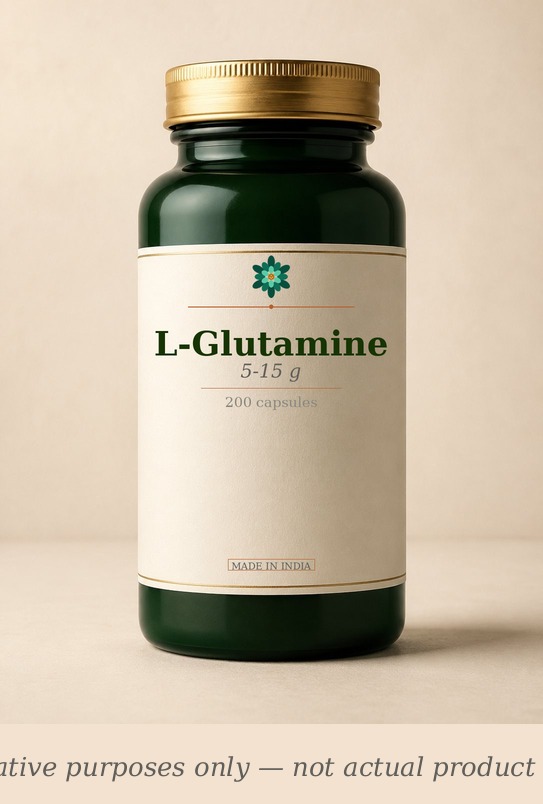
SacredBod's longer take on L-Glutamine — context the structured blocks above don't capture.
L-glutamine is the most abundant amino acid in the human body, yet its role is often misunderstood by supplement consumers. It is classified as “conditionally essential” — meaning the body normally produces enough from other amino acids, but during periods of severe physiological stress (trauma, burns, major surgery, sepsis, intense athletic training), demand outstrips supply and supplementation becomes clinically necessary. This conditional essentiality is the key to understanding glutamine: it is a critical therapeutic nutrient for sick and stressed people, but it is not a muscle-building miracle for healthy adults who eat adequate protein.
The gut barrier function is glutamine’s most important physiological role. The cells lining the intestine (enterocytes) use glutamine as their primary fuel source, consuming it at a rate higher than glucose. Without adequate glutamine, intestinal cells become energy-starved, tight junctions between cells loosen, and the gut barrier becomes permeable — a condition commonly called “leaky gut.” This allows bacterial toxins, undigested proteins, and pathogens to cross into the bloodstream, triggering systemic inflammation and immune activation. A 2016 review by Rao and colleagues documented how glutamine protects intestinal tight junction proteins (occludin, claudin, ZO-1) and reduces bacterial translocation in experimental models of intestinal injury. For people with intestinal permeability issues, inflammatory bowel disease, or recovering from gastrointestinal surgery, glutamine is a genuinely important therapeutic agent.
The clinical evidence in critical illness is robust. A 2003 review by Wischmeyer and colleagues in Current Opinion in Clinical Nutrition and Metabolic Care summarized decades of clinical data showing that glutamine supplementation in critically ill patients reduces infection rates, shortens hospital stays, and decreases mortality. Burn patients, who have massive glutamine depletion due to skin loss and hypermetabolism, show particular benefit from supplementation. A 2010 review by Kuhn and colleagues found that glutamine improved protein synthesis, reduced chemotherapy-induced mucositis (mouth and gut lining inflammation), and supported immune function in cancer patients. These are genuine clinical indications supported by multiple RCTs and meta-analyses.
The muscle-building claims for healthy adults are overhyped. Bodybuilding supplements often include glutamine with claims of “muscle preservation,” “protein synthesis enhancement,” and “recovery acceleration.” The reality is that healthy adults eating adequate protein (0.8-1.2 g/kg body weight) consume 5-10 grams of glutamine daily from food and synthesize additional amounts endogenously. Supplementing with 5-10 grams more provides no demonstrated benefit for muscle growth, strength, or recovery in well-nourished individuals. The studies showing muscle benefits were conducted in catabolic states (post-surgery, trauma, starvation), not in healthy weightlifters. The honest framing: if you are healthy and eating enough protein, glutamine supplementation for muscle building is a waste of money.
The immune support mechanism is real but context-dependent. Immune cells (lymphocytes, macrophages, neutrophils) use glutamine as a fuel source for proliferation and function. During severe stress or illness, glutamine depletion impairs immune responses, increasing infection risk. Supplementation restores immune cell function in these contexts. However, in healthy, unstressed individuals, immune cells have adequate glutamine and supplementation provides no measurable immune enhancement. The honest framing: glutamine supports immune function during stress and illness, but it does not “boost” immunity in healthy people.
Safety is generally good but with specific cautions. The most common side effects are mild stomach upset, constipation, or headache. More concerning is the potential for glutamine to worsen hepatic encephalopathy in severe liver disease — glutamine is metabolized to ammonia, which accumulates when the liver cannot detoxify it. People with advanced cirrhosis should avoid glutamine. The theoretical concern about cancer is also worth noting: many tumors are “glutamine addicted,” using it as a primary fuel source. While no clinical trial has shown that glutamine supplementation accelerates cancer growth, caution is warranted, and cancer patients should use glutamine only under oncologist supervision.
Quality and product selection is straightforward. L-glutamine powder is the most cost-effective form — it is tasteless, mixes easily in water or juice, and allows flexible dosing. Capsules are convenient for travel but more expensive per gram. Look for products that specify “L-glutamine” (the biologically active form) rather than “glutamine peptides” or proprietary blends. In the Indian market, NutriJa, AS-IT-IS, and MuscleBlaze offer quality glutamine powders at reasonable prices. For gut health, pure powder is preferable; for convenience, capsules are acceptable.
Comparative positioning within the gut health supplement landscape clarifies glutamine’s role. For intestinal permeability, zinc carnosine (Polaprezinc) has stronger clinical trial evidence. For general gut healing, collagen peptides provide structural amino acids (glycine, proline) that support mucosal repair. For microbiome support, probiotics are more directly impactful. Glutamine’s unique contribution is as the primary fuel for intestinal cells — it supports the energy needs of the gut lining in a way that other supplements do not. For comprehensive gut healing, a combination approach (glutamine + zinc carnosine + collagen + probiotics) may be most effective.
Practical guidance: Take 5-15 g of L-glutamine daily, divided into 2-3 doses with meals. For gut health and intestinal permeability, 5 g twice daily is standard. For recovery from trauma, surgery, or intense training, 10-15 g daily under medical or sports nutrition supervision. For healthy adults seeking muscle building, save your money and ensure adequate protein intake instead. Combine with zinc carnosine (75-150 mg), collagen peptides (5-10 g), and a multi-strain probiotic for comprehensive gut healing. Do not use if you have severe liver disease or active cancer without oncologist approval. Store in a cool, dry place; glutamine powder is stable for years.
Dietary sources are abundant for people eating adequate protein. Beef, poultry, fish, eggs, dairy products, beans, and cabbage are all rich in glutamine. A 100-gram serving of beef provides approximately 4-5 grams of glutamine. Whey protein powder is particularly glutamine-rich, providing 4-6 grams per 25-gram serving. For people consuming 100+ grams of protein daily, dietary glutamine intake is 5-10 grams, which is sufficient for normal physiological needs. Supplementation becomes relevant only when dietary intake is inadequate or physiological demand is elevated.
Storage and handling is simple. L-glutamine powder is one of the most stable amino acid supplements, with a shelf life of 3-5 years when kept dry. It is tasteless and odorless, mixing easily in water, juice, or protein shakes. It is heat-stable and can be added to hot beverages without degradation. Keep the container tightly closed to prevent moisture absorption, which can cause clumping. If clumping occurs, the glutamine is still effective — simply break up the clumps or dissolve in warm water. Refrigeration is not necessary.