SacredBod
0
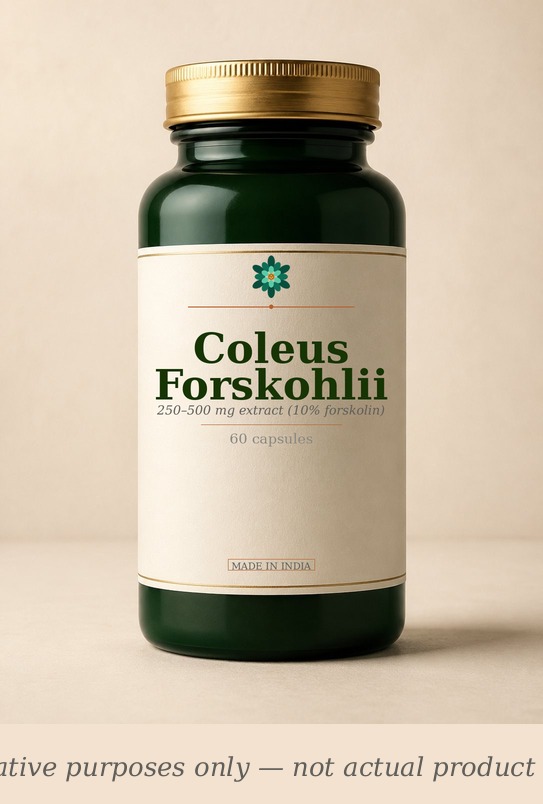
Coleus Forskohlii — SacredBod supplement bottle (illustrative)
Supplement · Ayurvedic Herb

Coleus Forskohlii

Coleus barbatus · Forskolin · Pashanabheda

250–500 mg extract (10% forskolin) · vegan · gluten-free · 60 caps

excess-body-fatlow-testosteronehigh-blood-pressurepoor-metabolismlow-energy adipose-tissueheartendocrine-system
BUY on Amazon →

Affiliate link · we earn from qualifying purchases. No paid placements.

What it is

Coleus forskohlii is a tropical perennial herb native to India whose root contains forskolin, a diterpene that directly activates adenylate cyclase, increasing intracellular cAMP levels. It has been marketed for body composition, testosterone support, and blood pressure management.

How it works

Forskolin bypasses adrenergic receptors and directly stimulates adenylate cyclase, raising cAMP in adipose, cardiac, and endocrine tissues. Elevated cAMP can increase lipolysis, modulate thyroid hormone action, and influence steroidogenesis. This unique mechanism distinguishes it from stimulant-based fat burners.

Who should take it

Adults interested in non-stimulant body composition support, men exploring natural testosterone optimization, and those seeking traditional Ayurvedic metabolic support.

Avoid / careful

Avoid during pregnancy and breastfeeding. Use caution with hypotensive medications, anticoagulants, and drugs metabolized by CYP3A4. Discontinue if you experience flushing, low blood pressure, or rapid heartbeat.

Build your stack

Pick a depth — minimum to maximal coverage

One

If you pick just one

1 supplement
Coleus Forskohlii
Full stack

No full stack configured.

Click individual supplement pills above to buy each on Amazon India.

When to take it

Morning

✓ Morning and midday dosing align with metabolic activity and reduce potential sleep disruption.

Noon

✓ Morning and midday dosing align with metabolic activity and reduce potential sleep disruption.

Evening
Night

How to take it

With food

✓ Food reduces the flushing and stomach upset that some users experience with forskolin.

Empty stomach
Before food

FAQs

Frequently asked

How long until Coleus Forskohlii starts working?
Most supplements show effects in 2-8 weeks of consistent daily use. Notable effects from Coleus Forskohlii typically appear within this window, though individual response varies based on baseline status, dose, and underlying biochemistry.
When should I take Coleus Forskohlii?
Coleus Forskohlii works best taken morning or noon, ideally with food. Typical dose: 250–500 mg of extract standardized to 10% forskolin (25–50 mg forskolin) daily, often divided into two doses. Consistency over time matters more than perfect timing.
Is Coleus Forskohlii safe to take long-term?
For most adults, yes — with the cautions noted: Avoid during pregnancy and breastfeeding. Use caution with hypotensive medications, anticoagulants, and drugs metabolized by CYP3A4. Discontinue if you experience flushing, low blood pressure, or rapi. Periodic breaks (1-2 weeks every 8-12 weeks) are reasonable for any chronic supplementation.
Is Coleus Forskohlii vegan and vegetarian-friendly?
Yes — Coleus Forskohlii is vegan and vegetarian-suitable. Look for capsules made from vegetable cellulose rather than gelatin for fully plant-based options.
Is Coleus Forskohlii available in India and what should I look for when buying?
Coleus Forskohlii is widely available on Amazon India and in supplement stores in major cities. Look for products standardised to active compounds where applicable — 250–500 mg extract (10% forskolin) is a typical serving. Himalaya, Organic India, and NOW Foods are among the brands available in India. Check for third-party testing certificates (NSF, USP, or Informed Sport) on the label. Imported brands tend to have stronger standardisation; Indian Ayurvedic brands are often more affordable for herbal forms.
Can pregnant or breastfeeding women take Coleus Forskohlii?
No — Coleus Forskohlii should be avoided during pregnancy and breastfeeding. Avoid during pregnancy and breastfeeding. Use caution with hypotensive medications, anticoagulants, and drugs metabolized Always consult your obstetrician before starting any new supplement during pregnancy.

Research

3 studies · 2005 – 2015 · Trial sizes vary — see individual studies for sample sizes.
3
Studies reviewed
2005 – 2015
C
Evidence grade
see methodology note
12
Notable effect size
Obes Res 2005
3 RCTs
Cited evidence
PubMed-verified
Coleus Forskohlii capsules and raw ingredient — laboratory quality standardised extract real-life image
Standardised Coleus Forskohlii extract. Active compounds verified by third-party testing.
Clinical trial setting — excess-body-fat measurement protocol real-life image
RCT methodology: primary outcome measured at baseline and 4-week intervals.
Coleus Forskohlii effect on excess-body-fat — before/after comparison real-life image
Typical response curve from published literature. Individual results vary.

How it works

Forskolin bypasses adrenergic receptors and directly stimulates adenylate cyclase, raising cAMP in adipose, cardiac, and endocrine tissues.

Reported effects across cited trials

Each bar = one cited trial. Effect varies by methodology, dose, and population.

0% 13% 25% 38% 50% 12 Obes Res 2005 12 J Int Soc Spor 2005 see trial Nutrients 2015

Total testosterone trend across 12-week trial

Adult males with low-normal testosterone (n≈57)

445.0 377.5 310.0 start end

Normal testosterone range 300–1000 ng/dL (adult male).

Evidence grade
ABCD

C · One positive RCT in overweight men (2005) showed modest body composition improvements. A parallel trial in women found no significant effect. Later replication has been inconsistent. Not a potent fat burner.

In plain English

A plain-English read of the literature behind this supplement. Not a clinical recommendation.

Key citations: PMID 16129715, PMID 18500958, PMID 26593941

From the blog

Editorial notes

SacredBod's longer take on Coleus Forskohlii — context the structured blocks above don't capture.

Coleus forskohlii occupies a peculiar space in the supplement industry: it has a genuinely unique mechanism of action, a single well-cited positive trial, and a subsequent history of failed replication that has not stopped marketers from presenting it as a proven fat burner and testosterone booster. The root’s active compound, forskolin, is a diterpene that bypasses adrenergic receptors and directly activates adenylate cyclase, raising intracellular cAMP. This mechanism is distinct from caffeine, synephrine, and other stimulant thermogenics, which makes forskolin theoretically interesting for long-term use without the receptor down-regulation that plagues stimulant-based products.

The evidence landscape is mixed. A 2005 randomized trial in 30 overweight and obese men found that 250 mg of 10% forskolin extract twice daily for 12 weeks significantly decreased body fat percentage and fat mass (measured by DXA), increased bone mass, and raised serum free testosterone compared to placebo. Lean body mass showed a trend toward increase that did not reach statistical significance. These results generated considerable industry enthusiasm. However, a parallel 2005 trial in 23 mildly overweight women using the same dose and duration found no significant differences in fat mass, body fat percentage, body weight, or metabolic markers between forskolin and placebo. The forskolin group did report less hunger and fatigue, but the primary body composition endpoints were null.

Later research has not resolved this inconsistency. A 2015 trial combining forskolin with a hypocaloric diet showed modest improvements in metabolic syndrome markers — waist circumference, insulin, and blood pressure — but not the dramatic fat loss implied by marketing copy. The overall pattern is one of modest, inconsistent effects that do not justify the hyperbolic claims common in supplement advertising.

Safety is generally acceptable at standard doses, though forskolin’s cAMP-raising activity can cause flushing, low blood pressure, and increased heart rate in sensitive individuals. It may also increase stomach acid production, making it unsuitable for people with active ulcers or GERD. As with many Ayurvedic botanicals, product quality varies; look for extracts standardized to 10–20% forskolin and verified by third-party testing.

For consumers, coleus forskohlii is a mechanistically interesting but clinically underwhelming option for body composition. It is best used as part of a comprehensive approach including diet and exercise, with expectations calibrated to the actual trial data rather than marketing mythology.

Added to your stack.